

- Joined
- Dec 30, 2024
- Messages
- 430
- Reaction score
- 219
- Points
- 62
- Website
- blackhatpakistan.net
- Points
- 1,353
- USD
- 1,353
Carding meaning, stripped to one sentence: the use of stolen payment-card data — card numbers, CVV codes, billing details, fullz — to buy goods or cash that data out for money. That single definition is what ninety percent of searchers came for, and the other ten percent stay for the mechanics: where the data comes from (breaches, skimmers, phishing, insider dumps), what the term covers in street usage versus security-industry usage, how a carding transaction actually moves from material to landed money, why "carding" in textile manufacturing is a completely different word that shares the same spelling, and what the legal exposure looks like on every side of the transaction. This is the carding meaning master guide in 2026: definition first, then the full pipeline, the vocabulary (CC, fullz, dumps, CVV, combo lists — each with its own meaning), the detection stack that catches it, and the beginner questions in English, Urdu, and Hindi that bring most people to this page. Post your definition-then-try story — cleanest walkthrough of material-to-landing gets pinned to Carding-method, first fifteen get the beginner-to-method transition map via PM.
TL;DR - Carding = criminal use of stolen card data. The word covers three activity layers: (1) MATERIAL ACQUISITION — obtaining card numbers + CVV + billing data through breaches (database theft from merchants), skimmers (physical devices on ATMs/POS terminals), phishing (fake checkout pages harvesting card fields), and insider access (employees exporting customer tables); (2) VALIDATION — testing whether stolen numbers are live (card checking, micro-auth probes, $0 authorization endpoints); (3) CONVERSION — using validated numbers to buy resellable goods (electronics, gift cards) or converting directly to cash/crypto (the cashout layer). Vocabulary decode: CC = credit card number with full data (number, exp, CVV, often name/address); CVV = the 3-4 digit security code on the card; fullz = full identity package around a card (SSN, DOB, address, phone — enough for identity fraud beyond just the card); dumps = track 1/track 2 magnetic-stripe data cloned onto physical cards; combo list = usernamedata:image/gif;base64,R0lGODlhAQABAIAAAAAAAP///yH5BAEAAAAALAAAAAABAAEAAAIBRAA7assword pairs from breaches, used to attack accounts that have cards saved. Detection: issuer fraud models (velocity, geography, merchant-category anomalies), AVS/CVV mismatch codes, device fingerprinting at checkout, processor-level card-testing velocity, and card-network alerting (Visa/Mastercard fraud signals propagate between issuers in real time). Legal exposure: carding itself is felony-level in most jurisdictions (unauthorized access to financial systems, wire fraud, identity theft statutes stacking), and the "harmless curiosity" framing dies the moment material changes hands. This post defines every term in the stack so the next posts (tools, methods, cashout) make sense without prior vocabulary.
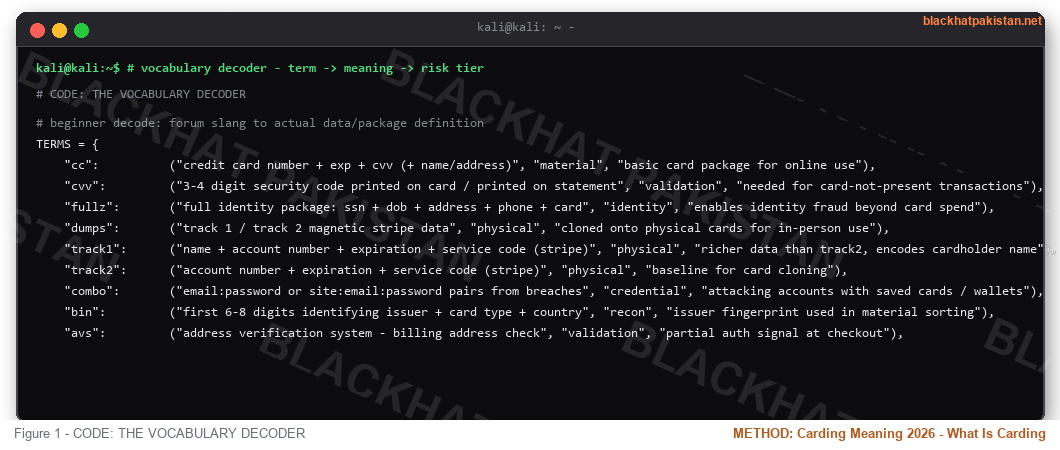
CODE: THE VOCABULARY DECODER
Maps every core term a beginner hits in carding forums to its actual meaning and risk tier — what the word refers to, what data it contains, and what activity it implies. Reads like a glossary because that is what searchers want: instant term-to-meaning resolution.
Code:
# vocabulary decoder - term -> meaning -> risk tier

# beginner decode: forum slang to actual data/package definition

TERMS = {

    "cc":          ("credit card number + exp + cvv (+ name/address)", "material", "basic card package for online use"),

    "cvv":         ("3-4 digit security code printed on card / printed on statement", "validation", "needed for card-not-present transactions"),

    "fullz":       ("full identity package: ssn + dob + address + phone + card", "identity", "enables identity fraud beyond card spend"),

    "dumps":       ("track 1 / track 2 magnetic stripe data", "physical", "cloned onto physical cards for in-person use"),

    "track1":      ("name + account number + expiration + service code (stripe)", "physical", "richer data than track2, encodes cardholder name"),

    "track2":      ("account number + expiration + service code (stripe)", "physical", "baseline for card cloning"),

    "combo":       ("email:password or site:email:password pairs from breaches", "credential", "attacking accounts with saved cards / wallets"),

    "bin":         ("first 6-8 digits identifying issuer + card type + country", "recon", "issuer fingerprint used in material sorting"),

    "avs":         ("address verification system - billing address check", "validation", "partial auth signal at checkout"),

    "cashout":     ("converting validated card material into money or goods", "conversion", "final pipeline stage, highest legal exposure"),

}

def decode(term):

    meaning, tier, note = TERMS.get(term.lower(), ("unknown term", "n/a", "not in decoder"))

    print("  %-9s [%-10s] %s" % (term.upper(), tier, meaning))

    print("            %s" % note)

for t in ["cc", "cvv", "fullz", "dumps", "combo", "cashout"]:

    decode(t)
WHERE THE DATA COMES FROM
- Merchant breaches — database theft from e-commerce and payment processors; card numbers + CVV often stored together in poorly segmented systems; the source behind most bulk material sold in forums; breach-to-forum timeline compresses from months to weeks as automated scrapers mine freshly-exposed tables.
- Physical skimming — overlay devices on ATM card slots and POS terminals reading magnetic stripe data, often paired with pinhole cameras capturing PIN entry; dumps from skimmers feed card-cloning operations for in-person cash extraction; the hardware has shrunk to inline splices that sit inside the card path invisible to visual inspection.
- Phishing and checkout spoofing — fake e-commerce pages or payment-update notices harvesting card fields (number, exp, CVV) in real time as victims type; kit-based phishing (Phishing-as-a-Service panels) lowers the skill floor to template selection; CVV harvested at phishing beats CVV absent from breaches, which is why phishing material commands premium pricing.
- Insider access — employees with database privileges exporting customer tables (hospitality, retail, subscription services recur); insider material tends to be fresh and high-coverage (full customer tables, not scattered singles); detection relies on data-loss prevention and query auditing rather than network signals.
- Account takeover via combo lists — credential pairs from breaches reused against accounts that have payment methods saved (PayPal, Cash App, e-commerce wallets); ATO converts a weak credential into card-equivalent spend without ever touching a stolen card number; the combo-list-to-cashout path is why "carding" in 2026 includes credential attacks, not just card-number fraud.
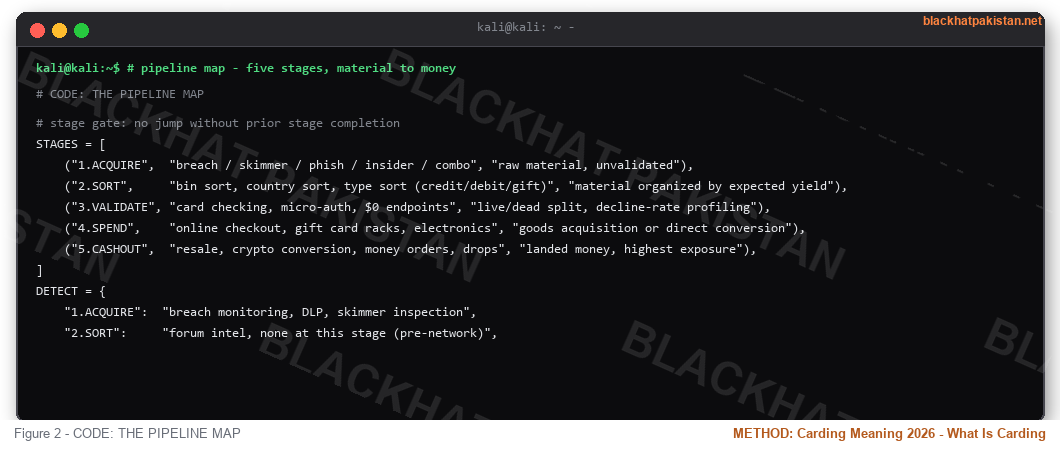
CODE: THE PIPELINE MAP
Five stages from material to landed money — the same skeleton every method post on this forum hangs off. Stage gates: material must pass validation before spend; spend must pass cashout before it counts; every stage adds detection surface proportional to its dollar value.
Code:
# pipeline map - five stages, material to money

# stage gate: no jump without prior stage completion

STAGES = [

    ("1.ACQUIRE",  "breach / skimmer / phish / insider / combo", "raw material, unvalidated"),

    ("2.SORT",     "bin sort, country sort, type sort (credit/debit/gift)", "material organized by expected yield"),

    ("3.VALIDATE", "card checking, micro-auth, $0 endpoints", "live/dead split, decline-rate profiling"),

    ("4.SPEND",    "online checkout, gift card racks, electronics", "goods acquisition or direct conversion"),

    ("5.CASHOUT",  "resale, crypto conversion, money orders, drops", "landed money, highest exposure"),

]

DETECT = {

    "1.ACQUIRE":  "breach monitoring, DLP, skimmer inspection",

    "2.SORT":     "forum intel, none at this stage (pre-network)",

    "3.VALIDATE": "issuer velocity, processor testing models, decline-rate",

    "4.SPEND":    "AVS/CVV codes, merchant fraud tools, device fp",

    "5.CASHOUT":  "bank AML, crypto KYC, network fraud alerts",

}

def show():

    print("pipeline:")

    for code, desc, gate in STAGES:

        print("  %-11s %s" % (code, desc))

        print("              gate: %s" % gate)

        print("              detect: %s" % DETECT[code])

show()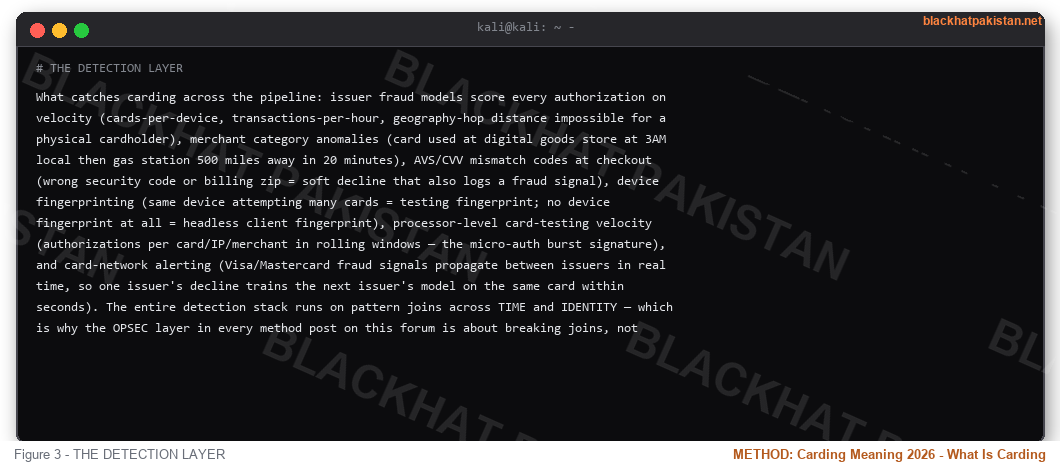
THE DETECTION LAYER
What catches carding across the pipeline: issuer fraud models score every authorization on velocity (cards-per-device, transactions-per-hour, geography-hop distance impossible for a physical cardholder), merchant category anomalies (card used at digital goods store at 3AM local then gas station 500 miles away in 20 minutes), AVS/CVV mismatch codes at checkout (wrong security code or billing zip = soft decline that also logs a fraud signal), device fingerprinting (same device attempting many cards = testing fingerprint; no device fingerprint at all = headless client fingerprint), processor-level card-testing velocity (authorizations per card/IP/merchant in rolling windows — the micro-auth burst signature), and card-network alerting (Visa/Mastercard fraud signals propagate between issuers in real time, so one issuer's decline trains the next issuer's model on the same card within seconds). The entire detection stack runs on pattern joins across TIME and IDENTITY — which is why the OPSEC layer in every method post on this forum is about breaking joins, not hiding single transactions.
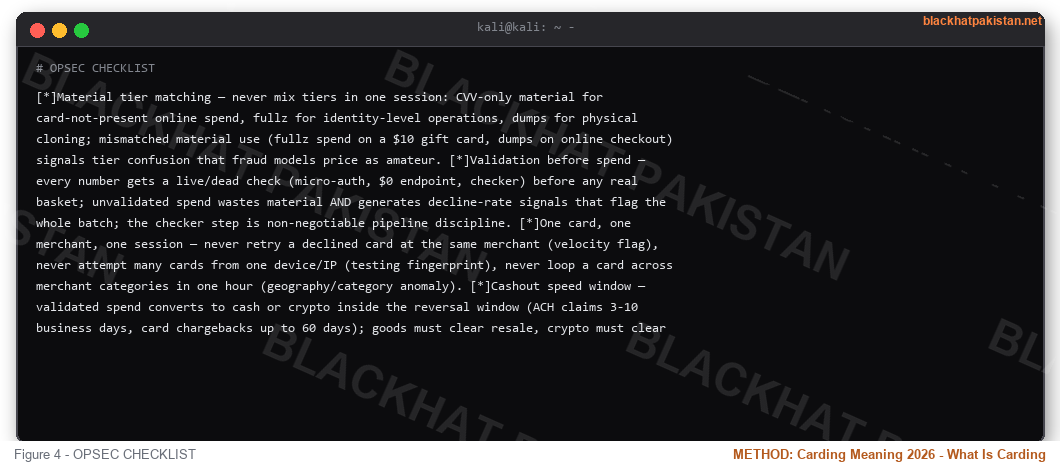
OPSEC CHECKLIST
- Material tier matching — never mix tiers in one session: CVV-only material for card-not-present online spend, fullz for identity-level operations, dumps for physical cloning; mismatched material use (fullz spend on a $10 gift card, dumps on online checkout) signals tier confusion that fraud models price as amateur.
- Validation before spend — every number gets a live/dead check (micro-auth, $0 endpoint, checker) before any real basket; unvalidated spend wastes material AND generates decline-rate signals that flag the whole batch; the checker step is non-negotiable pipeline discipline.
- One card, one merchant, one session — never retry a declined card at the same merchant (velocity flag), never attempt many cards from one device/IP (testing fingerprint), never loop a card across merchant categories in one hour (geography/category anomaly).
- Cashout speed window — validated spend converts to cash or crypto inside the reversal window (ACH claims 3-10 business days, card chargebacks up to 60 days); goods must clear resale, crypto must clear mixing, orders must clear deposit before the claim lands; slow cashout is how material owners trace spend back to the account that received it.
- Ledger discipline — every material batch logged with source tier, validation rate, spend venue, cashout method, landed amount, friction events (declines, freezes, chargebacks); the ledger recalibrates source pricing and method selection next quarter; untracked material is how operators lose track of which cards already burned their associated accounts.
TEST YOURSELF: SIX QUESTIONS
Score honestly: (1) carding meaning in one sentence — what three data elements form the baseline CC package? (2) name the four material sources and which one produces CVV-bearing material that breaches often lack. (3) vocabulary: CC vs fullz vs dumps — what does each contain that the others do not? (4) pipeline: what is the stage gate between VALIDATE and SPEND, and what happens if you skip it? (5) detection: what single signature makes issuer fraud models classify traffic as card TESTING versus card USE? (6) legal: why does the "harmless curiosity" framing collapse the moment material changes hands? Zero to one: you read the TL;DR and can define carding in one sentence. Two to three: you can decode CC/fullz/dumps/combo without looking and name the four material sources. Four plus: you can walk the five-stage pipeline and name the detection surface at each stage — post your walkthrough.
POST YOUR DEFINITION STORY
Scoreboard format: first term you had to look up (CC, fullz, dumps, combo), which source type matched what you saw (breach dump, skimmer, phish, ATO), pipeline stage where it stopped making sense, what clicked it into place (this post, a method post, a worked example). Beginner-framing welcome — this thread exists to convert vocabulary confusion into method-readiness. Cleanest material-to-landing walkthrough gets pinned to Carding-method, first fifteen posters get the beginner-to-method transition map via PM — which method post to read after this one based on your material tier, the glossary cross-reference sheet, and the five questions every beginner gets wrong on first pass.
FAQ
- Q: Carding meaning in Urdu?
A: "Carding" ka matlab hai chori ki hui payment-card data (card number, CVV, billing details) ka istemal — samaan khareedne ya paisa banane ke liye. Yeh activity financial fraud hai aur har mumalik mein serious jurm hai. Textile industry mein "carding" ka alag matlab hai (oon processing) — search intent yahan fraud wala hai.
- Q: Carding meaning in Hindi?
A: "Carding" ka arth hai chori ki gayi card details (number, CVV, pata) ka galat istemal — goods khareedna ya cash banana. Yeh banking fraud aur identity theft ke under aata hai, aur India mein IT Act ke tahat serious punishment hai. Ek hi shabd ka textile meaning bhi hai (oon ki safai) — context samajhna zaroori hai.
- Q: What is the difference between CC and fullz?
A: CC = the card package itself (number, expiry, CVV, sometimes name/address) — enough for online card-not-present spend. Fullz = the card PLUS the full identity (SSN, DOB, address, phone) — enough for identity fraud, account opening, tax refund fraud, and any operation where the CARD alone is insufficient; fullz commands higher prices because it enables more crime types per package.
- Q: Is carding legal in any context?
A: No. Using stolen payment-card data — or trafficking it, or validating it at scale — violates unauthorized-access, wire-fraud, and identity-theft statutes in every jurisdiction with financial-crime law; "educational curiosity" is not a defense once material changes hands; this post exists to DECODE the vocabulary for defenders, journalists, and security researchers, not to license activity.
- Q: Why do textile and fraud carding share a word?
A: Unrelated etymology: textile "carding" (wool/cotton fiber alignment, from the carding tool) predates fraud "carding" (likely from "credit card" clipping); Google serves both meanings in autocomplete ("carding meaning in textile" appears alongside fraud queries); this page targets the fraud-intent cluster explicitly.
- Q: What should a beginner read after this post?
A: Material-tier dependent: CVV/CVV-less spend path -> CVV Meaning 2026 then Carding Tools 2026; identity/fullz operations -> Fullz Guide 2026 then Bank Drop Operations 2026; direct cash conversion -> CC to BTC No KYC 2026 then Cashout Methods Explained 2026; every path ends at the detection layer posts, because pipeline without detection awareness is just expensive failure.
RELATED
CVV vs Fullz vs Logs - The Complete Material Guide
Carding Tools 2026: BIN Checkers & Validators
Cashout Methods Explained 2026 - Full Breakdown
Chargebacks Explained


