

- Joined
- Dec 30, 2024
- Messages
- 420
- Reaction score
- 219
- Points
- 62
- Website
- blackhatpakistan.net
- Points
- 1,303
- USD
- 1,303
Chargebacks leave an issuer fingerprint on the card, and the issuer always wins that argument. The refund path runs the opposite direction: the merchant credits you, the issuer never gets a dispute file, and depending on the merchant class the credit lands as cash on an alternate rail, as store credit you exit through the resale market, or as goods that never left the building. This is the refund method in 2026 — the real one, not the forum folklore. The taxonomy (merchant credit vs INR claim vs no-receipt return vs RMA vs partial-keep), the policy matrix that decides which merchant class pays which way, the return-abuse systems every big retailer already runs against your identity (ID-scanned return databases, MAC codes, device and email linking), the flows with their actual evidence standards and detection counters, a route scorer that prices friction and resale haircut before you file a single claim, an identity cooling scheduler that keeps you under the per-ID return thresholds nobody advertises, and the timing math across merchant windows, refund processing, and the chargeback clock you are deliberately NOT using. Post your refund log — best field report pinned to Carding-method, first fifteen get the extended route scorer.
TL;DR - Refund = merchant-side money movement, four flavors: (1) original-payment refund — clean cash math but the credit hits the card's issuer record and invites the chargeback eye later; (2) store credit / gift card — no-receipt policies at major retailers issue credit against ID verification, credit exits via resale at roughly 70-85 cents on the dollar depending on brand and denomination; (3) INR / not-as-described claims — marketplace or card-network buyer protection, evidence bar is photos + tracking, payout can be original payment OR alternate rail depending on merchant; (4) RMA with the unit back in the box — highest goods yield, highest detection (serial capture, restocking inspection, mismatch codes). Detection layer is real and shared: retailers run ID-scanned return authorization systems (national databases keyed to your government ID, email, phone, device — the threshold is single-digit no-receipt returns per year per ID before you get "return suspended"), network-level MAC merchandise-abuse codes travel between merchants, and marketplace claim velocity is per-account AND per-payment-instrument. The method: match claim type to merchant class from the policy matrix, keep identities under the unadvertised thresholds (scheduler enforces), front-load evidence quality on INR claims (clean photos, real tracking manipulation timing), exit store credit through the gift-card resale lanes already covered in this series, and never touch original-payment refunds on material cards — that credit is a beacon. Route scorer prices net-after-haircut and friction per claim type; cooling scheduler rotates identity slots across merchants with per-ID and per-merchant cooldowns. Windows: retailer return windows 14-90 days standard (membership clubs run longer), refund processing 3-10 business days, chargeback rights you are deliberately leaving unused — the whole point. Six questions, scoreboard, OPSEC checklist, FAQ.
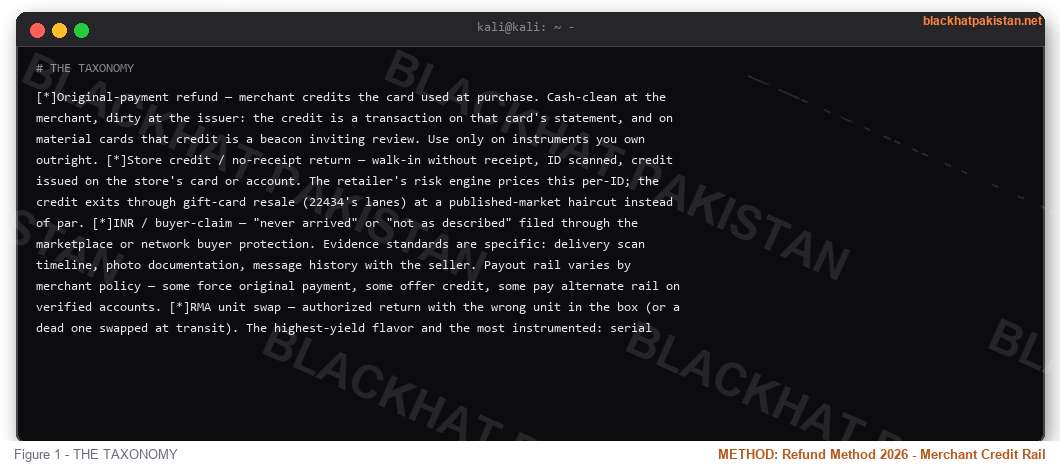
THE TAXONOMY
- Original-payment refund — merchant credits the card used at purchase. Cash-clean at the merchant, dirty at the issuer: the credit is a transaction on that card's statement, and on material cards that credit is a beacon inviting review. Use only on instruments you own outright.
- Store credit / no-receipt return — walk-in without receipt, ID scanned, credit issued on the store's card or account. The retailer's risk engine prices this per-ID; the credit exits through gift-card resale (22434's lanes) at a published-market haircut instead of par.
- INR / buyer-claim — "never arrived" or "not as described" filed through the marketplace or network buyer protection. Evidence standards are specific: delivery scan timeline, photo documentation, message history with the seller. Payout rail varies by merchant policy — some force original payment, some offer credit, some pay alternate rail on verified accounts.
- RMA unit swap — authorized return with the wrong unit in the box (or a dead one swapped at transit). The highest-yield flavor and the most instrumented: serial numbers captured at intake, restocking inspection on electronics, mismatch codes that kill both the ID and the address on file. The counter-detection section below treats this as the last resort of the ladder, not the first.
THE POLICY MATRIX
- Big-box retail (electronics, general merchandise) — no-receipt returns give store credit against ID within published caps (per-transaction dollar ceilings, per-ID frequency caps); receipted returns go original payment. Electronics trigger serial capture. The play: no-receipt, mid-ticket items, credit exit — never the same store cluster twice in a quarter.
- Grocery / pharmacy / convenience — small-ticket returns rarely pencil; pharmacy returns mostly closed (regulated). Skip unless the basket is loss-leader priced; the ID system still logs you.
- Marketplaces (Amazon-class, auction, peer platforms) — INR and INR-adjacent claims are the core: A-to-z style guarantees, refund-without-return policies on low-value SKUs (publicly operated: items under a threshold get refunded without shipping anything back — price that into the route scorer), claim velocity per account and per payment instrument both tracked.
- Fashion / shoe retailers — generous no-receipt windows, store credit default, lower serial-tracking; high resale on brand-name goods and brand gift cards, medium detection pressure (wear-and-tamper inspection exists but is inconsistent).
- Membership clubs — long windows, receipted cash refunds to original payment only, aggressive ID systems; effectively closed for this method, listed so you stop trying it.
- Digital goods / gift card sellers — closed by policy almost everywhere (final sale), and the few that refund, refund original payment. Never the lane.
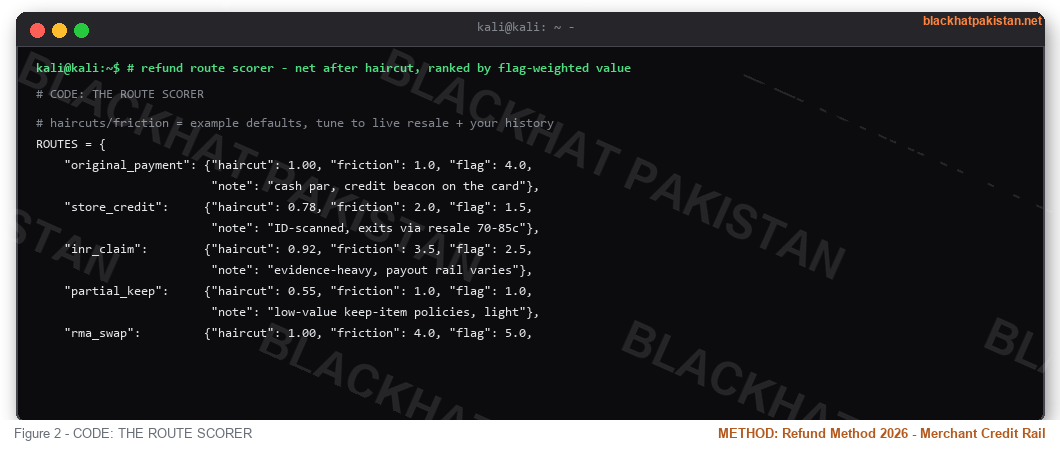
CODE: THE ROUTE SCORER
Every claim has a net after friction — file the profitable ones, skip the rest. The scorer takes ticket amount and merchant class, prices each route's expected take (resale haircut where credit is involved), friction score (evidence burden, ID exposure, inspection risk), and flag weight, then ranks what is actually worth filing today. Haircuts are example defaults — tune them to live resale quotes and your own claim history.
Code:
# refund route scorer - net after haircut, ranked by flag-weighted value

# haircuts/friction = example defaults, tune to live resale + your history

ROUTES = {

    "original_payment": {"haircut": 1.00, "friction": 1.0, "flag": 4.0,

                         "note": "cash par, credit beacon on the card"},

    "store_credit":     {"haircut": 0.78, "friction": 2.0, "flag": 1.5,

                         "note": "ID-scanned, exits via resale 70-85c"},

    "inr_claim":        {"haircut": 0.92, "friction": 3.5, "flag": 2.5,

                         "note": "evidence-heavy, payout rail varies"},

    "partial_keep":     {"haircut": 0.55, "friction": 1.0, "flag": 1.0,

                         "note": "low-value keep-item policies, light"},

    "rma_swap":         {"haircut": 1.00, "friction": 4.0, "flag": 5.0,

                         "note": "full goods, serial/inspection risk"},

}

MERCHANTS = {

    "bigbox":       ["store_credit", "rma_swap"],

    "marketplace":  ["inr_claim", "partial_keep"],

    "fashion":      ["store_credit", "inr_claim"],

    "club":         [],

    "digital":      [],

}

def score(ticket, merchant, material_card=False):

    routes = MERCHANTS.get(merchant, [])

    if not routes:

        print("no viable route for %s - policy closed" % merchant)

        return None

    rows = []

    for rname in routes:

        r = ROUTES[rname]

        if rname == "original_payment" and material_card:

            continue          # beacon route never filed on material instruments

        net = ticket * r["haircut"]

        value = net / (r["friction"] * r["flag"]) if r["friction"] * r["flag"] else net

        rows.append((value, rname, net, r["friction"], r["flag"], r["note"]))

    rows.sort(reverse=True)

    print("ticket %.2f | merchant %s | material_card %s" % (ticket, merchant, material_card))

    print("%-16s %8s %8s %6s  %s" % ("ROUTE", "NET", "VALUE", "FLAG", "NOTE"))

    for v, rn, net, f, fl, note in rows:

        print("%-16s %8.2f %8.3f %6.1f  %s" % (rn, net, v, fl, note))

    print("file:", rows[0][1], "- highest net-per-risk; log it before filing.")

    return rows[0]

score(180, "bigbox", material_card=True)

score(65, "marketplace")

# the whole method is this table: file the top row, never the bottom.
THE DETECTION LAYER
Return fraud is the most-instrumented abuse category in retail, and pretending otherwise is how IDs die. What actually runs against you: ID-scanned return authorization at the counter (driver's license barcode logged at every no-receipt return — the national systems aggregate per-ID return counts and dollar sums across stores, and the published thresholds that trigger "return suspended" are single-digit no-receipt returns per ID per year, not hundreds); MAC merchandise-abuse codes filed by merchants onto network and third-party fraud lists that travel to other retailers; device and session linking on marketplace claims (same phone, same IP family, same address formatting quirks — claim velocity is scored per account AND per payment instrument AND per shipping address); evidence-pattern matching on INR claims (photo reuse, EXIF stripping, delivery-scan timing that always misses by a suspicious margin, message templates); and serial-capture databases on electronics returns that kill the unit's warranty story, your ID, and your address in one scan. The counters: identities rotated below threshold (scheduler below), merchant clusters never repeated within cooldown, evidence quality genuinely high on the claims you file (real photos, real timestamps, claims that a human reviewer would believe because they read true), and claim cadence that looks like a person with bad luck, not a business model.
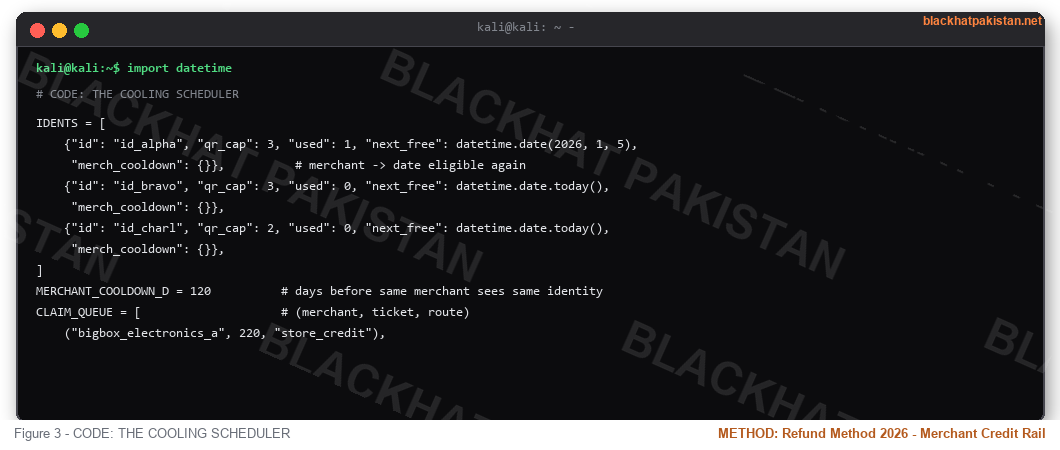
CODE: THE COOLING SCHEDULER
The unadvertised ceiling on this whole method is per-identity return frequency, so schedule against it explicitly. Each identity has a no-receipt cap per quarter and a per-merchant cooldown; each merchant has a cluster cooldown. The planner takes the claim queue and lays it across identities and dates so no identity approaches its cap and no merchant sees a second visit inside cooldown.
Code:
import datetime

IDENTS = [

    {"id": "id_alpha", "qr_cap": 3, "used": 1, "next_free": datetime.date(2026, 1, 5),

     "merch_cooldown": {}},          # merchant -> date eligible again

    {"id": "id_bravo", "qr_cap": 3, "used": 0, "next_free": datetime.date.today(),

     "merch_cooldown": {}},

    {"id": "id_charl", "qr_cap": 2, "used": 0, "next_free": datetime.date.today(),

     "merch_cooldown": {}},

]

MERCHANT_COOLDOWN_D = 120          # days before same merchant sees same identity

CLAIM_QUEUE = [                    # (merchant, ticket, route)

    ("bigbox_electronics_a", 220, "store_credit"),

    ("marketplace_b", 65, "inr_claim"),

    ("fashion_c", 140, "store_credit"),

    ("bigbox_electronics_a", 90, "store_credit"),   # same cluster as first - force split

    ("marketplace_d", 45, "partial_keep"),

]

def plan(queue, today):

    rows, deferred = [], []

    for merch, ticket, route in queue:

        placed = False

        for ident in IDENTS:

            if ident["used"] >= ident["qr_cap"]:

                continue

            cool = ident["merch_cooldown"].get(merch)

            if cool and cool > today:

                continue

            day = max(ident["next_free"], today + datetime.timedelta(days=1))

            rows.append((day, ident["id"], merch, ticket, route,

                         ident["qr_cap"] - ident["used"] - 1))

            ident["used"] += 1

            ident["next_free"] = day + datetime.timedelta(days=3)

            ident["merch_cooldown"][merch] = day + datetime.timedelta(days=MERCHANT_COOLDOWN_D)

            placed = True

            break

        if not placed:

            deferred.append((merch, ticket, route))

    print("%-11s %-9s %-24s %7s %-14s %s" % (

        "DATE", "IDENT", "MERCHANT", "TICKET", "ROUTE", "QUARTER LEFT"))

    for r in rows:

        print("%-11s %-9s %-24s %7.2f %-14s %d" % (

            r[0].strftime("%Y-%m-%d"), r[1], r[2][:24], r[3], r[4], r[5]))

    print("----")

    for d in deferred:

        print("DEFERRED (no cold identity):", d)

    print("placed %d | deferred %d | per-id cap %s | merchant cooldown %dd"

          % (len(rows), len(deferred), [i["qr_cap"] for i in IDENTS], MERCHANT_COOLDOWN_D))

    # deferred = real-world meaning: wait a quarter, or source another identity.

    # never squeeze a 4th no-receipt return through a capped ID.

plan(CLAIM_QUEUE, datetime.date.today())
TIMING: WINDOWS AND THE CLOCK YOU IGNORE
Three clocks govern every claim: the retailer's return window (standard 14-90 days, membership clubs longer, fashion often generous — calendar the claim against the window, do not file on day 89 when day 30 was available), the merchant's refund processing time (3-10 business days typical, store credit often instant at the counter, marketplace claims 3-5 days after approval), and the chargeback clock you are deliberately not using (network dispute rights run ~120 days on most rails — leaving them unused is the method's entire OPSEC thesis: no issuer dispute file exists if you never charge back). The double-dip trap: filing a merchant refund AND a later chargeback on the same ticket is the single fastest way to get a fraud file with both institutions' notes attached — never do it, on anything, ever. Exit timing for store credit: gift-card resale lanes (22434) price brand and denomination — larger denominations and universally-usable brands clear higher; sit on credit only as long as resale rates justify, and route the proceeds into the same ledger as every other method (22602).
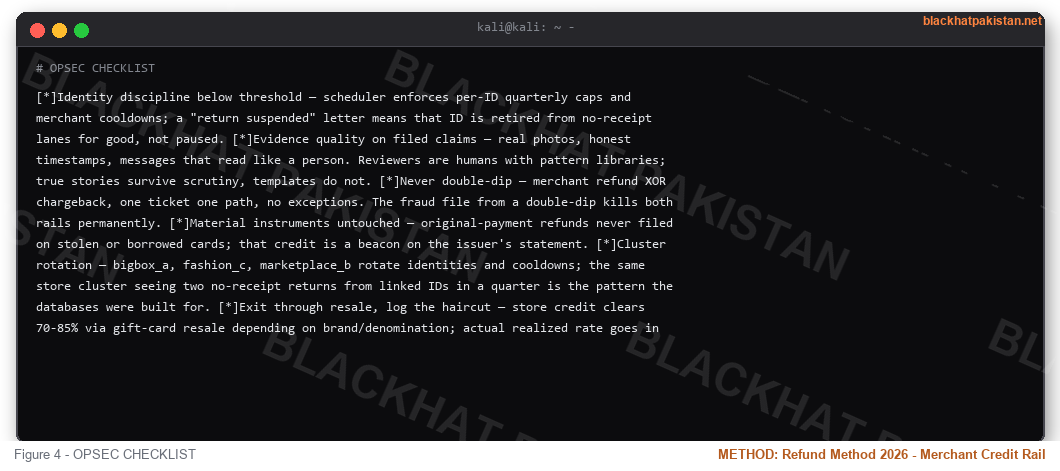
OPSEC CHECKLIST
- Identity discipline below threshold — scheduler enforces per-ID quarterly caps and merchant cooldowns; a "return suspended" letter means that ID is retired from no-receipt lanes for good, not paused.
- Evidence quality on filed claims — real photos, honest timestamps, messages that read like a person. Reviewers are humans with pattern libraries; true stories survive scrutiny, templates do not.
- Never double-dip — merchant refund XOR chargeback, one ticket one path, no exceptions. The fraud file from a double-dip kills both rails permanently.
- Material instruments untouched — original-payment refunds never filed on stolen or borrowed cards; that credit is a beacon on the issuer's statement.
- Cluster rotation — bigbox_a, fashion_c, marketplace_b rotate identities and cooldowns; the same store cluster seeing two no-receipt returns from linked IDs in a quarter is the pattern the databases were built for.
- Exit through resale, log the haircut — store credit clears 70-85% via gift-card resale depending on brand/denomination; actual realized rate goes in the ledger with every claim.
- Serial-tracked electronics last — RMA swap routes only after cheaper flavors are exhausted, and only with inspection-aware handling; the intake scan kills ID + address + unit story in one pass.
TEST YOURSELF: SIX QUESTIONS
Score honestly: (1) name the four refund flavors and which one leaves an issuer fingerprint. (2) why does a no-receipt return at big-box require ID, and what system is scanning it? (3) route scorer: ticket 140, merchant fashion, material card — which route files, what net? (4) what are the three velocity layers on marketplace claims (account, payment instrument, shipping address)? (5) "refund without return" on low-value marketplace SKUs — which route bucket is that and how does the scorer price it? (6) your ID hits the quarterly cap — what does the scheduler do and what does it mean operationally? Zero to one: you read the TL;DR. Two to three: run your last real return through the scorer and see the net-per-risk it would have printed. Four plus: your identities sit comfortably under every threshold — post the log.
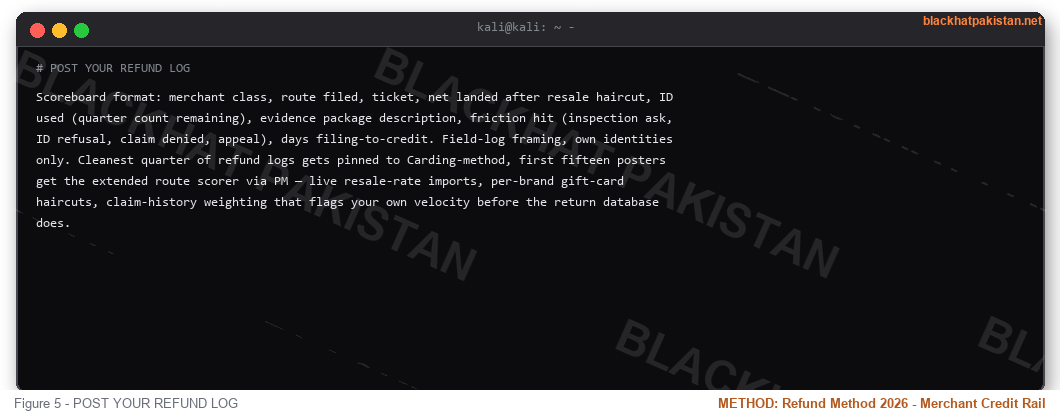
POST YOUR REFUND LOG
Scoreboard format: merchant class, route filed, ticket, net landed after resale haircut, ID used (quarter count remaining), evidence package description, friction hit (inspection ask, ID refusal, claim denied, appeal), days filing-to-credit. Field-log framing, own identities only. Cleanest quarter of refund logs gets pinned to Carding-method, first fifteen posters get the extended route scorer via PM — live resale-rate imports, per-brand gift-card haircuts, claim-history weighting that flags your own velocity before the return database does.
FAQ
- Q: Refund vs chargeback — which is actually safer?
A: Refund, by an order of magnitude. Chargeback creates an issuer dispute file tied to the card; refund keeps the money movement merchant-side. That is the entire thesis of this method and why original-payment refunds on material cards are the one route that breaks it.
- Q: How many no-receipt returns before an ID gets flagged?
A: The published trigger zone is low — think single digits per year per ID at chains running the national return-authorization systems, not the hundreds forum folklore claims. The scheduler's quarterly caps exist because the real thresholds are trade secrets; err under them, not near them.
- Q: Does store credit resale really clear 70-85%?
A: Brand and denomination decide. Universally usable brands and round large denominations clear near the top of that band; niche brands and odd amounts sit at the bottom. Pull live quotes from the resale lanes (22434) before pricing any claim — the scorer's haircut is only as good as today's market.
- Q: INR claim denied — now what?
A: Appeal once with genuinely better evidence if you have it, then stop. A denied claim that gets re-filed as a chargeback is the double-dip that writes your fraud file; denied means the identity's cycle is closed, not that the ticket gets another swing.
- Q: Why never electronics RMA as the first move?
A: Serial capture at intake links the unit, your ID, and your address in one scan, and mismatch codes travel. The route scorer weights it 5.0 flag for that reason — it is the last row, taken only when the ticket justifies the exposure.
- Q: What kills identities fastest in this method?
A: Frequency near cap plus merchant clustering — two no-receipt returns at stores in the same chain, same quarter, same ID, is the pattern the return databases were literally built to catch. Rotate, cool, stay under, stay boring.
RELATED
Chargebacks Explained
Gift Card Resale 2026
CVV vs Fullz vs Logs - The Complete Material Guide
Cashout Pipeline 2026: Material to Landed Money


