

- Joined
- Dec 30, 2024
- Messages
- 430
- Reaction score
- 219
- Points
- 62
- Website
- blackhatpakistan.net
- Points
- 1,353
- USD
- 1,353
Buy-now-pay-later does not care about the card — it cares about the basket. Afterpay's rail works by paying the merchant in full at checkout while the consumer owes four installments, which flips the fraud equation: the merchant gets made whole instantly, Afterpay carries the default risk, and the entire underwriting decision happens in the four hundred milliseconds between cart and approval. That decision stack — soft-pull credit reads, device and session signals, linked-instrument health, and the virtual-card mode that extends Afterpay past its own merchant network — is where the method lives. This is the pay-in-4 pipeline in 2026: how Afterpay actually underwrites (what the soft pull sees, what the internal score weights, when limits step up), the three conversion surfaces (merchant checkout, virtual card anywhere-Visa, Cash App ecosystem), default economics priced honestly, the Block risk stack that runs against every account's whole life, and a limit-ladder scorer that grades account readiness before you push a basket. Post your pay-in-4 log — cleanest quarter of landed goods gets pinned to Carding-method, first fifteen get the extended merchant-integration matrix via PM.
TL;DR - Afterpay (Block-owned, Cash App sibling) is a short-term installment underwriter, not a wallet. Flow at checkout: consumer selects Afterpay -> Afterpay runs real-time underwriting (internal score + soft credit pull + device/session signals + linked bank/card health) -> approval returns a spending limit (per-account, refreshes per merchant category) -> Afterpay pays the merchant in full minus merchant fee (4-6% typical) -> consumer owes 4 installments over 6 weeks, first quarter due at purchase. Three conversion surfaces: (1) merchant checkout at Afterpay's partner network (fashion, electronics, beauty — the integrated POS flow, merchant gets paid, goods ship on approval); (2) virtual card mode — Afterpay issues a one-time-use virtual Visa tied to the approved basket, usable anywhere that Visa is accepted online within the approval window, which stretches the rail far past partner merchants; (3) Cash App ecosystem adjacency (Block ownership means shared device/identity graphs — signals flow between properties). The economics: merchant eats nothing (Afterpay paid them), Afterpay prices default risk into merchant fees + consumer late fees + collections, and the account's repayment history is the asset that builds limits. Detection: Block's shared device graph (one device across Afterpay + Cash App + Square = one identity graph), soft-pull velocity (too many BNPL underwrites in a window = desperation signal across the whole BNPL industry via credit headers), delivery-address and recipient graphs, default-rate modeling per account cohort, and virtual-card merchant-category scope enforcement. The ladder scorer below grades account readiness (repayment history, instrument health, device standing) before you size any basket.
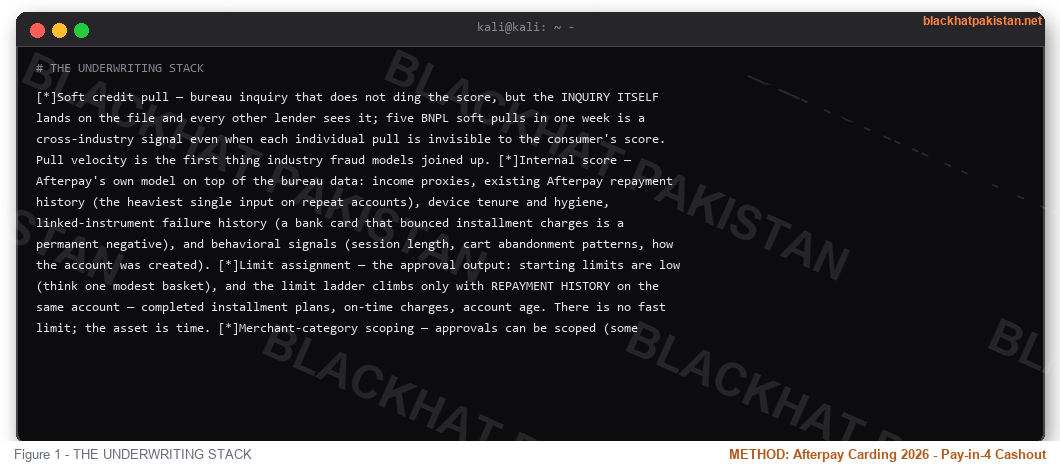
THE UNDERWRITING STACK
- Soft credit pull — bureau inquiry that does not ding the score, but the INQUIRY ITSELF lands on the file and every other lender sees it; five BNPL soft pulls in one week is a cross-industry signal even when each individual pull is invisible to the consumer's score. Pull velocity is the first thing industry fraud models joined up.
- Internal score — Afterpay's own model on top of the bureau data: income proxies, existing Afterpay repayment history (the heaviest single input on repeat accounts), device tenure and hygiene, linked-instrument failure history (a bank card that bounced installment charges is a permanent negative), and behavioral signals (session length, cart abandonment patterns, how the account was created).
- Limit assignment — the approval output: starting limits are low (think one modest basket), and the limit ladder climbs only with REPAYMENT HISTORY on the same account — completed installment plans, on-time charges, account age. There is no fast limit; the asset is time.
- Merchant-category scoping — approvals can be scoped (some accounts clear fashion but not electronics, some merchants are on reduced limits); the virtual card inherits the approved basket's scope, not open-ended spending power. Basket sizing therefore reads the account's category permissions before checkout, not after decline.
- Virtual card mechanics — approval generates a single-use virtual Visa for the approved amount, valid for a short window (hours to days depending on flow) at the merchant(s) in scope; the card dies after use or expiry. The virtual card decouples the spend from Afterpay-branded checkout, which is exactly why its merchant-category and velocity limits are tighter than integrated checkout.
CODE: LIMIT LADDER SCORER
Grades an account's readiness for the next basket size before checkout. Inputs are the ones the underwriting engine actually weights — repayment history count, on-time ratio, linked-instrument failure flags, device tenure, soft-pull velocity across the account. Prints GO / HOLD / SHRINK with the recommended basket ceiling. Demo accounts show a ladder-climber, a fresh account, and a burned instrument.
Code:
# limit ladder scorer - grades account readiness before basket sizing

# afterpay weights repayment history heaviest; instrument health second

def ladder_score(plans_completed, on_time_ratio, instrument_bounces,

                 device_tenure_days, soft_pulls_30d, avg_basket):

    score = 0

    # repayment history = the asset (heaviest weight)

    score += min(40, plans_completed * 4)

    score += int(on_time_ratio * 20)

    # instrument health: a bounced installment charge is near-permanent negative

    if instrument_bounces == 0:

        score += 15

    elif instrument_bounces == 1:

        score += 0

    else:

        score -= 20

    # device tenure and hygiene

    if device_tenure_days  > 180:

        score += 10

    elif device_tenure_days  > 30:

        score += 5

    # pull velocity = cross-industry desperation signal

    if soft_pulls_30d  > 5:

        score -= 15

    elif soft_pulls_30d  > 2:

        score -= 5

    # ceiling = what the ladder will actually clear

    ceiling = avg_basket * (1 + min(score, 60) / 40.0)

    if score  >= 55:

        verdict = "GO - push to ceiling $%.0f" % ceiling

    elif score  >= 30:

        verdict = "HOLD - basket at current avg $%.0f, one more paid plan unlocks next rung" % avg_basket

    else:

        verdict = "SHRINK - stay under $%.0f or expect decline + score damage" % (avg_basket * 0.6)

    return score, ceiling, verdict

# ladder-climber: seasoned, clean instrument, paid plans

print("A:", ladder_score(9, 1.0, 0, 400, 1, 180))

# fresh account: no history, new device, one prior pull

print("B:", ladder_score(0, 0.0, 0, 12, 1, 180))

# burned instrument: one bounce already recorded

print("C:", ladder_score(4, 0.75, 1, 120, 0, 180))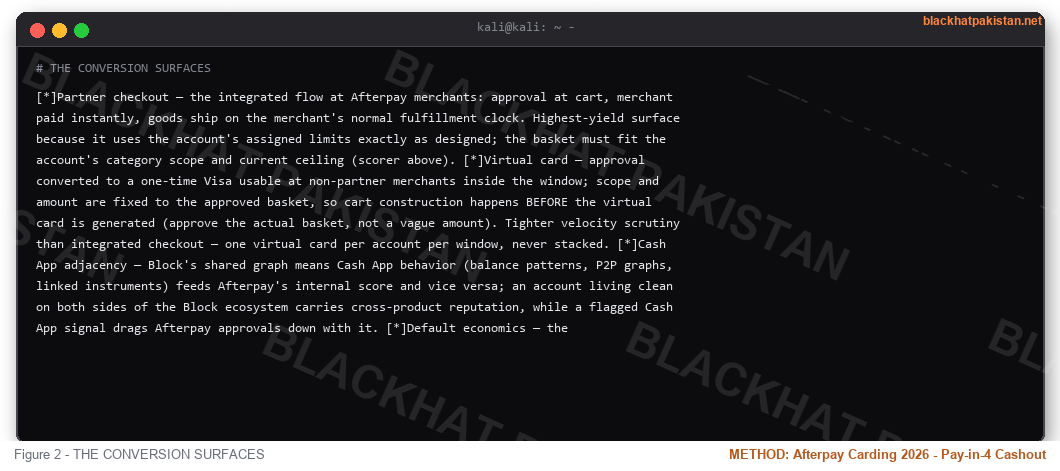
THE CONVERSION SURFACES
- Partner checkout — the integrated flow at Afterpay merchants: approval at cart, merchant paid instantly, goods ship on the merchant's normal fulfillment clock. Highest-yield surface because it uses the account's assigned limits exactly as designed; the basket must fit the account's category scope and current ceiling (scorer above).
- Virtual card — approval converted to a one-time Visa usable at non-partner merchants inside the window; scope and amount are fixed to the approved basket, so cart construction happens BEFORE the virtual card is generated (approve the actual basket, not a vague amount). Tighter velocity scrutiny than integrated checkout — one virtual card per account per window, never stacked.
- Cash App adjacency — Block's shared graph means Cash App behavior (balance patterns, P2P graphs, linked instruments) feeds Afterpay's internal score and vice versa; an account living clean on both sides of the Block ecosystem carries cross-product reputation, while a flagged Cash App signal drags Afterpay approvals down with it.
- Default economics — the fourth-installment default (goods already shipped, merchant already paid, Afterpay holds the bag) is priced into the model: late fees first, collections second, bureau reporting on seasoned delinquencies third, permanent limit death on the account. The ladder builds by paying; the ceiling dies the day a plan defaults.
CODE: ORDER CADENCE SCHEDULER
Lays baskets across a fleet of accounts so no single account runs hot and no cluster pattern (same device, same address, same instrument family, same hour) joins accounts together. One account = one plan in flight max; addresses and recipient names never repeat across the fleet; basket timing spreads like ordinary shopping.
Code:
# order cadence scheduler - fleet-level basket timing

# rules: 1 plan in flight per account, no shared address/device/instrument, human timing

import datetime

ACCOUNTS = {

    "acct_alpha":  {"plans_paid": 8, "ceiling": 420, "addr": "addr_1", "device": "dev_1", "instr": "inst_1"},

    "acct_bravo":  {"plans_paid": 3, "ceiling": 210, "addr": "addr_2", "device": "dev_2", "instr": "inst_2"},

    "acct_charl":  {"plans_paid": 1, "ceiling": 120, "addr": "addr_3", "device": "dev_3", "instr": "inst_3"},

}

BASKETS = [  # (merchant_class, amount, recipient_hint)

    ("fashion",  280, "recipient_a"),

    ("electronics", 195, "recipient_b"),

    ("beauty",   85,  "recipient_c"),

    ("fashion",  340, "recipient_d"),

]

def schedule(baskets, accounts, start):

    t = start

    used_addrs, used_dev, used_instr, inflight = set(), set(), set(), set()

    rows = []

    for mclass, amt, recip in baskets:

        pick = None

        for aid, a in sorted(accounts.items(), key=lambda kv: -kv[1]["plans_paid"]):

            if aid in inflight:

                continue                      # one plan in flight, always

            if amt  > a["ceiling"]:

                continue                      # ladder ceiling respected

            if a["addr"] in used_addrs or a["device"] in used_dev or a["instr"] in used_instr:

                continue                      # fleet separation

            pick = (aid, a)

            break

        if not pick:

            rows.append((mclass, amt, "DEFERRED", "no cold account fits"))

            continue

        aid, a = pick

        used_addrs.add(a["addr"]); used_dev.add(a["device"]); used_instr.add(a["instr"])

        inflight.add(aid)

        rows.append((mclass, amt, aid, t.strftime("%m-%d %H:%M")))

        # human cadence: next order 2-6 days out, afternoon hours

        t += datetime.timedelta(days=2 + (hash(mclass) % 4), hours=14 % 8)

    print("fleet schedule:")

    for mclass, amt, aid, when in rows:

        print("  %-12s $%-7.2f %-12s %s" % (mclass, amt, aid, when))

    go = sum(1 for r in rows if r[2] not in ("DEFERRED",))

    print("  ---- placed %d | deferred %d" % (go, len(rows) - go))

schedule(BASKETS, ACCOUNTS, datetime.datetime(2026, 10, 13, 15, 0))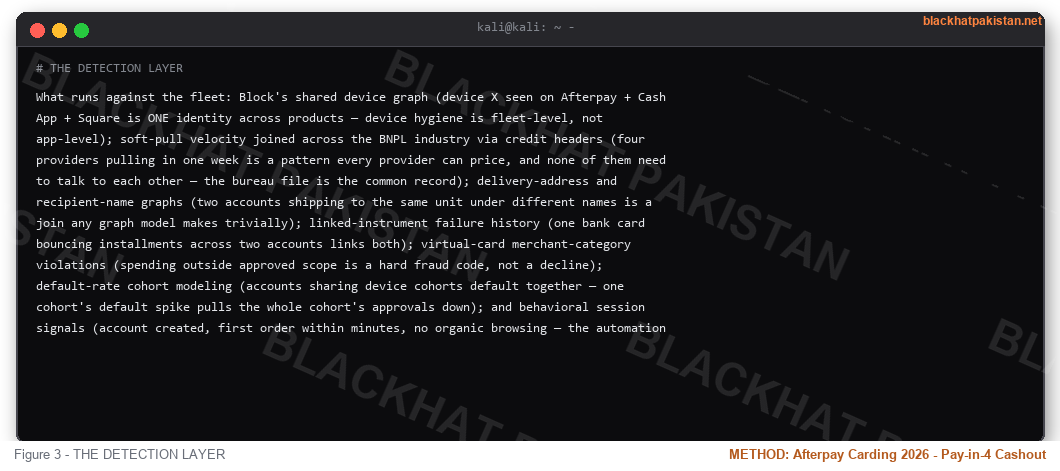
THE DETECTION LAYER
What runs against the fleet: Block's shared device graph (device X seen on Afterpay + Cash App + Square is ONE identity across products — device hygiene is fleet-level, not app-level); soft-pull velocity joined across the BNPL industry via credit headers (four providers pulling in one week is a pattern every provider can price, and none of them need to talk to each other — the bureau file is the common record); delivery-address and recipient-name graphs (two accounts shipping to the same unit under different names is a join any graph model makes trivially); linked-instrument failure history (one bank card bouncing installments across two accounts links both); virtual-card merchant-category violations (spending outside approved scope is a hard fraud code, not a decline); default-rate cohort modeling (accounts sharing device cohorts default together — one cohort's default spike pulls the whole cohort's approvals down); and behavioral session signals (account created, first order within minutes, no organic browsing — the automation signature that precedes every first-order-default run). The rail's defense is graph theory, and the graph only sees what you let it join.
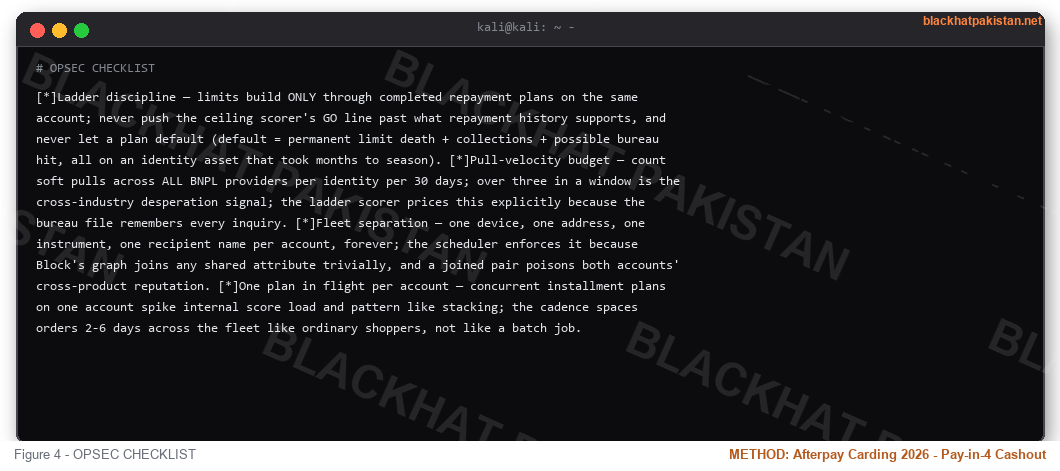
OPSEC CHECKLIST
- Ladder discipline — limits build ONLY through completed repayment plans on the same account; never push the ceiling scorer's GO line past what repayment history supports, and never let a plan default (default = permanent limit death + collections + possible bureau hit, all on an identity asset that took months to season).
- Pull-velocity budget — count soft pulls across ALL BNPL providers per identity per 30 days; over three in a window is the cross-industry desperation signal; the ladder scorer prices this explicitly because the bureau file remembers every inquiry.
- Fleet separation — one device, one address, one instrument, one recipient name per account, forever; the scheduler enforces it because Block's graph joins any shared attribute trivially, and a joined pair poisons both accounts' cross-product reputation.
- One plan in flight per account — concurrent installment plans on one account spike internal score load and pattern like stacking; the cadence spaces orders 2-6 days across the fleet like ordinary shoppers, not like a batch job.
- Virtual-card scope — generate the virtual card for the ACTUAL basket (scope + amount fixed at approval); never spend outside approved merchant category (hard fraud code); never stack virtual cards inside one window.
- Instrument health — linked cards/accounts must never bounce an installment charge; a single bounce is a near-permanent negative on the account's internal score and follows the instrument across accounts it touches; autopay from a funded source, always.
- Ledger discipline — every order logged with account, ceiling at time of order, ladder score, merchant class, plan completion status, and any friction (decline, step-up, limit cut); the ledger recalibrates the scorer's weights next quarter.
TEST YOURSELF: SIX QUESTIONS
Score honestly: (1) who carries default risk in a pay-in-4 flow — merchant, consumer, or Afterpay — and what does that mean for merchant cooperation? (2) name the four inputs the underwriting stack weights and which one is heaviest on repeat accounts. (3) ladder scorer: 9 paid plans, on-time 1.0, zero bounces, 400-day device, 1 pull in 30d, avg basket $180 — score band and verdict? (4) why must the virtual card be generated for the actual basket, not a vague amount? (5) what does soft-pull velocity signal to OTHER BNPL providers who never saw this account before? (6) name the three shared-attribute joins (device, address, instrument) that turn two accounts into one graph node and the one rule the scheduler enforces to prevent each. Zero to one: you read the TL;DR. Two to three: run your current fleet through the ladder scorer and check whether any account's GO line exceeds its repayment-supported ceiling. Four plus: your fleet schedule shows zero shared attributes and every account inside its ladder rung — post the log.
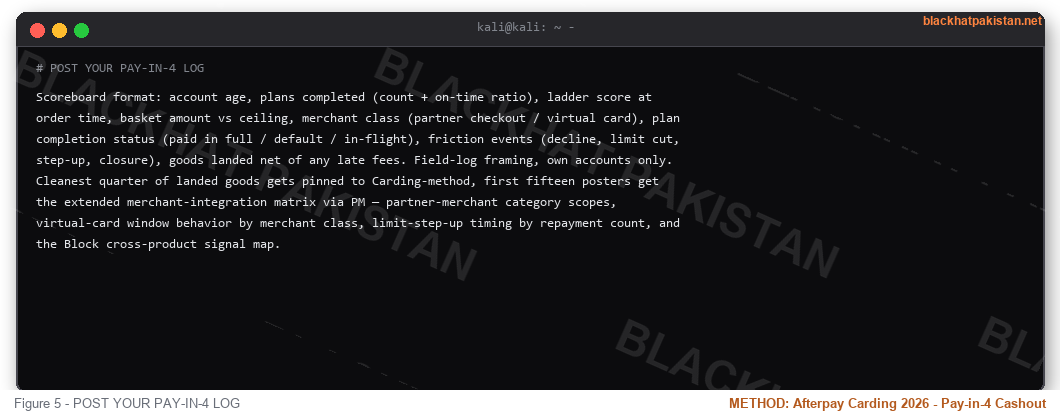
POST YOUR PAY-IN-4 LOG
Scoreboard format: account age, plans completed (count + on-time ratio), ladder score at order time, basket amount vs ceiling, merchant class (partner checkout / virtual card), plan completion status (paid in full / default / in-flight), friction events (decline, limit cut, step-up, closure), goods landed net of any late fees. Field-log framing, own accounts only. Cleanest quarter of landed goods gets pinned to Carding-method, first fifteen posters get the extended merchant-integration matrix via PM — partner-merchant category scopes, virtual-card window behavior by merchant class, limit-step-up timing by repayment count, and the Block cross-product signal map.
FAQ
- Q: Does Afterpay report to the credit bureaus?
A: Not for ordinary on-time activity — the soft pull at underwrite lands on the file as an inquiry, but installment payments do not build positive history. Serious delinquency and default can be reported on seasoned accounts, which is why a default is an identity-level event, not just an account-level one.
- Q: Why is my limit stuck after three paid plans?
A: The ladder climbs on repayment count AND account age AND instrument health, and merchant-category scopes refresh on their own clocks; three plans is still early. The scorer's HOLD band exists for exactly this — push the current ceiling's supported basket, let one more plan complete, re-check.
- Q: Can the virtual card be used anywhere?
A: Anywhere that Visa is accepted INSIDE the approved basket's merchant scope and window — scope and amount are fixed at approval, spending outside either is a hard fraud code. It extends the rail past Afterpay's partner network without extending the account's actual power.
- Q: Does Cash App activity really affect Afterpay approvals?
A: Block runs a shared identity graph across its properties — device, instrument, and behavioral signals flow between products. A clean Cash App history is cross-product reputation; a flagged one drags approvals down without Afterpay ever explaining why.
- Q: What kills an Afterpay account fastest?
A: A defaulted installment plan — late fees, collections, possible bureau reporting, permanent limit death, and cohort-level score damage if the default joins a device cohort that defaults together. The entire ladder asset dies with the default; paying plans is the ONLY way limits grow.
- Q: How does this rail differ from Klarna or Zip?
A: Same pay-in-4 economics, different underwriting weights and merchant networks — but the soft-pull inquiry hits the SAME credit file all of them read, so pull velocity across providers is the cross-industry signal none of them have to share data to see; Block ownership also gives Afterpay a shared-product graph (Cash App, Square) that pure-play BNPL providers lack.
RELATED
Klarna Carding Method 2026 — BNPL Cashout
Cashout Pipeline 2026: Material to Landed Money
Gift Card Resale 2026
Walmart Carding Method 2026 — Step by Step


