

- Joined
- Dec 30, 2024
- Messages
- 430
- Reaction score
- 219
- Points
- 62
- Website
- blackhatpakistan.net
- Points
- 1,353
- USD
- 1,353
A bank drop is not an account — it is a lifecycle. The account that receives fraud proceeds is stage two of a pipeline that starts at identity construction and ends at withdrawal discipline, and every stage has its own detection surface: application-stage identity verification (KYC vendors scoring synthetic and mule signals in real time), funding-stage patterns (odd-balance first deposits that read like test transactions), and the withdrawal stage where most drops die (branch cash-out behaviors, ATM velocity, Zelle/Venmo fan-out that graph tools join in hours, not weeks). The operators who last treat the drop as a farm: accounts planted in rotations, aged through legitimate-looking activity, harvested once or twice at controlled amounts, then retired before the fraud claim lands. This is the bank drop pipeline in 2026: account sourcing options (synthetic construction vs. rent-a-drop economics vs. mule recruitment), the lifecycle stages with detection at each, withdrawal patterns that stay under review thresholds, graph-join risks that collapse whole farms at once, and a lifecycle tracker that ages every account on its own clock. Post your lifecycle log — cleanest quarter of retired accounts gets pinned to cashout-method, first fifteen get the account-aging matrix via PM.
TL;DR - A bank drop account is the receiving endpoint of the cashout layer, and its risk profile is a function of LIFE-STAGE: brand-new accounts receive money differently than aged accounts in the eyes of every fraud model (new accounts have no behavioral baseline, so ANY inbound volume above their projected activity is a flag; aged accounts with organic-looking history absorb inbound funds below their behavioral envelope). Three sourcing paths: (1) synthetic identity construction (composed identity — real SSN fragment + fabricated name/address/DOB combo — applied through online enrollment flows; KYC vendors now score synthetic signals in milliseconds: device reputation, email/phone age, address reputation, application velocity); (2) rent-a-drop (purchasing access to someone else's account — economics run 15-30% of throughput, retention risk scales with the renter's desperation, and the account owner can always reclaim via bank lockout + claim); (3) recruited mules (willing account holders running deposits-then-withdrawals — highest legal exposure for the mule, lowest control for you, graph-join risk through their existing social/financial graph). The lifecycle: application -> funding (first deposit sized to look organic, typically small-balance seeded) -> aging (legitimate-looking activity over weeks: payroll-pattern credits, bill payments, small P2P) -> harvest (one or two controlled inbound fraud credits, quick dispersal below review thresholds) -> retirement (stop use before the fraud claim reverses inbound credits — reversal windows run 3-10 business days for ACH, up to 60 days for debit-card chargebacks). Detection: KYC application scoring (device/email/phone/address reputation graphs that flag synthetic construction in real time), inbound-velocity models (new account receiving high-value credits = the single strongest drop signal), dispersal-pattern graphs (funds in, funds out within 24-48 hours at near-equal amounts = layering pattern every AML queue is tuned for), branch behavioral flags (first-time large cash withdrawals, unfamiliar branch, ATM velocity), and cross-bank information sharing (fraud alerts propagate through shared KYC networks and consortium feeds faster than most operators update their farms). The lifecycle tracker below keeps every account's stage, age, baseline envelope, harvest count, and retirement clock on one ledger.
THE SOURCING PATHS
- Synthetic construction — composed identity (real SSN fragment paired with fabricated or mismatched name/DOB/address) applied through bank online-enrollment flows; the application itself is scored by KYC vendors (device fingerprint reputation, email domain age, phone number age and carrier, address reputation against known mail-drop coordinates, application velocity across banks); modern synthetic detection flags the MISMATCH pattern (SSN issued 1970, driver's license issued 2024, email created last week, device seen on 40 other applications) more reliably than any single attribute; the accounts that pass are the ones where every attribute was aged and consistent before application.
- Rent-a-drop — purchasing use of an existing account held by a willing stranger (often recruited through cash-advancing gigs); economics typically 15-30% of throughput; control risk is asymmetric: the owner can lock you out via branch ID + fraud claim at any moment, and their own transaction history (overdrafts, prior flags, thin file) taints the account's baseline; retention requires the account to keep looking organic to the owner's bank, which means the owner must not panic when inbound credits appear.
- Recruited mule accounts — a willing human holder running deposits and withdrawals on instruction; highest legal exposure sits with the mule (money transmitter / structuring / fraud conspiracy charges depending on volume), lowest operational control for you (they can walk, spend, or talk); graph-join risk is the farm-killer: the mule's existing P2P graph (family, roommates, employers) links their drop account into real-life networks that investigators traverse trivially; mule farms collapse when ONE mule gets visited and names the instruction chain.
- Hybrid sourcing — synthetic shells for the bulk of the farm (cheap, disposable, no human dependency) with one or two aged rent-a-drops for the high-value inbound credits that need a real behavioral baseline; the aged drop absorbs what the synthetics cannot, and the synthetics carry the volume that would risk burning the asset accounts.
CODE: LIFECYCLE TRACKER
Tracks each account through the five stages (apply, fund, age, harvest, retire) with stage gates: accounts cannot harvest before aging clears its minimum days, cannot receive inbound above their baseline envelope, and auto-flag for retirement after the reversal window closes on any harvest credit. One ledger, every account's clock visible.
Code:
# lifecycle tracker - stage gates + reversal-window retirement clock

# stages: apply -> fund -> age -> harvest -> retire

import datetime

REVERSAL_DAYS = {"ach": 10, "debit": 60}   # claim windows after inbound credit

class Drop:

    def __init__(self, did, sourced, baseline):

        self.did, self.sourced, self.baseline = did, sourced, baseline

        self.stage, self.age_days, self.harvests = "apply", 0, 0

        self.credits, self.retire_at = [], None

    def fund(self, amount):

        assert self.stage == "apply", "fund only from apply stage"

        assert amount <= self.baseline * 0.3, "first deposit must stay organic-small"

        self.stage, self.age_days = "fund", 0

        self.credits.append(("seed", amount))

    def tick_day(self):

        self.age_days += 1

        if self.stage == "age" and self.age_days >= 45:

            self.stage = "harvest_ready"

    def harvest(self, amount, rail="ach"):

        assert self.stage in ("harvest_ready", "harvest"), "age gate not cleared"

        assert amount <= self.baseline, "inbound above baseline envelope = flag"

        self.stage = "harvest"

        self.harvests += 1

        self.credits.append(("inbound", amount))

        # retirement clock = reversal window on this credit

        self.retire_at = self.age_days + REVERSAL_DAYS[rail]

        if self.harvests >= 2:

            self.stage = "retire_scheduled"

    def report(self):

        print("  %s [%s] age=%dd harvests=%d baseline=$%.0f retire_d%s" % (

            self.did, self.stage, self.age_days, self.harvests,

            self.baseline, "n/a" if self.retire_at is None else self.retire_at))

farm = [Drop("synth_01", "synthetic", 800), Drop("rent_02", "rented", 2500), Drop("mule_03", "mule", 1200)]

for d in farm:

    d.fund(100 if d.baseline == 800 else 300)

    for _ in range(50):

        d.tick_day()

    if d.stage == "harvest_ready":

        d.harvest(400 if d.baseline == 800 else 900)

    d.report()
THE LIFECYCLE STAGES
- Application — identity assembled and submitted through online enrollment; device hygiene is everything here (one device fingerprint across multiple applications is the synthetic-detection signal that beats every attribute trick); email and phone aged and consistent with the identity's claimed timeline; application spread across banks with no shared ownership (the same address on three applications in one week joins all three into one investigation).
- Funding — first deposit sized to look organic (a fraction of the account's projected baseline, never the full drop amount on day one); funding source matches the identity story (small P2P from an aged peer, or a payroll-pattern ACH where synthetic construction allows); the funding transaction itself is scored (new account + high-value first deposit = the strongest inbound-velocity flag in modern AML models).
- Aging — weeks of legitimate-looking activity: recurring small credits that pattern like payroll or benefits, bill payments (utilities, phone), small P2P exchanges with aged counterparties, organic spending on a debit card at plausible merchants; the goal is behavioral baseline construction so the account has a projected envelope that later harvest credits can sit under; aging does not compress well — models score account history depth, and a two-week-old account cannot fake two years of depth.
- Harvest — one or two inbound fraud credits sized under the baseline envelope, never at the cap edge; dispersal within 24-48 hours across multiple rails (partial Zelle fan-out, partial bill-pay, partial card spend) at amounts that do not mirror the inbound credit exactly (near-equal in-and-out is the layering pattern every queue is tuned for); after each harvest, the reversal clock starts on that credit and the account's remaining life is capped by it.
- Retirement — cease all use before the reversal window closes on any harvest credit (ACH claims: 3-10 business days; debit-card chargebacks: up to 60 days; wire: nearly unrecallable but heavily investigated); retirement means stop, not "one last withdrawal" — the account that takes one more transfer after a fraud claim lands is the account whose holder gets a visit, and the visit names the instruction chain.
CODE: DISPERSAL SCHEDULER
Splits an inbound harvest credit across withdrawal rails and amounts that avoid the mirror-pattern flag (no near-equal out to the in), spread across hours not minutes, never touching the full inbound balance in one rail. Keeps each outflow under per-rail review thresholds and logs the residual float left in the account to age out naturally before retirement.
Code:
# dispersal scheduler - split inbound credit, avoid mirror pattern

# rule: no single outflow over 60% of inbound, no full-balance drain, spread hours

import datetime, random

RAILS = {

    "zelle":  {"threshold": 2500, "hold_hours": (1, 6)},

    "billpay": {"threshold": 5000, "hold_hours": (2, 12)},

    "card":   {"threshold": 1200, "hold_hours": (0, 2)},

    "atm":    {"threshold": 800,  "hold_hours": (3, 10)},

}

def disperse(inbound, t0):

    # residual float stays in account to age (never full drain)

    residual = inbound * random.uniform(0.08, 0.15)

    pool = inbound - residual

    picks = random.sample(list(RAILS.keys()), 3)

    splits = [pool * f for f in (0.45, 0.35, 0.20)]

    t = t0

    rows = []

    for rail, amt in zip(picks, splits):

        lo, hi = RAILS[rail]["hold_hours"]

        t += datetime.timedelta(hours=random.randint(lo, hi))

        cap = RAILS[rail]["threshold"]

        status = "OK" if amt  <= cap else "SPLIT - over rail threshold"

        rows.append((rail, amt, t.strftime("%H:%M"), status))

    print("  inbound $%.2f -> residual $%.2f (aged out)" % (inbound, residual))

    for rail, amt, when, status in rows:

        print("    %-8s $%-9.2f %s  %s" % (rail, amt, when, status))

    print("    ---- out %.2f | float %.2f | mirror-risk: none (ratios 45/35/20)" % (

        inbound - residual, residual))

random.seed(7)

disperse(900, datetime.datetime(2026, 10, 13, 14, 0))
THE DETECTION LAYER
What runs against the farm: KYC application scoring (device reputation, email and phone age, address reputation against known mail-drop coordinates, application velocity across the banking consortium — synthetic construction dies here when attributes are inconsistent with the identity's claimed timeline, which is why aging every attribute BEFORE application is the only reliable synthetic discipline); inbound-velocity models (new account receiving high-value credits above its projected envelope is the single strongest drop signal in modern AML, which is why the funding stage stays small and the aging stage does not compress); dispersal-pattern graphs (funds in and funds out within 24-48 hours at near-equal amounts is textbook layering — the scheduler's asymmetric splits and residual float exist specifically to break the mirror); branch behavioral flags (first-time large cash withdrawal at an unfamiliar branch, ATM velocity in unusual hours, card-not-present patterns that flip to in-person after inbound credits land); cross-bank information sharing (fraud alerts and KYC flags propagate through shared networks and consortium feeds — one bank's freeze on a suspected drop account alerts the next bank on the account's graph within days, not weeks, and farms that rotate after freeze instead of after retirement get flagged faster); and the mule-visit cascade (the weakest link in any farm is a human mule who gets a visit from investigators and names the instruction chain — synthetic accounts have no human to visit, which is their structural advantage, and why mule-sourced drops should never carry high-value harvests that justify a visit).
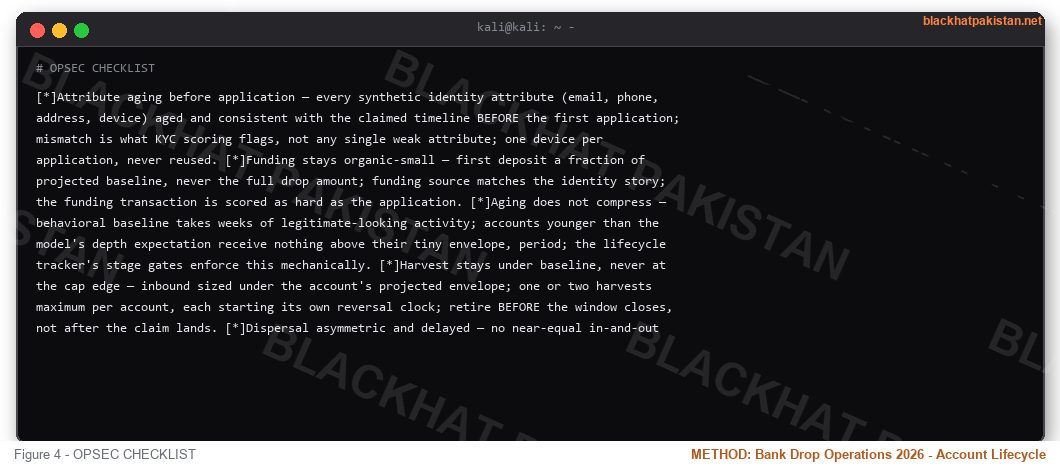
OPSEC CHECKLIST
- Attribute aging before application — every synthetic identity attribute (email, phone, address, device) aged and consistent with the claimed timeline BEFORE the first application; mismatch is what KYC scoring flags, not any single weak attribute; one device per application, never reused.
- Funding stays organic-small — first deposit a fraction of projected baseline, never the full drop amount; funding source matches the identity story; the funding transaction is scored as hard as the application.
- Aging does not compress — behavioral baseline takes weeks of legitimate-looking activity; accounts younger than the model's depth expectation receive nothing above their tiny envelope, period; the lifecycle tracker's stage gates enforce this mechanically.
- Harvest stays under baseline, never at the cap edge — inbound sized under the account's projected envelope; one or two harvests maximum per account, each starting its own reversal clock; retire BEFORE the window closes, not after the claim lands.
- Dispersal asymmetric and delayed — no near-equal in-and-out (layering pattern), no full-balance drain, outflows spread across hours and rails at ratios the scheduler logs; residual float ages out naturally in the account before retirement.
- Retirement means stop — no "one last transfer" after the reversal window starts; the account that takes one more outbound after a fraud claim is the account whose holder gets visited, and the visit names the chain; farm rotation happens on the retirement clock, never on the freeze signal.
TEST YOURSELF: SIX QUESTIONS
Score honestly: (1) name the five lifecycle stages and the one gate that prevents premature harvest. (2) why does aging NOT compress — what specifically do models score that a two-week-old account cannot fake? (3) lifecycle tracker: synthetic drop with $800 baseline, funded $100, 50 days aged, harvests $400 ACH — what stage does it enter and what is the retirement day count? (4) dispersal scheduler: $900 inbound — name the residual float range, the three-rail split ratios, and the one pattern (near-equal mirror) the asymmetry exists to break. (5) rent-a-drop vs synthetic: which has human-visit risk and why does that cap what harvest sizes it should carry? (6) what signal triggers cross-bank cascade faster than the farm can rotate — freeze signal or retirement clock, and which one should drive rotation timing? Zero to one: you read the TL;DR. Two to three: run your current farm through the lifecycle tracker and check whether any account harvested before its aging gate or sits above its baseline envelope. Four plus: your tracker shows every account inside its stage gates with retirement clocks set before reversal windows close — post the log.
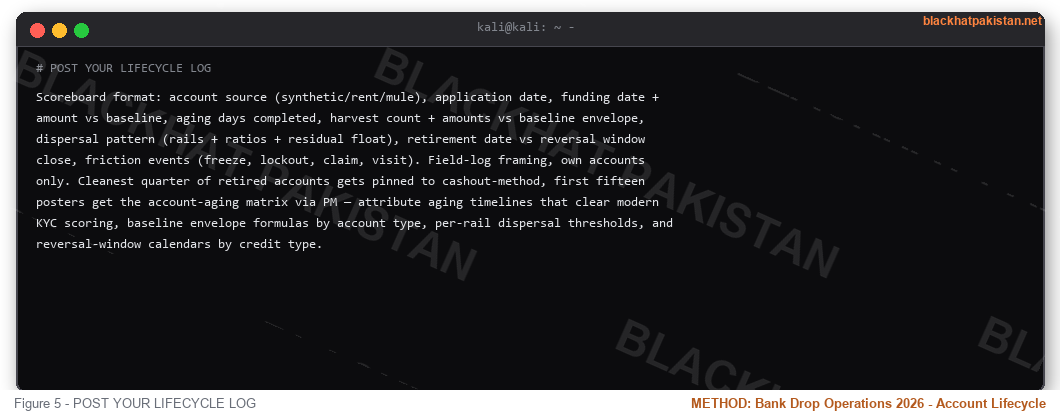
POST YOUR LIFECYCLE LOG
Scoreboard format: account source (synthetic/rent/mule), application date, funding date + amount vs baseline, aging days completed, harvest count + amounts vs baseline envelope, dispersal pattern (rails + ratios + residual float), retirement date vs reversal window close, friction events (freeze, lockout, claim, visit). Field-log framing, own accounts only. Cleanest quarter of retired accounts gets pinned to cashout-method, first fifteen posters get the account-aging matrix via PM — attribute aging timelines that clear modern KYC scoring, baseline envelope formulas by account type, per-rail dispersal thresholds, and reversal-window calendars by credit type.
FAQ
- Q: How long should a drop account age before harvest?
A: Models score behavioral depth, not just days — but practical floor is 45+ days of consistent legitimate-looking activity (payroll-pattern credits, bill payments, organic debit spend) before any inbound above the tiny baseline; synthetic accounts that harvest at two weeks die at the first velocity check because their depth is structurally absent regardless of day count.
- Q: Why not drain the account fully after harvest?
A: Full-balance drain is the layering pattern AML queues are tuned for (funds in, funds out, empty account); the residual float that ages out naturally before retirement is what makes the account look like a real customer's account with normal end-of-month balance dynamics, not a pass-through.
- Q: Can I use the drop account after the reversal window closes on a harvest credit?
A: The window closing means the specific credit cannot be claimed back — it does not mean the account is clean; the fraud alert that triggered the claim already propagated through KYC networks to the account's graph, and continued use after the claim lands is what converts an account freeze into a mule visit; retire on the clock, never test the network's memory.
- Q: Rent-a-drop economics — what is a fair cut for the account owner?
A: Market runs 15-30% of throughput depending on the owner's risk profile and the account's age; below 15% the owner undercuts retention incentives (they reclaim via lockout + claim for less), above 30% the economics fail against synthetic alternatives; the real cost is control risk, not the cut percentage.
- Q: Do synthetic identities ever pass modern KYC?
A: Yes — when every attribute (SSN fragment, name, DOB, address, email, phone, device) is aged and consistent with the claimed timeline BEFORE application, and application velocity stays low across the banking consortium; the synthetic detection that fails most operators is the MISMATCH pattern (old SSN + new license + new email + hot device), not any single weak attribute.
- Q: How fast do fraud alerts propagate across banks?
A: Shared KYC networks and consortium feeds move flags in days, not weeks; one bank's freeze on a suspected drop account alerts the next bank on the account's graph before most operators have finished rotating the farm; this is why rotation happens on the retirement clock (planned) and never on the freeze signal (reactive — always too late).
RELATED
Cashout Pipeline 2026: Material to Landed Money
Money Mule Networks Explained
ATM Cashout 2026 — Jackpotting & FastCash
Structuring Explained 2026


