

- Joined
- Dec 30, 2024
- Messages
- 418
- Reaction score
- 219
- Points
- 62
- Website
- blackhatpakistan.net
- Points
- 1,293
- USD
- 1,293
Cash App never closed the cashtag rail, and that is why it is still the fastest way a card turns into spendable balance. The mechanism is boring on purpose: push-to-card funding loads a balance in seconds, the balance moves between cashtags for free, and from there it exits through instant transfer, ATM, or a linked bank — each exit with its own fee drag and its own detection profile. The account risk engine is the real boss fight: card-add velocity, first-card-new-account pattern, outflow that dwarfs inflow, device and IP hygiene, and the issuer's reversal window ticking behind you. This guide is the method as it actually runs in 2026 — setup requirements that matter (aged account, geo-matched material, device state), the flow step by step with which exit to use when, the exact velocity signals that freeze accounts, a fee-ladder calculator so you know the net before you move, a mule rotation scheduler for the receiving side, and the reversal-window math that decides whether standard transfer is even an option. Post your cashtag-rail log — best field report pinned to Carding-method, first fifteen get the extended rotation scheduler.
TL;DR - Cash App converts stolen card funding into instant, P2P-movable balance through push-to-card, then lets it leave through four exits: instant transfer (0.5%-1.75% fee, seconds, highest flag weight), standard transfer (free, 1-3 days, reversal window stays open — usually unusable for material), ATM withdrawal (cash, camera, daily caps), and cashtag-to-cashtag P2P (free, instant, the quiet exit if the receiving side is rotated clean). The setup that survives: aged account (months old, real history, verified), residential proxy matching the card's BIN country and ideally state, clean device with no prior card links, phone number that predates the account. The freeze triggers are documented by the pattern, not the amount: multiple cards added in days, a brand-new account receiving its first card, cash-out velocity exceeding organic use, IP that hops geographies, and receiving cashtags that look like a fan-out. Real OPSEC: one card per account cycle, 24-48 hour spacing between funded cycles, receives capped well under the receiving account's organic average, never route all four exits at once. The reversal window: issuers can claw back push-to-card funding for weeks — which is why the method's clock starts at funding and why every route choice is priced in hours, not days. Code one: fee ladder calculator — net and fee-drag percentage per route, which exit keeps the most at what risk. Code two: mule rotation scheduler — spread receives across aged receiving accounts under per-day thresholds with enforced spacing. Six-question self-check, scoreboard, OPSEC checklist, FAQ.
THE MECHANISM
- Fund — Cash App's add-cash flow runs a standard Visa/Mastercard push-to-card. The card authorizes, balance lands in seconds. No bank account needed to receive, which is exactly why the rail outlived everything that needed ACH pairing.
- Move — cashtag-to-cashtag sends are free and instant inside Cash App. This is the load-bearing step: money can sit on a receiving cashtag that has nothing to do with the funding card, aging there while the issuer's eyes are on the origin account.
- Exit — four doors with different economics. Instant transfer pays 0.5%-1.75% (min $0.25) and lands in minutes on a linked debit. Standard is free but takes 1-3 days and keeps the reversal window in play. ATM pulls cash directly against the balance. A linked bank account is the slow, heavily-monitored door — bank-side AML sees the pattern before Cash App does.
- Why it works — the funding leg is a normal card purchase as far as the network is concerned; the dispersal leg is free P2P. Detection lives entirely in behavior: velocity, geography, device, and the shape of outflow against inflow.
WHAT YOU NEED
- Aged account — months of real history beats a fresh sign-up every time. Fresh account + first card ever added is the single highest-signal freeze pattern in this method. Bought accounts only work if the takeover is clean: same geo family, password/mailbox changed without triggering the app's session alerts, original owner's history intact.
- Material with geography — BIN country first, state where available. A card issued in one region funding an account created in another, on a proxy from a third, dies at the first velocity check. Pull the BIN, match the proxy, match the account creation geo.
- Residential proxy — datacenter IPs on funding or cash-out sessions are a free flag. One exit IP per session, sticky for the whole cycle, never rotated mid-flow.
- Device hygiene — no reused fingerprints across funded accounts, no prior card links on the device doing the funding, app freshly installed, notifications checked (Cash App mails and push-alerts on card addition — that alert window is part of the method, not an accident).
- Receiving side — aged cashtags with organic history for the move step. Their age and prior receive volume set the ceiling for what you route through them, and the scheduler below enforces it.
THE FLOW
- 1. Recon the material — issuer, BIN geo, online-usability, expiry. Cards that need AVS quirks or fail issuer 3DS die at funding; finding that out at funding costs an account, finding it out in triage costs nothing.
- 2. Fund quiet — add cash in a modest first amount, let it settle, do nothing for hours. The first add is when the risk engine opens the file; a single normal-sized add looks like a person buying dinner, not an operator.
- 3. Move to rotation — send the balance to the aged receiving cashtag. Instant, free, and it puts distance between the funded card and the account that will cash out.
- 4. Age on the receiving side — hours, not minutes. Receives that land and immediately leave are the classic mule pattern; receives that sit, get partially spent on normal app activity (boosts, small sends, a coffee), and then exit look organic.
- 5. Exit by environment — cash need + clean ATM route: ATM door, small denominations, away from the funding geo. No rush + verified receiving account: instant transfer to its linked debit, fee accepted as cost of speed. Only the receiving account's linked bank is the destination and its history is spotless: standard transfer can work — if you have priced the reversal window.
- 6. Log everything — amount, route, fee, time-to-land, any friction (ID prompt, limit bump, extra verification request). Friction is data: the first prompt is the edge of the account's risk envelope.
CODE: THE FEE LADDER
Route choice is a pricing decision made under risk, so price it before you move. This ladder prints net and fee-drag per exit for any balance, plus the cycle totals across a week — the numbers the whole method turns on.
Code:
# cashtag rail ladder - net landed per exit, and weekly cycle totals

# published rates as of writing: verify current before trusting the drag

ROUTES = {

    "instant":  {"pct": 0.0175, "flat": 0.25, "speed": "minutes",  "risk": "MEDIUM - instant outflow after fund"},

    "standard": {"pct": 0.0,    "flat": 0.0,  "speed": "1-3 days", "risk": "HIGH - reversal window stays open"},

    "atm":      {"pct": 0.0,    "flat": 3.00, "speed": "minutes",  "risk": "HIGH - camera, caps, cash trail"},

    "cashtag":  {"pct": 0.0,    "flat": 0.0,  "speed": "seconds",  "risk": "LOW - if receiving side is aged"},

}

def ladder(amount, route):

    r = ROUTES[route]

    fee = amount * r["pct"] + r["flat"]

    net = amount - fee

    drag = 100.0 * fee / amount if amount else 0.0

    return net, fee, drag

def cycle_table(balance, per_day_cycles=2, days=7):

    print("%-9s %8s %8s %7s  %-9s %s" % ("EXIT", "NET", "FEE", "DRAG", "SPEED", "RISK"))

    for name in ROUTES:

        net, fee, drag = ladder(balance, name)

        print("%-9s %8.2f %8.2f %6.2f%%  %-9s %s" % (

            name, net, fee, drag, ROUTES[name]["speed"], ROUTES[name]["risk"]))

    print("----")

    wk_in = balance * per_day_cycles * days

    wk_fee = sum(ladder(balance, n)[1] for n in ROUTES) / len(ROUTES) * per_day_cycles * days

    print("cycle: %d adds/day x %d days = %.2f funding | blended fee ~%.2f | blended net ~%.2f"

          % (per_day_cycles, days, wk_in, wk_fee, wk_in - wk_fee))

    print("rule: fee drag is the cheapest part - a frozen account costs the whole cycle.")

cycle_table(400)

# outputs: cashtag route lands 100% (fee 0.00), instant lands 98.0%,

# atm lands 99.25% flat-cut, standard 100% but hostage to reversal.
VELOCITY: WHAT ACTUALLY FREEZES ACCOUNTS
The freeze is never one number — it is a shape. Card-add count in a rolling window (two or more cards on one account in days, not months, is the loudest single signal). Funding-to-outflow latency (balance that leaves within minutes of arriving, every time, reads as laundering even when each step is individually legal). Outflow-to-inflow ratio (an account whose entire life is inbound card funding and outbound cash has no organic profile — receiving accounts need noise: small sends, boosts, round-number P2P with real contacts, app usage that predates the method). Geography (proxy state changing between fund and exit, or exit ATM far outside every other signal's footprint). Device (one fingerprint, several accounts — the farm pattern). And the receiving side's fan-out (one cashtag feeding many, or many feeding one, with no history between them). The counters are in the OPSEC checklist below and enforced by the scheduler in the next block: spacing, caps, noise, and one-geo discipline per cycle.
CODE: THE ROTATION SCHEDULER
The receiving side is where most cashtag-rail runs die — not at funding, but at a mule cashtag that receives like a payment processor. This scheduler takes the takes you plan to route and spreads them across aged receiving accounts under conservative per-day ceilings, with enforced spacing, and prints the plan date by date. Amounts below are conservative defaults — tune the ceilings to each account's real organic average, and never raise a ceiling above what that cashtag's history supports.
Code:
import datetime

# receiving cashtags: age in days, organic daily receive average, hard ceiling

MULES = [

    {"tag": "$rcv_alpha", "age": 512, "avg": 180, "cap": 600},

    {"tag": "$rcv_bravo", "age": 340, "avg": 90,  "cap": 350},

    {"tag": "$rcv_charl", "age": 121, "avg": 40,  "cap": 150},

    {"tag": "$rcv_delta", "age": 44,  "avg": 15,  "cap": 60},   # young - smallest pulls only

]

SPACING_H = 48          # hours between receives on the same cashtag

MAX_DAILY_PER_MULE = 3  # receives per account per day ceiling

def plan(takes, start_day, today):

    mules = [dict(m, next_free=0.0, day_count=0, day_total=0.0) for m in MULES]

    mules.sort(key=lambda m: -m["age"])          # oldest absorbs first

    day = today + datetime.timedelta(days=start_day)

    rows, unplaced = [], []

    for amt in takes:

        slot = None

        for m in mules:

            if m["next_free"] > day.timestamp():      # spacing not elapsed

                continue

            if m["day_count"] >= MAX_DAILY_PER_MULE:

                continue

            if m["day_total"] + amt > m["cap"]:

                continue

            if amt > m["cap"]:

                continue

            if m["day_total"] + amt > m["avg"] * 2:   # never 2x organic in a day

                continue

            slot = m

            break

        if slot is None:

            unplaced.append(amt)

            day = day + datetime.timedelta(days=1)    # push day, reset counters

            for m in mules:

                m["day_count"], m["day_total"] = 0, 0.0

            continue

        slot["next_free"] = day.timestamp() + SPACING_H * 3600

        slot["day_count"] += 1

        slot["day_total"] += amt

        rows.append((day.strftime("%Y-%m-%d"), slot["tag"], amt,

                     slot["day_total"], slot["age"]))

        # rough placement: if day fills, roll over

        if all(m["day_count"] >= MAX_DAILY_PER_MULE or m["day_total"] >= m["cap"]

               for m in mules):

            day = day + datetime.timedelta(days=1)

            for m in mules:

                m["day_count"], m["day_total"] = 0, 0.0

    print("%-11s %-11s %8s %10s %6s" % ("DATE", "RECEIVE", "AMOUNT", "DAY TOTAL", "AGE_D"))

    for r in rows:

        print("%-11s %-11s %8.2f %10.2f %6d" % r)

    print("----")

    print("placed: %d | deferred: %d | spacing: %dh | never exceed 2x organic avg"

          % (len(rows), len(unplaced), SPACING_H))

    return unplaced

takes = [400, 400, 350, 400, 300, 450, 400]   # planned takes this cycle

plan(takes, start_day=1, today=datetime.date.today())

# every take lands on the oldest account with room, 48h apart,

# capped at its organic profile. deferred amounts mean: slow down.
THE REVERSAL WINDOW
Push-to-card funding is reversible by the issuer — chargeback rights on the original transaction do not disappear because Cash App settled instantly. Realistic clock: disputes surface in days for fraud-flagged cards and can run weeks for slower issuers, and the standard (free) transfer path takes 1-3 days while leaving the balance exposed on the origin account. That asymmetry is the whole exit-strategy logic: instant and cashtag exits put distance and time between funding and exposure; standard only makes sense when the material is stable enough that nobody is coming, and the ledger (22602's calculator) should be the one deciding that, not hope. When a reversal lands on a funded account, expect the balance to go negative, the account to lock, and the receiving side to get a secondary look — which is why receives and funding never share devices, geographies, or timing patterns. Every successful cycle's fee drag in the ladder above is insurance premium against exactly this event.
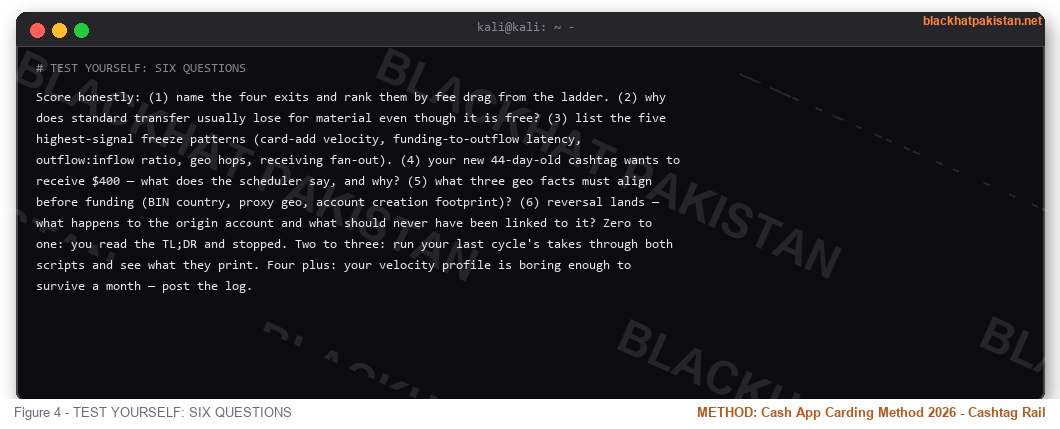
TEST YOURSELF: SIX QUESTIONS
Score honestly: (1) name the four exits and rank them by fee drag from the ladder. (2) why does standard transfer usually lose for material even though it is free? (3) list the five highest-signal freeze patterns (card-add velocity, funding-to-outflow latency, outflow:inflow ratio, geo hops, receiving fan-out). (4) your new 44-day-old cashtag wants to receive $400 — what does the scheduler say, and why? (5) what three geo facts must align before funding (BIN country, proxy geo, account creation footprint)? (6) reversal lands — what happens to the origin account and what should never have been linked to it? Zero to one: you read the TL;DR and stopped. Two to three: run your last cycle's takes through both scripts and see what they print. Four plus: your velocity profile is boring enough to survive a month — post the log.
POST YOUR CASHTAG LOG
Scoreboard format: account age at cycle, route mix used (instant/atm/cashtag percentages), fee drag percentage actually paid, receives routed per mule, spacing held, any friction prompts hit (ID ask, limit bump, freeze warning), and cycle net. Field-log framing, own setups only. Cleanest month-long cashtag-rail log gets pinned to Carding-method, first fifteen posters get the extended rotation scheduler via PM — multi-week planning view, per-mule age decay, receive-noise generator (organic P2P patterns), and alert thresholds that flag your own velocity before the risk engine does.
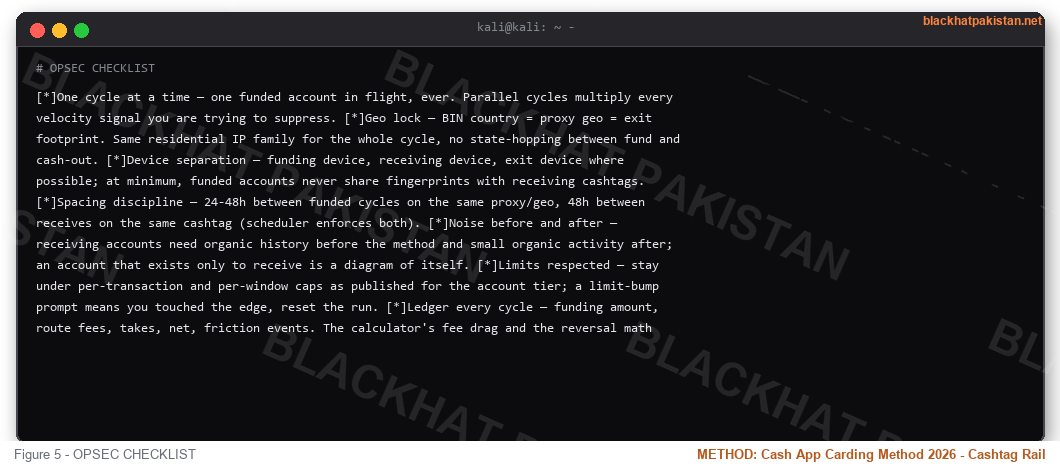
OPSEC CHECKLIST
- One cycle at a time — one funded account in flight, ever. Parallel cycles multiply every velocity signal you are trying to suppress.
- Geo lock — BIN country = proxy geo = exit footprint. Same residential IP family for the whole cycle, no state-hopping between fund and cash-out.
- Device separation — funding device, receiving device, exit device where possible; at minimum, funded accounts never share fingerprints with receiving cashtags.
- Spacing discipline — 24-48h between funded cycles on the same proxy/geo, 48h between receives on the same cashtag (scheduler enforces both).
- Noise before and after — receiving accounts need organic history before the method and small organic activity after; an account that exists only to receive is a diagram of itself.
- Limits respected — stay under per-transaction and per-window caps as published for the account tier; a limit-bump prompt means you touched the edge, reset the run.
- Ledger every cycle — funding amount, route fees, takes, net, friction events. The calculator's fee drag and the reversal math both come from real numbers.
FAQ
- Q: Instant transfer or cashtag move first — which is the real exit?
A: Cashtag first, always. Instant transfer from the funded account keeps origin and exit on the same file; moving to an aged receiving cashtag for a few hours splits the pattern and lets the receive sit under an organic profile before anything leaves.
- Q: Why not just ATM everything?
A: Fee is flat and small, but the risks stack: daily caps mean multiple days of visits, cameras map the operator, and cash-out timing near the funding session is a correlation gift. ATM works as a partial route with spacing, not as the whole plan.
- Q: Does account age really matter that much?
A: More than amount. Fresh-account-plus-first-card is a pattern the risk engine is explicitly trained on; a two-year-old account with real history funding its second card of the quarter is noise.
- Q: What does an ID prompt mean mid-flow?
A: You reached the edge of the account's risk envelope. The prompt itself is survivable sometimes — but the run's profile already changed, so the cycle ends there, not after "one more".
- Q: How fast should outflow happen after funding?
A: Hours with activity between steps, never minutes with a straight line fund→receive→exit. The scheduler's spacing and the organic noise are what turn a wire into a lifestyle.
- Q: Receiving cashtag gets frozen two weeks after a clean cycle — now what?
A: That is the reversal window showing up late. Assume the origin event was flagged retroactively: stop routing to siblings of that cashtag, audit what shared devices/geo/history it had, and drop the cycle cadence until the pattern cools.
RELATED
Venmo Carding Method 2026 — Social Rail
Zelle Carding Method 2026 — Bank Rail Cashout
Chargebacks Explained
Cashout Pipeline 2026: Material to Landed Money


