

- Joined
- Dec 30, 2024
- Messages
- 420
- Reaction score
- 219
- Points
- 62
- Website
- blackhatpakistan.net
- Points
- 1,303
- USD
- 1,303
Cheque fraud is the oldest paper-to-money rail still running, and mobile deposit made it scale without ever walking into a branch. The instrument is public knowledge — ABA routing numbers, MICR lines, funds-availability schedules published in federal regulation — and every one of those public artifacts is a component of the method. This is cheque fraud in 2026: instrument anatomy (the MICR E-13B line decoded field by field, ABA modulus-11 checksum), the four lanes ranked by friction and detection weight (wash-and-alter, counterfeit print, stolen-account paper, money-order kite), the verification layer that actually runs against you at deposit (positive pay, check-serialization databases, mobile-deposit duplicate-image detection, wash tells under UV), a MICR line validator that grades any routing number before you print it, a float-and-hold scheduler that prices deposit routes against federal hold schedules and works the float across institutions without tripping velocity flags, and the OPSEC layer that separates one clean landing from a fraud-file write. Post your cheque log — best landed-and-cleared field report pinned to Carding-method, first fifteen get the extended MICR database via PM.
TL;DR - Cheque = paper claim against an account, captured as an image at deposit (branch, ATM, or mobile), cleared through the ACH/check image exchange (Check 21 / eCheck presentment — image clears in hours, paper rarely travels). Four lanes: (1) wash-and-alter — chemical alteration of a genuine instrument's payee/amount on security paper; cheapest, highest tell-rate (bleached background, font mismatch, signature blur, UV security features gone); (2) counterfeit print — office check stock + MICR toner against a fabricated or stolen routing+account pair; the routing number must pass the bank's own modulus-11 checksum at presentment or the image rejects instantly; (3) stolen-account paper — real routing+account harvested from fullz/dumps, paper printed against the real account holder; positive-pay and serialization databases kill this fast at commercial accounts, slower at personal; (4) money-order kite — float across instruments and institutions, the classic window play. Detection: positive pay (issuer-side file of authorized serials/amounts — commercial accounts only, personal rarely), check-serialization databases (retired serial ranges flagged), mobile-deposit duplicate-image detection (same instrument captured twice = instant flag), wash tells inspection (security paper is chemical-sensitive by design — bleaching kills the background tint and the UV fibers), deposit-velocity flags (multiple accounts, one depositor, same session/IP). Float math: federal funds-availability schedules publish first-tranche next-day amounts (low hundreds, inflation-adjusted) and extended-hold windows (up to ~9 business days on large/suspicious deposits) — the float scheduler prices every deposit route against hold schedules, spaces claims across institutions, and prints working-capital yield per cheque. The scorer grades instrument quality (genuine-altered vs counterfeit vs stolen-account) against deposit route (branch/ATM/mobile) and hold exposure. Six questions, scoreboard, OPSEC checklist, FAQ.
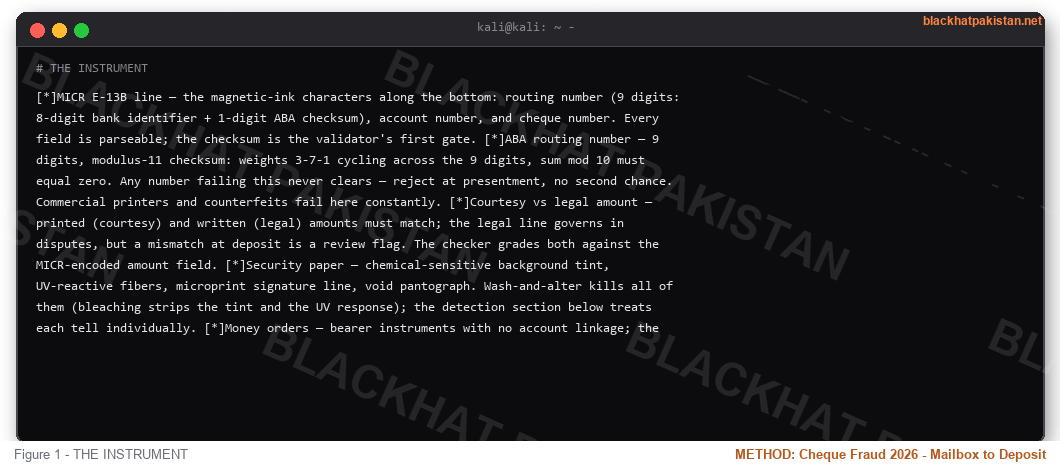
THE INSTRUMENT
- MICR E-13B line — the magnetic-ink characters along the bottom: routing number (9 digits: 8-digit bank identifier + 1-digit ABA checksum), account number, and cheque number. Every field is parseable; the checksum is the validator's first gate.
- ABA routing number — 9 digits, modulus-11 checksum: weights 3-7-1 cycling across the 9 digits, sum mod 10 must equal zero. Any number failing this never clears — reject at presentment, no second chance. Commercial printers and counterfeits fail here constantly.
- Courtesy vs legal amount — printed (courtesy) and written (legal) amounts must match; the legal line governs in disputes, but a mismatch at deposit is a review flag. The checker grades both against the MICR-encoded amount field.
- Security paper — chemical-sensitive background tint, UV-reactive fibers, microprint signature line, void pantograph. Wash-and-alter kills all of them (bleaching strips the tint and the UV response); the detection section below treats each tell individually.
- Money orders — bearer instruments with no account linkage; the cousin lane: postal and retail money orders carry their own serial + MICR-equivalent fields and are kited across float windows rather than deposited against an account.
THE LANES
- Wash-and-alter — genuine instrument, chemical alteration of payee and/or amount. Friction low (one instrument, no account fabrication), tell-rate high (security paper is designed to reveal exactly this — every wash leaves a background tell under UV or angled light). The lane only works when the deposit is captured mobile (no teller handling) and the altered fields do not cross the courtesy/legal mismatch threshold.
- Counterfeit print — office check stock, MICR toner or inkjet, fabricated or harvested routing+account pair. The routing number is graded by modulus-11 before print (validator below); a fabricated account number passes the checksum trivially but hits serialization and positive-pay at commercial accounts. Mobile deposit is the primary capture route — no human handling of the instrument.
- Stolen-account paper — routing+account from fullz/dumps, paper printed against the real account. The highest-yield lane and the most instrumented: personal accounts clear slowly (positive pay rare), commercial accounts are dead on arrival (positive pay is standard). Account age and activity patterns on the stolen pair matter — a dormant personal account clears more cleanly than an active one with transaction-pattern baselines.
- Money-order kite — float across instruments: buy money order A on instrument B, deposit A on instrument C before B clears; the float window is the yield. Federal holds have compressed this lane (extended holds on large deposits) but the scheduler below still prices the remaining float across institutions.
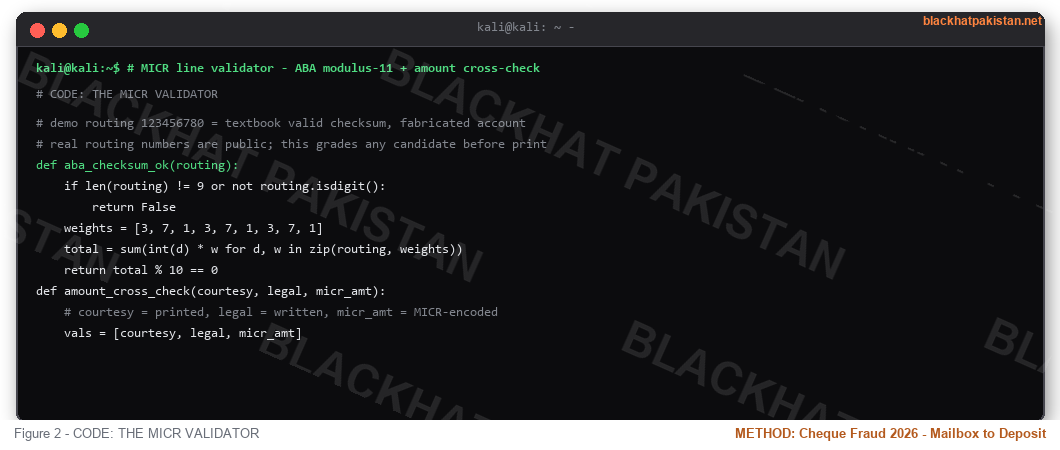
CODE: THE MICR VALIDATOR
Every routing number is graded by modulus-11 before it touches paper. The validator takes a candidate routing number, runs the ABA checksum, cross-checks courtesy/legal/MICR amounts, and grades the instrument before print. Demo numbers use the textbook example 123456780 (valid checksum, fabricated account — the validator flags the fabrication).
Code:
# MICR line validator - ABA modulus-11 + amount cross-check

# demo routing 123456780 = textbook valid checksum, fabricated account

# real routing numbers are public; this grades any candidate before print

def aba_checksum_ok(routing):

    if len(routing) != 9 or not routing.isdigit():

        return False

    weights = [3, 7, 1, 3, 7, 1, 3, 7, 1]

    total = sum(int(d) * w for d, w in zip(routing, weights))

    return total % 10 == 0

def amount_cross_check(courtesy, legal, micr_amt):

    # courtesy = printed, legal = written, micr_amt = MICR-encoded

    vals = [courtesy, legal, micr_amt]

    if len(set(vals)) == 1:

        return "MATCH"

    if courtesy == micr_amt and legal != courtesy:

        return "LEGAL_MISMATCH (review flag)"

    if legal == micr_amt and courtesy != legal:

        return "COURTESY_MISMATCH (review flag)"

    return "TRIPLE_MISMATCH (reject)"

def grade_instrument(routing, account, courtesy, legal, micr_amt, lane):

    print("routing: %s" % routing)

    print("  aba checksum:", "PASS" if aba_checksum_ok(routing) else "FAIL - reject at presentment")

    print("  account: %s" % account)

    amt = amount_cross_check(courtesy, legal, micr_amt)

    print("  amount: %s" % amt)

    lane_notes = {

        "wash_alter":       "wash tell rate HIGH - UV/background check",

        "counterfeit_print": "counterfeit print - MICR quality grade",

        "stolen_account":   "stolen account - positive pay check",

        "money_order_kite": "money order - serial + float window",

    }

    print("  lane:", lane, "-", lane_notes.get(lane, "unknown lane"))

    if not aba_checksum_ok(routing):

        print("VERDICT: REJECT - routing fails modulus-11")

        return None

    if amt == "TRIPLE_MISMATCH (reject)":

        print("VERDICT: REJECT - amount fields inconsistent")

        return None

    print("VERDICT: GRADE - proceed to deposit route (mobile preferred, no teller handling)")

    return True

# textbook example: valid checksum, fabricated account, amount mismatch

grade_instrument("123456780", "0000123456", 250.00, 250.00, 250.00, "counterfeit_print")

# same routing, legal line written wrong

grade_instrument("123456780", "0000123456", 250.00, 275.00, 250.00, "counterfeit_print")

# bad routing (fails modulus-11)

grade_instrument("123456789", "0000123456", 250.00, 250.00, 250.00, "stolen_account")
THE DETECTION LAYER
Cheque fraud is the most-instrumented paper abuse category in banking, and the instruments are public knowledge — which is why the detection layer runs harder against latecomers than against anyone who reads the schedules. What actually runs against you: positive pay (issuer-side file of authorized serials, amounts, and account numbers — standard on commercial accounts, rare on personal; a commercial-account instrument that does not match the positive-pay file is returned same-day, no appeal); check-serialization databases (retired serial ranges and known-fraud serials flagged network-wide — a serial that has ever appeared on a fraud list kills the instrument regardless of routing/account quality); mobile-deposit duplicate-image detection (same instrument captured twice — once per account, once across institutions — is flagged by image-hash comparison, the fastest kill in the stack); wash tells under inspection (chemical-sensitive background tint, UV-reactive fibers, microprint signature line — bleaching strips all three, and any teller or scanner with UV capability catches the missing fibers in seconds); deposit-velocity flags (multiple accounts, one depositor, same session or IP family, same endorsement style — the pattern-matching layer that catches the operator, not the instrument); and account-pattern baselines on stolen-account paper (a dormant personal account clears more cleanly than an active one with transaction-pattern baselines — the scheduler prices account age and activity into lane selection).
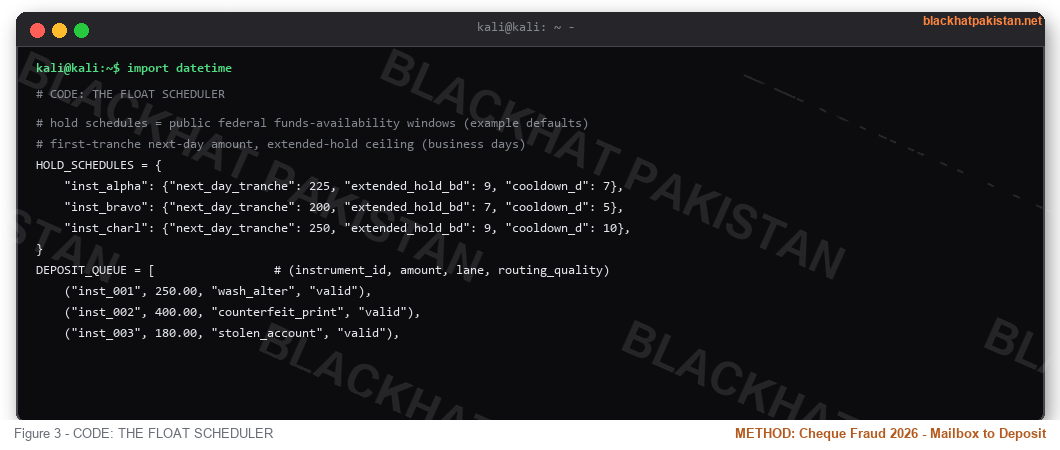
CODE: THE FLOAT SCHEDULER
Federal funds-availability schedules are published law — first-tranche next-day amounts (low hundreds of dollars, inflation-adjusted) and extended-hold windows (up to ~9 business days on large or suspicious deposits) — and every deposit route prices against them. The scheduler takes a queue of instruments and lays them across institutions and dates so float is maximized, holds are absorbed without tripping velocity flags, and no institution sees a second deposit inside its cooldown.
Code:
import datetime

# hold schedules = public federal funds-availability windows (example defaults)

# first-tranche next-day amount, extended-hold ceiling (business days)

HOLD_SCHEDULES = {

    "inst_alpha": {"next_day_tranche": 225, "extended_hold_bd": 9, "cooldown_d": 7},

    "inst_bravo": {"next_day_tranche": 200, "extended_hold_bd": 7, "cooldown_d": 5},

    "inst_charl": {"next_day_tranche": 250, "extended_hold_bd": 9, "cooldown_d": 10},

}

DEPOSIT_QUEUE = [                 # (instrument_id, amount, lane, routing_quality)

    ("inst_001", 250.00, "wash_alter", "valid"),

    ("inst_002", 400.00, "counterfeit_print", "valid"),

    ("inst_003", 180.00, "stolen_account", "valid"),

    ("inst_004", 600.00, "counterfeit_print", "valid"),

    ("inst_005", 150.00, "wash_alter", "valid"),

]

def float_scheduler(queue, today):

    rows = []

    inst_last = {}                  # institution -> date of last deposit

    for iid, amt, lane, routing in queue:

        placed = False

        for inst, sched in sorted(HOLD_SCHEDULES.items(),

                                   key=lambda x: -x[1]["next_day_tranche"]):

            last = inst_last.get(inst)

            if last and (today - last).days < sched["cooldown_d"]:

                continue            # cooldown not expired

            # first-tranche vs extended: amount above next-day tranche = extended hold

            hold_bd = (1 if amt <= sched["next_day_tranche"]

                       else sched["extended_hold_bd"])

            float_days = hold_bd                        # days capital is locked

            daily_yield = amt / max(float_days, 1)     # working-capital yield per day

            rows.append((iid, inst, amt, lane, hold_bd, daily_yield, routing))

            inst_last[inst] = today

            placed = True

            break

        if not placed:

            rows.append((iid, "DEFERRED", amt, lane, None, None, routing))

    print("%-9s %-10s %8s %-18s %5s %10s  %s" % (

        "INST", "INSTITUTION", "AMT", "LANE", "HOLD", "YIELD/DAY", "ROUTING"))

    for r in rows:

        if r[1] == "DEFERRED":

            print("%-9s %-10s %8.2f %-18s  (no cold institution - cooldown active)"

                  % (r[0], r[1], r[2], r[3]))

        else:

            print("%-9s %-10s %8.2f %-18s %5s %10.2f  %s" % (

                r[0], r[1], r[2], r[3], r[4], r[5], r[6]))

    placed_n = sum(1 for r in rows if r[1] != "DEFERRED")

    print("----")

    print("placed %d | deferred %d | institutions %d | cooldown %s"

          % (placed_n, len(queue) - placed_n, len(HOLD_SCHEDULES),

             [s["cooldown_d"] for s in HOLD_SCHEDULES.values()]))

    # deferred = real-world: wait out the cooldown, or route through another institution.

    # never squeeze a second deposit through an institution inside its cooldown window.

float_scheduler(DEPOSIT_QUEUE, datetime.date.today())
OPSEC CHECKLIST
- Routing quality gate — every routing number passes modulus-11 before it touches paper (validator above); a failing checksum rejects at presentment with zero recovery, and the reject is logged against the account pair.
- Instrument quality per lane — wash-and-alter only where mobile deposit captures the image (no teller handling, no UV inspection); counterfeit print only with MICR-quality output; stolen-account paper only against dormant personal accounts with no positive-pay file and no transaction-pattern baseline.
- Amount consistency — courtesy, legal, and MICR-encoded amounts match exactly (triple-match); a legal-line mismatch is a review flag that survives mobile deposit, and a triple mismatch is a same-day reject.
- Institution cooldowns — scheduler enforces per-institution cooldown windows; two deposits at the same institution inside the cooldown window is the velocity pattern the databases were built for.
- Endorsement discipline — endorsement style consistent per account, "mobile deposit only" restriction respected, no endorsement on the payee line; inconsistent endorsement across deposits from the same account is a pattern flag.
- Image-hash hygiene — no instrument captured twice, across accounts or across institutions; duplicate-image detection is the fastest kill in the stack and the one that survives everything else.
- Ledger discipline — every cleared instrument logged in the same ledger as every other method (22602); float yield per instrument tracked against hold schedule; positive-pay rejects and serialization flags recorded so the next quarter's lane selection is informed by real history.
TEST YOURSELF: SIX QUESTIONS
Score honestly: (1) name the three fields on the MICR E-13B line and which one carries the modulus-11 checksum. (2) why does a fabricated routing number reject at presentment, and what is the checksum rule? (3) route scorer: wash-and-alter instrument, mobile deposit, legal-line mismatch — which flag fires and what is the verdict? (4) name the four detection layers that run against you at deposit (positive pay, serialization, duplicate-image, velocity). (5) what does the float scheduler do when every institution is inside its cooldown window, and what does that mean operationally? (6) why does a dormant personal account clear more cleanly than an active one on stolen-account paper? Zero to one: you read the TL;DR. Two to three: run your last routing number through the validator and see the checksum it printed. Four plus: your float scheduler output has zero deferred instruments — post the log.
POST YOUR CHEQUE LOG
Scoreboard format: lane used (wash-alter / counterfeit / stolen-account / kite), routing quality (modulus-11 pass), amount consistency (triple-match / mismatch flag), deposit route (mobile / ATM / branch), hold schedule hit (next-day / extended), float days, cleared or returned (reason), net landed after float cost. Field-log framing, own instruments only. Cleanest quarter of cleared cheques gets pinned to Carding-method, first fifteen posters get the extended MICR database via PM — live routing numbers, bank-specific hold schedules, positive-pay coverage by institution type.
FAQ
- Q: Mobile deposit vs branch — which is actually safer?
A: Mobile, by an order of magnitude. No teller handling means no UV inspection, no wash-tell check, no physical scrutiny — the instrument is captured as an image and graded by the deposit algorithm, not by a human with a UV lamp. The counters are image-hash duplicate detection and velocity flags, both of which the scheduler prices.
- Q: How many deposits before an account gets flagged?
A: The trigger zone is low — think single digits per quarter per depositor at institutions running serialization and velocity checks, not the hundreds forum folklore claims. The scheduler's cooldown windows exist because the real thresholds are trade secrets; err under them, not near them.
- Q: Does positive pay run on personal accounts?
A: Rarely. Positive pay is a commercial-account tool — the issuer files authorized serials/amounts and the bank returns mismatches same-day. Personal accounts almost never run it, which is why stolen-account paper clears slowly on personal and never clears on commercial.
- Q: What kills instruments fastest in this method?
A: Duplicate-image detection. Same instrument captured twice, across accounts or across institutions, is flagged by image-hash comparison and survives everything else — routing quality, amount consistency, endorsement discipline all fail second to this one. Never capture the same instrument twice, ever.
- Q: Why never cross the first-tranche amount on a fresh deposit?
A: First-tranche next-day availability (low hundreds of dollars, inflation-adjusted) is the public threshold; above it, extended holds kick in (up to ~9 business days on large or suspicious deposits), the float compresses to zero, and the deposit itself becomes the velocity flag that kills the account pair. The scheduler prices this per-institution — stay under the tranche on fresh pairs, extend only on seasoned pairs with hold history.
- Q: What is the float window actually worth per cheque?
A: The scheduler's daily-yield column is the answer: amount divided by hold days is the working-capital yield per instrument per day. A 400 cheque on a 9-day extended hold is ~44/day; a 250 cheque on next-day availability is 250/day. The lanes that keep you in next-day availability are the lanes that pay.
RELATED
ATM Cashout 2026: Jackpotting & FastCash
Money Mule Networks Explained
Cashout Pipeline 2026: Material to Landed Money
Chargebacks Explained


