

- Joined
- Dec 30, 2024
- Messages
- 430
- Reaction score
- 219
- Points
- 62
- Website
- blackhatpakistan.net
- Points
- 1,353
- USD
- 1,353
CVV meaning, exact: the Card Verification Value — that 3-digit code printed on the signature strip of most credit cards, or the 4-digit code on the front of American Express cards, that proves the person authorizing a card-not-present transaction has the physical card (or at least its data) in hand. It is not the card number, not the PIN, not the expiry — it is the third field that e-commerce checkouts demand to complete an online purchase, and its entire security model rests on the assumption that the code is never stored by merchants after authorization. That assumption broke years ago; breaches still capture CVV alongside card numbers, phishing pages harvest it in real time, and the security code's role in the carding pipeline is precisely why stolen CC packages without CVV sell at a discount while CVV-bearing material commands the premium. This is the CVV meaning master guide in 2026: what the code actually is (CVC vs CID vs CVV2 naming across networks), where it lives on every card type, why issuers treat it as a fraud signal when it mismatches, how it functions in the validation and spend stages of the pipeline, and the beginner questions in English, Urdu, and Hindi that bring most searchers to this page. Post your CVV mismatch story — cleanest decline-code diagnosis gets pinned to Carding-method, first fifteen get the checkout response-code sheet via PM.
TL;DR - CVV (Card Verification Value) = 3-digit security code on the back signature strip (Visa/Mastercard/Discover) or 4-digit code on the front (American Express). Network naming: Visa calls it CVV2, Mastercard CVC2, Amex CID — same function, different label. Purpose: verify the cardholder (or transaction initiator) possesses the physical card or its full data during card-not-present (CNP) transactions — e-commerce, phone orders, recurring billing setup. Storage rule: PCI DSS forbids merchants from storing CVV after authorization — which is why breaches that DO contain CVV are treated as higher-severity (the merchant violated storage rules, or the data was captured pre-authorization via skimming or phishing). In the pipeline: CVV separates CC-only material (number + exp, usable at some CNP merchants that skip CVV check or via ATO with saved cards) from full CC material (number + exp + CVV, the baseline package for online spend); validation stage tests whether the CVV matches at checkout (soft decline on mismatch = number may still be live with wrong data attached); spend stage: AVS-zip + CVV-match together raise auth probability, mismatch on either logs a fraud signal even when the transaction is otherwise approved. Detection: CVV mismatch codes are logged per card + per device + per IP — repeated mismatches across many cards from one source = testing fingerprint; issuers also flag CVV-absent authorizations (merchants that skip the check) at higher fraud-monitoring priority. Legal: CVV-only data is still payment-card fraud material under unauthorized-access and card-fraud statutes — the "just the code" framing is a distinction without a legal difference.
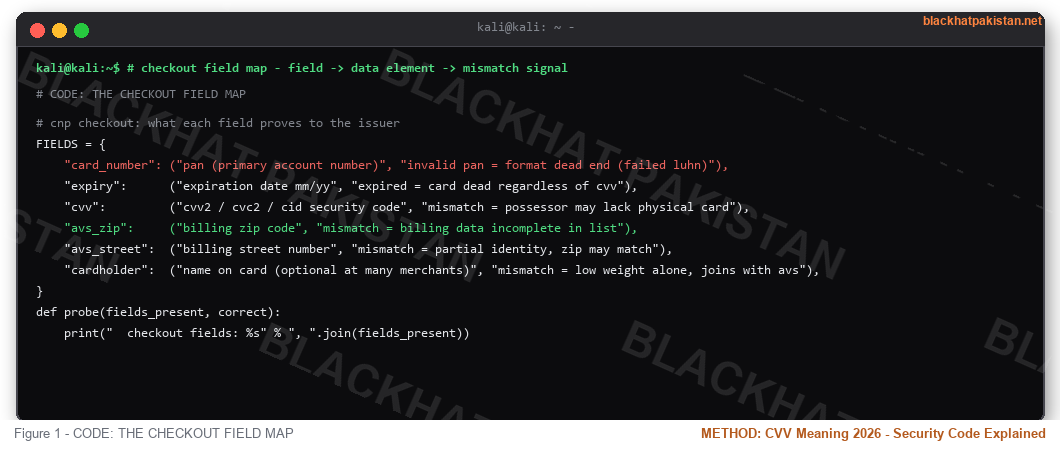
CODE: THE CHECKOUT FIELD MAP
Maps every field a standard CNP checkout demands, what data element it corresponds to, and what a mismatch signals to the issuer's fraud model. Reads like the checkout form because that is where CVV lives and where mismatch codes originate.
Code:
# checkout field map - field -> data element -> mismatch signal

# cnp checkout: what each field proves to the issuer

FIELDS = {

    "card_number": ("pan (primary account number)", "invalid pan = format dead end (failed luhn)"),

    "expiry":      ("expiration date mm/yy", "expired = card dead regardless of cvv"),

    "cvv":         ("cvv2 / cvc2 / cid security code", "mismatch = possessor may lack physical card"),

    "avs_zip":     ("billing zip code", "mismatch = billing data incomplete in list"),

    "avs_street":  ("billing street number", "mismatch = partial identity, zip may match"),

    "cardholder":  ("name on card (optional at many merchants)", "mismatch = low weight alone, joins with avs"),

}

def probe(fields_present, correct):

    print("  checkout fields: %s" % ", ".join(fields_present))

    for f in fields_present:

        meaning, signal = FIELDS[f]

        match = correct.get(f, "?")

        state = "MATCH" if match == "Y" else ("MISMATCH" if match == "N" else "ABSENT")

        print("    %-12s %-10s %s | issuer sees: %s" % (f, state, meaning, signal))

    print("    ---- full match set raises auth; any mismatch logs fraud signal")

probe(["card_number", "expiry", "cvv", "avs_zip"],

      {"card_number": "Y", "expiry": "Y", "cvv": "N", "avs_zip": "Y"})
WHERE CVV LIVES ON EVERY CARD
- Visa / Mastercard / Discover — 3-digit code on the back, right side of the signature strip panel; printed on the stripe-data-free portion so swipe/cloning does not capture it (the stripe does NOT contain CVV — which is why dumps + PIN clones work in-person without CVV but online CNP spend requires the printed code); some newer issues print the code embossed next to the strip.
- American Express — 4-digit code printed on the FRONT of the card, typically above and right of the card number; Amex's security model treats front-print as harder to skim from signature-strip cameras; same CNP verification role, one extra digit.
- Virtual cards — issuer-generated card numbers for online use; CVV generated alongside the number, often displayed once in the app or portal; recurring-billing setups store the virtual CVV per PCI rules (the merchant cannot, but the issuer's own vault can under their acquiring relationship).
- Card-not-present vs card-present — CNP (online, phone, recurring): CVV required by most merchants, mismatch = soft decline; CP (in-person EMV or swipe): CVV irrelevant — chip cryptographic authentication or stripe data + PIN does the verification; this split is why CVV meaning matters specifically for the online spend stage of the pipeline and not for physical cloning.
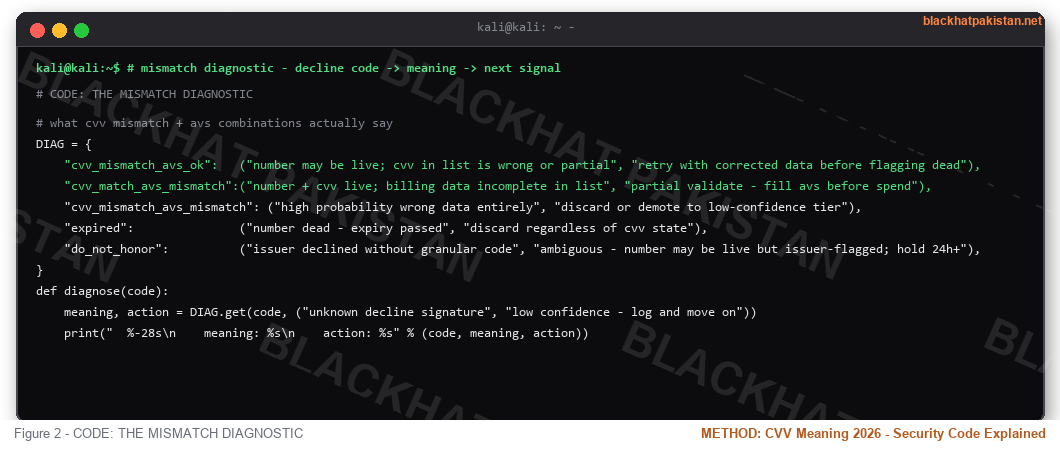
CODE: THE MISMATCH DIAGNOSTIC
Reads a checkout decline response and maps it to what the mismatch actually means — number live with wrong data, number dead, or testing fingerprint logged. Three common decline signatures a tester or defender sees, with the correct interpretation of each.
Code:
# mismatch diagnostic - decline code -> meaning -> next signal

# what cvv mismatch + avs combinations actually say

DIAG = {

    "cvv_mismatch_avs_ok":   ("number may be live; cvv in list is wrong or partial", "retry with corrected data before flagging dead"),

    "cvv_match_avs_mismatch":("number + cvv live; billing data incomplete in list", "partial validate - fill avs before spend"),

    "cvv_mismatch_avs_mismatch": ("high probability wrong data entirely", "discard or demote to low-confidence tier"),

    "expired":               ("number dead - expiry passed", "discard regardless of cvv state"),

    "do_not_honor":          ("issuer declined without granular code", "ambiguous - number may be live but issuer-flagged; hold 24h+"),

}

def diagnose(code):

    meaning, action = DIAG.get(code, ("unknown decline signature", "low confidence - log and move on"))

    print("  %-28s\n    meaning: %s\n    action: %s" % (code, meaning, action))

for c in ["cvv_mismatch_avs_ok", "cvv_match_avs_mismatch", "expired"]:

    diagnose(c)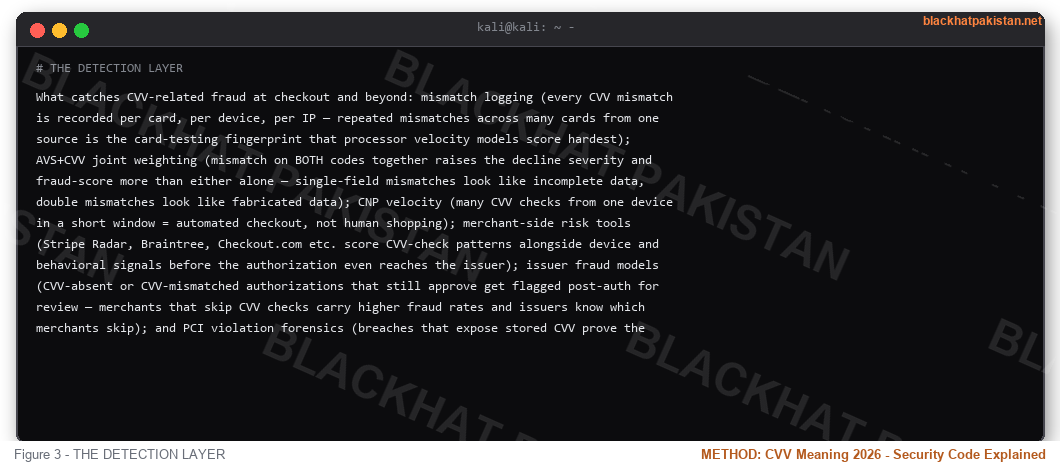
THE DETECTION LAYER
What catches CVV-related fraud at checkout and beyond: mismatch logging (every CVV mismatch is recorded per card, per device, per IP — repeated mismatches across many cards from one source is the card-testing fingerprint that processor velocity models score hardest); AVS+CVV joint weighting (mismatch on BOTH codes together raises the decline severity and fraud-score more than either alone — single-field mismatches look like incomplete data, double mismatches look like fabricated data); CNP velocity (many CVV checks from one device in a short window = automated checkout, not human shopping); merchant-side risk tools (Stripe Radar, Braintree, Checkout.com etc. score CVV-check patterns alongside device and behavioral signals before the authorization even reaches the issuer); issuer fraud models (CVV-absent or CVV-mismatched authorizations that still approve get flagged post-auth for review — merchants that skip CVV checks carry higher fraud rates and issuers know which merchants skip); and PCI violation forensics (breaches that expose stored CVV prove the merchant violated PCI DSS storage rules — which is why CVV-bearing breach data is both more valuable to attackers and more damning to the merchant; post-breach, issuers reissue cards with new CVVs at scale, which is why fresh CVV-bearing material has a shelf life).
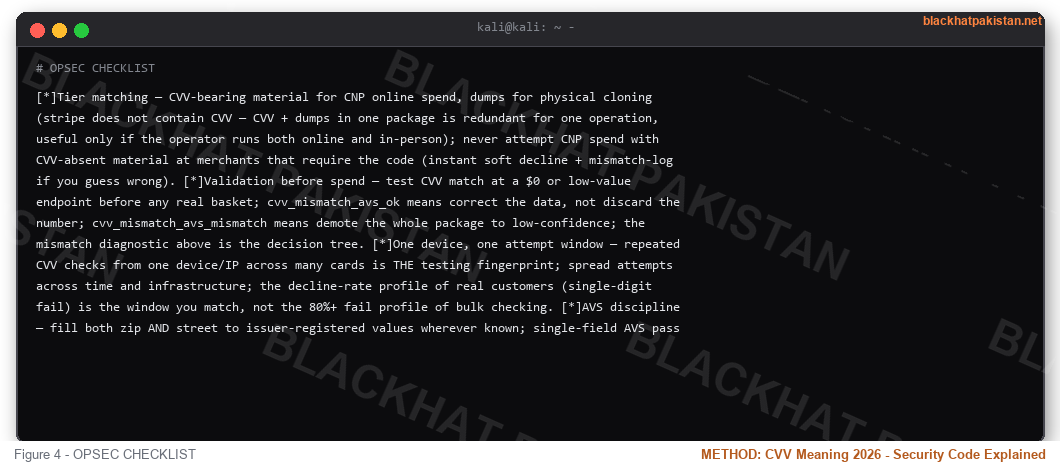
OPSEC CHECKLIST
- Tier matching — CVV-bearing material for CNP online spend, dumps for physical cloning (stripe does not contain CVV — CVV + dumps in one package is redundant for one operation, useful only if the operator runs both online and in-person); never attempt CNP spend with CVV-absent material at merchants that require the code (instant soft decline + mismatch-log if you guess wrong).
- Validation before spend — test CVV match at a $0 or low-value endpoint before any real basket; cvv_mismatch_avs_ok means correct the data, not discard the number; cvv_mismatch_avs_mismatch means demote the whole package to low-confidence; the mismatch diagnostic above is the decision tree.
- One device, one attempt window — repeated CVV checks from one device/IP across many cards is THE testing fingerprint; spread attempts across time and infrastructure; the decline-rate profile of real customers (single-digit fail) is the window you match, not the 80%+ fail profile of bulk checking.
- AVS discipline — fill both zip AND street to issuer-registered values wherever known; single-field AVS pass raises auth probability meaningfully over single-field fail; complete data packages (number + exp + CVV + full billing) clear checkout at measurably higher rates than bare CC.
- Reissue awareness — issuers reissue cards with NEW CVVs after breach notification; material older than the breach-notification cycle may carry expired CVVs even when the number itself remains valid; freshness dating on material is CVV-stage discipline, not optional overhead.
TEST YOURSELF: SIX QUESTIONS
Score honestly: (1) CVV meaning in one sentence — what does the code prove and where does it live on Visa vs Amex cards? (2) why does the magnetic stripe NOT contain CVV, and what does that mean for dumps vs CNP spend material tiers? (3) PCI DSS storage rule: what are merchants forbidden to store post-authorization, and why does that make CVV-bearing breaches higher severity? (4) mismatch diagnostic: cvv_mismatch_avs_ok — is the number likely live, and what is the correct next action? (5) detection: what exact pattern turns CVV mismatch logs from "incomplete data" into "card testing fingerprint"? (6) reissue cycle: why does CVV-bearing material have a shorter shelf life than CVV-absent number-only material? Zero to one: you read the TL;DR and can point to the CVV on a Visa card. Two to three: you can run the mismatch diagnostic on three decline signatures without looking. Four plus: you can explain why the CVV storage rule exists and what it means for breach severity — post your diagnosis.
POST YOUR MISMATCH STORY
Scoreboard format: decline signature seen (cvv mismatch / avs mismatch / expired / do-not-honor), merchant type, response code captured, what the diagnostic said it meant, what you did next (corrected data / demoted / discarded), outcome (approved on retry / still declining / flagged). Field-log framing, own checkout attempts only. Cleanest decline-code diagnosis gets pinned to Carding-method, first fifteen posters get the checkout response-code sheet via PM — gateway-specific decline tables (Stripe, Braintree, Adyen), AVS/CVV joint-weighting rules by processor, and the CNP velocity windows processors publish in risk documentation.
FAQ
- Q: CVV meaning in Urdu?
A: "CVV" ka matlab hai card verification value — credit card ke pichle side signature strip par print 3-digit code (American Express par 4-digit front par), jo prove karta hai ke transaction karne wala ke paas card ka data hai. Online shopping mein yeh code zaroori hai; merchants ise authorization ke baad store nahi kar sakte (PCI rule).
- Q: CVV meaning in Hindi?
A: "CVV" arth hai card verification value — card ke pichhe signature strip par 3-digit (ya Amex par 4-digit front) security code. Yeh card-not-present (online) transaction mein cardholder ko verify karta hai. PCI DSS rule ke mutabik merchants ise save nahi kar sakte; CVV galat hone par transaction soft decline hota hai.
- Q: Is CVV the same as PIN?
A: No. CVV verifies card-not-present transactions (online/phone) — printed on the card, never the same as the 4-digit ATM PIN; PIN verifies card-present ATM/POS transactions and is never printed on the card; confusing the two leads to wrong material-tier decisions (PIN is for cloned-card ATM pulls, CVV is for online checkout).
- Q: Why do some merchants not ask for CVV?
A: CVV check is optional at the acquirer level — some merchants skip it to reduce checkout friction (higher conversion) at the cost of higher fraud rates; issuers score CVV-absent authorizations from those merchants at higher fraud-monitoring priority precisely because the merchants skip the check; CNP transactions without CVV verification carry measurably higher fraud rates industry-wide.
- Q: Does the magnetic stripe contain CVV?
A: No — the stripe contains Track 1/Track 2 data (account number, expiry, service code, discretionary data) but NOT the printed CVV; this is why skimming captures stripe data for physical cloning but does not yield CVV for online spend, and why CVV-bearing breach/phish material commands premium pricing over stripe-only dumps for CNP operations.
- Q: What happens when CVV is wrong at checkout?
A: Soft decline (transaction declined, number may still be live with wrong data) — logged per card + device + IP; repeated mismatches across many cards from one source = testing fingerprint to processor velocity models; the mismatch diagnostic table above maps each decline signature (cvv mismatch + avs ok, both mismatch, expired, do-not-honor) to its correct interpretation.
RELATED
CVV vs Fullz vs Logs - The Complete Material Guide
EMV Chip Data Explained
Carding Tools 2026: BIN Checkers & Validators
Card Testing 2026 - Micro-Auth Bust-Through


