

ZloyTeam
New member
Greetings, community.
Companies detect Proxies and VPNs by just two basic parameters - IP and DNS. And while everyone has already learned to check the former against blacklists, DNS settings still remain a complete mystery to many.
The reality is that anti-fraud systems (Cloudflare, Stripe, Amazon...) know perfectly well what DNS resolvers, EDNS Client Subnet (ECS), and various latencies should look like for a legitimate user. But for some reason, sellers do not always pay due attention to proper DNS configuration. We regularly see situations where a client is sold an expensive US IP, but their resolvers route through Indonesia (and this happens even with top providers).
There was a time when checking IPs for cleanliness became standard practice. It is time to push for a new standard - DNS checking.
The Zloy.Team presents a FREE tool for deep analysis of DNS fingerprints.
 ZLOY DETECT | DNS Nativeness Checker:
https://dnsdetect.zl0y.team/
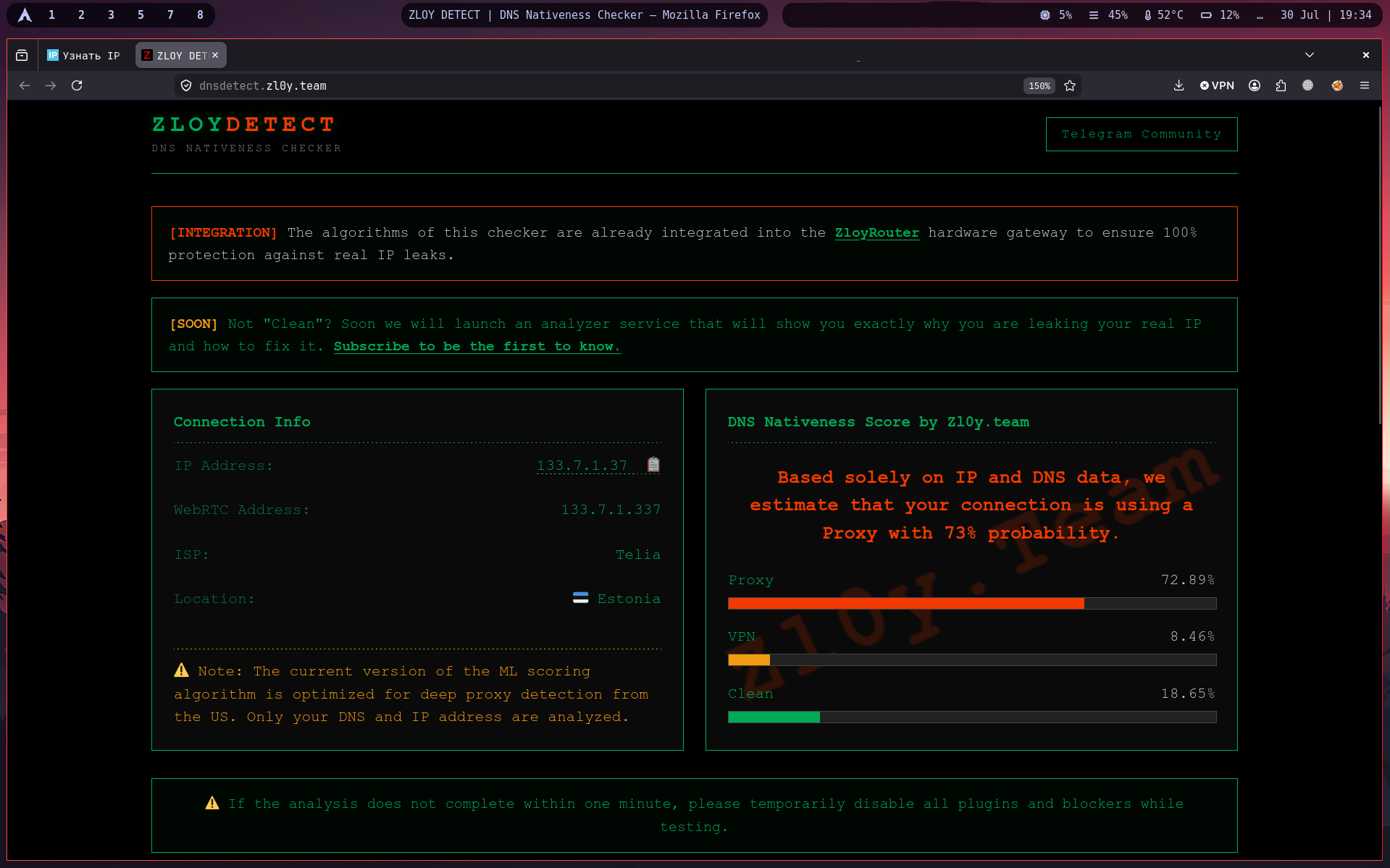
How it works:
Previously, such solutions were available only to large enterprises. After half a year of research based on >30 million real fingerprints, we have created a dynamically evolving correlation matrix.
The algorithm analyzes 170 parameters, runs them through >2.5 million rules, and answers a single question: does your DNS match the average clean fingerprint in the US?
The system outputs a mathematical probability:
Go to the site and check your daily consumables. If the DNS is subpar and the scoring confidently points to "Proxy" — it's up to you to decide whether to continue working with such a Proxy or not.
Spoiler: If you see the coveted "Clean" — don't flatter yourself. Your DNS settings might be fine, but our internal anti-fraud system is still capable of recognizing the use of an anti-detect browser or a virtual machine...
If you run this against your own proxies, drop the results here — genuinely curious how consistent this holds up across different providers and geos, especially results that don't match what I've seen.
P.S. The tool is free, no registration required, and we continue to develop and improve it
Companies detect Proxies and VPNs by just two basic parameters - IP and DNS. And while everyone has already learned to check the former against blacklists, DNS settings still remain a complete mystery to many.
The reality is that anti-fraud systems (Cloudflare, Stripe, Amazon...) know perfectly well what DNS resolvers, EDNS Client Subnet (ECS), and various latencies should look like for a legitimate user. But for some reason, sellers do not always pay due attention to proper DNS configuration. We regularly see situations where a client is sold an expensive US IP, but their resolvers route through Indonesia (and this happens even with top providers).
There was a time when checking IPs for cleanliness became standard practice. It is time to push for a new standard - DNS checking.
The Zloy.Team presents a FREE tool for deep analysis of DNS fingerprints.
ZLOY DETECT | DNS Nativeness Checker:https://dnsdetect.zl0y.team/
How it works:
Previously, such solutions were available only to large enterprises. After half a year of research based on >30 million real fingerprints, we have created a dynamically evolving correlation matrix.
The algorithm analyzes 170 parameters, runs them through >2.5 million rules, and answers a single question: does your DNS match the average clean fingerprint in the US?
The system outputs a mathematical probability:
- Clean (real native user)
- VPN (including server gateways)
- Proxy
Go to the site and check your daily consumables. If the DNS is subpar and the scoring confidently points to "Proxy" — it's up to you to decide whether to continue working with such a Proxy or not.
Spoiler: If you see the coveted "Clean" — don't flatter yourself. Your DNS settings might be fine, but our internal anti-fraud system is still capable of recognizing the use of an anti-detect browser or a virtual machine...
If you run this against your own proxies, drop the results here — genuinely curious how consistent this holds up across different providers and geos, especially results that don't match what I've seen.
P.S. The tool is free, no registration required, and we continue to develop and improve it


