

- Joined
- Dec 30, 2024
- Messages
- 430
- Reaction score
- 219
- Points
- 62
- Website
- blackhatpakistan.net
- Points
- 1,353
- USD
- 1,353
Money mule meaning, exact: a person who receives fraudulently obtained funds into their own bank account — or an account they control — and transfers or withdraws them onward, taking a cut for the service. The mule is the human layer of the cashout pipeline: the bridge between stolen funds sitting in a compromised account (or delivered as fraudulent transfers) and landed money in the criminal operator's hands. Mules arrive through three recruitment paths: romance and job scams (fake "financial agent" or "payment processing specialist" roles advertised on job boards and dating apps, where the victim genuinely believes the work is legal), direct criminal recruitment (dark-web and Telegram postings for "account rental" or "money transfer work" with crypto or transfer compensation), and coercion (identity-theft victims whose own accounts are opened or compromised and used as mules without their knowledge — the "money mule account means" query often comes from exactly this confused victim trying to figure out why their account received a police notice). This is the money mule meaning master guide in 2026: what the term covers (mule vs drop vs money transmitter), the recruitment funnels with their real economics, the legal exposure on the mule's side (money laundering, structuring, wire fraud conspiracy — felony-level in most jurisdictions), how banks detect mule accounts (behavioral baselines, inbound-from-many-outbound-to-few graphs, rapid-dispersal patterns), and the beginner questions in English, Hindi, and Urdu that bring most searchers to this page — including "money mule kya hota hai" from South Asian job seekers targeted by these exact recruitment funnels. Post your recruitment-story diagnosis — cleanest funnel breakdown gets pinned to cashout-method, first fifteen get the job-scam red-flag sheet via PM.
TL;DR - Money mule = person moving fraud proceeds through their own bank account for a cut (typically 5-20% of transferred volume, "commissions" of $200-$2000 per transfer in job-scam variants). Three recruitment funnels: (1) ROMANCE/JOB SCAMS — fake "financial company" hiring "payment agents" or "transfer specialists"; victim applies thinking it's legitimate remote work; first transfers feel like normal business payments; commission payments build trust before larger volumes arrive; the "employer" is a fraud operator cashing out stolen funds through the victim's account; (2) DIRECT CRIMINAL RECRUITMENT — Telegram/dark-web postings for "account rental", "US/UK account needed", crypto-compensated transfer work; recruit knows the work is illegal, accepts the risk for the pay; (3) COERCION/EXPLOITATION — identity-theft victims whose accounts are opened via synthetic identity or taken over via ATO, used as mule accounts without the real person's knowledge; often surfaces as the victim receiving fraud alerts, freezes, or police notices about transactions they never made. Legal exposure (mule side): money laundering (processing proceeds of crime), structuring (splitting transfers under reporting thresholds), wire fraud conspiracy (moving funds that crossed state/national lines as part of a fraud scheme) — felony charges in US/UK/EU jurisdictions, prison sentences typically 1-5 years for first-time mules in documented cases, permanent banking-access damage (ChexSystems negative marks, account closures). Detection (bank side): inbound-from-many-outbound-to-few account graphs (real customers receive from few sources and pay many bills; mules receive from many fraud sources and drain to few destinations), rapid-dispersal patterns (funds arrive and leave within 24-48 hours at near-equal amounts), behavioral baseline breaks (sudden volume spike on a thin/new account), and cross-bank information sharing (freeze notifications propagate through KYC networks when one bank flags a mule account — the farm-collapse cascade documented in Bank Drop Operations 2026). The detection graphs join across ACCOUNTS and TIME, which is why mule farms die when one holder gets a visit and names the instruction chain.
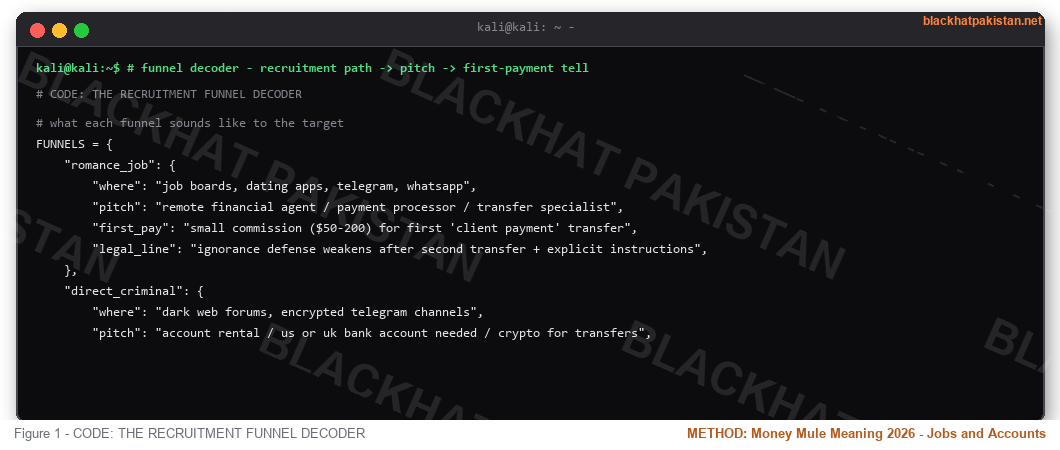
CODE: THE RECRUITMENT FUNNEL DECODER
Maps each recruitment funnel to its tells: where it appears, what the pitch sounds like, what the first payment feels like, and where the legal line crosses from "confused employee" to "knowing participant". Decodes the job-scam language job seekers actually encounter.
Code:
# funnel decoder - recruitment path -> pitch -> first-payment tell

# what each funnel sounds like to the target

FUNNELS = {

    "romance_job": {

        "where": "job boards, dating apps, telegram, whatsapp",

        "pitch": "remote financial agent / payment processor / transfer specialist",

        "first_pay": "small commission ($50-200) for first 'client payment' transfer",

        "legal_line": "ignorance defense weakens after second transfer + explicit instructions",

    },

    "direct_criminal": {

        "where": "dark web forums, encrypted telegram channels",

        "pitch": "account rental / us or uk bank account needed / crypto for transfers",

        "first_pay": "crypto payment upfront or percentage per transfer, negotiable",

        "legal_line": "knowing participation from day one - highest exposure tier",

    },

    "coercion_ato": {

        "where": "no recruitment - account opened/taken over via identity theft",

        "pitch": "none - victim unaware until freeze or police notice arrives",

        "first_pay": "none - account receives fraud proceeds without owner action",

        "legal_line": "victim, not participant - but must prove non-involvement actively",

    },

}

def decode(f):

    d = FUNNELS[f]

    print("  ---- %s ----" % f.upper())

    for k in ("where", "pitch", "first_pay", "legal_line"):

        print("    %-11s %s" % (k, d[k]))

for f in ["romance_job", "direct_criminal", "coercion_ato"]:

    decode(f)
THE LEGAL EXPOSURE STACK
- Money laundering statutes — processing funds known or reasonably suspected to be criminal proceeds; the charge does not require the mule to know the SPECIFIC fraud (drug money, stolen funds, and scam proceeds all launder the same way in the eyes of the statute); "I didn't know what it was" weakens sentencing, not the charge itself.
- Structuring — splitting transfers into multiple sub-threshold amounts ($10,000 CTR line in the US, equivalent thresholds elsewhere) to avoid bank reporting; the job-scam script that instructs "send $9,500 per transfer" is structuring instruction, and the instruction itself is evidence of knowledge.
- Wire fraud conspiracy — moving funds that crossed state or national lines as part of a fraud scheme; conspiracy charges reach every participant in the chain who shared intent, which is why the mule who "just moved money for a friend" gets charged alongside the organizer when intent can be shown.
- Banking-access destruction — even where charges do not stick (insufficient evidence, cooperating witness pleas), ChexSystems negative records, account closures, and KYC blacklisting follow the person for 5-7 years; opening a new account after a mule-flag closure requires second-chance banking at fee-heavy institutions; the practical punishment outlasts the legal one for many first-time mules.
- Coercion victims — identity-theft victims whose accounts were used without knowledge occupy a different legal posture (victim, not participant) but must actively prove non-involvement: filing police reports, identity-theft affidavits (FTC IdentityTheft.gov in the US), and account-closure paper trails; passivity while the account continues receiving fraud proceeds erodes the victim defense.
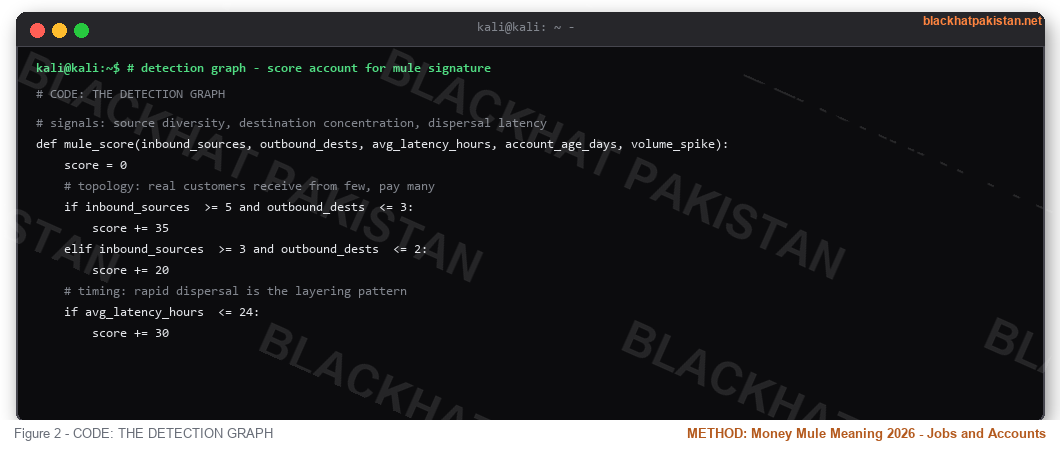
CODE: THE DETECTION GRAPH
Two account-graph signatures that catch mule accounts: inbound-many-outbound-few topology (real customers vs mules), and rapid-dispersal timing (funds-in-to-funds-out latency). Scores an account's mule-likelihood from its transaction graph shape and timing.
Code:
# detection graph - score account for mule signature

# signals: source diversity, destination concentration, dispersal latency

def mule_score(inbound_sources, outbound_dests, avg_latency_hours, account_age_days, volume_spike):

    score = 0

    # topology: real customers receive from few, pay many

    if inbound_sources  >= 5 and outbound_dests  <= 3:

        score += 35

    elif inbound_sources  >= 3 and outbound_dests  <= 2:

        score += 20

    # timing: rapid dispersal is the layering pattern

    if avg_latency_hours  <= 24:

        score += 30

    elif avg_latency_hours  <= 72:

        score += 15

    # thin accounts carrying volume

    if account_age_days  < 60 and volume_spike:

        score += 20

    if volume_spike:

        score += 15

    if score  >= 60:

        verdict = "HIGH - likely mule, escalate review"

    elif score  >= 30:

        verdict = "WATCH - topology or timing anomalous"

    else:

        verdict = "NORMAL - within customer envelope"

    return score, verdict

cases = [

    ("acct_alpha", 8, 2, 12, 45, True),

    ("acct_bravo", 2, 9, 48, 400, False),

    ("acct_charl", 3, 2, 60, 30, True),

]

for aid, src, dst, lat, age, spike in cases:

    s, v = mule_score(src, dst, lat, age, spike)

    print("  %-10s score=%-4s %s" % (aid, s, v))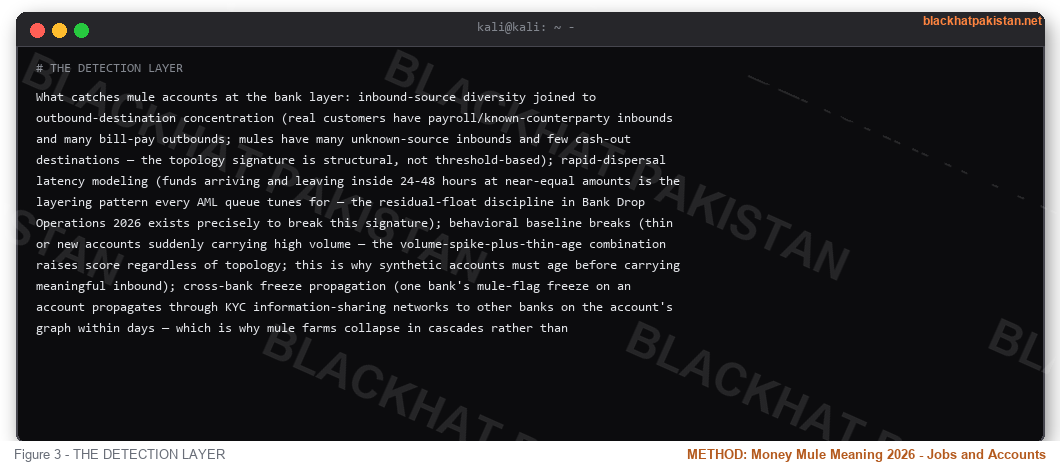
THE DETECTION LAYER
What catches mule accounts at the bank layer: inbound-source diversity joined to outbound-destination concentration (real customers have payroll/known-counterparty inbounds and many bill-pay outbounds; mules have many unknown-source inbounds and few cash-out destinations — the topology signature is structural, not threshold-based); rapid-dispersal latency modeling (funds arriving and leaving inside 24-48 hours at near-equal amounts is the layering pattern every AML queue tunes for — the residual-float discipline in Bank Drop Operations 2026 exists precisely to break this signature); behavioral baseline breaks (thin or new accounts suddenly carrying high volume — the volume-spike-plus-thin-age combination raises score regardless of topology; this is why synthetic accounts must age before carrying meaningful inbound); cross-bank freeze propagation (one bank's mule-flag freeze on an account propagates through KYC information-sharing networks to other banks on the account's graph within days — which is why mule farms collapse in cascades rather than account-by-account); and the visit cascade (investigators visit the mule holder — the human in the chain — and the interview names the instruction chain, collapsing the farm; synthetic accounts have no human to visit, which is their structural advantage over mule operations; this is the same cascade dynamic documented in Bank Drop Operations 2026's retirement-clock discipline). The entire detection apparatus runs on graph joins across accounts, counterparties, and time windows — every OPSEC rule in the mule context exists to break a different join edge.
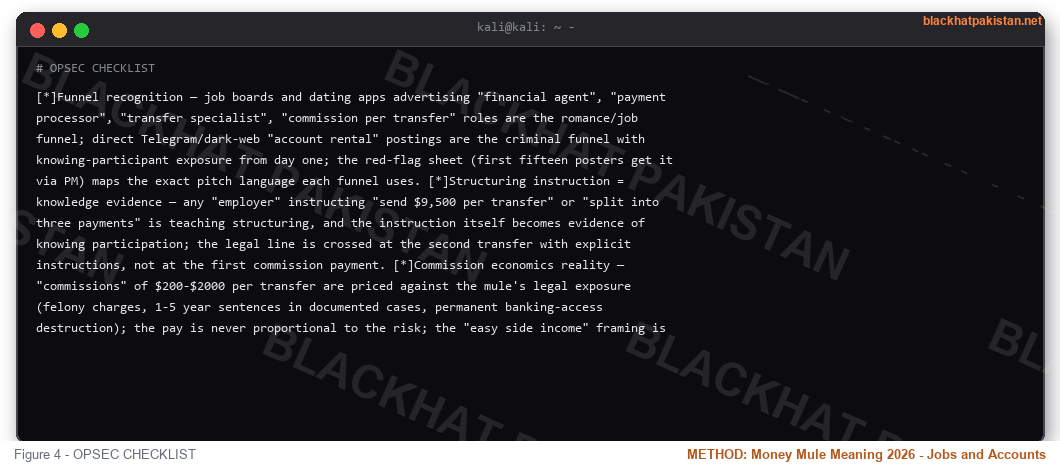
OPSEC CHECKLIST
- Funnel recognition — job boards and dating apps advertising "financial agent", "payment processor", "transfer specialist", "commission per transfer" roles are the romance/job funnel; direct Telegram/dark-web "account rental" postings are the criminal funnel with knowing-participant exposure from day one; the red-flag sheet (first fifteen posters get it via PM) maps the exact pitch language each funnel uses.
- Structuring instruction = knowledge evidence — any "employer" instructing "send $9,500 per transfer" or "split into three payments" is teaching structuring, and the instruction itself becomes evidence of knowing participation; the legal line is crossed at the second transfer with explicit instructions, not at the first commission payment.
- Commission economics reality — "commissions" of $200-$2000 per transfer are priced against the mule's legal exposure (felony charges, 1-5 year sentences in documented cases, permanent banking-access destruction); the pay is never proportional to the risk; the "easy side income" framing is the funnel's core deception.
- Coercion-victim protocol — if your account received fraud proceeds you never authorized: file police report immediately, file identity-theft affidavit (FTC IdentityTheft.gov in US, local equivalents elsewhere), close the account with paper trail, document every step; passivity while the account continues receiving fraud proceeds erodes the victim defense; the mule-score graph above is what the bank is running against your account while you decide whether to act.
- Graph-break discipline (operator side) — if running drop accounts rather than recruiting humans: synthetic accounts age before volume (behavioral baseline), inbound-velocity stays under envelope, dispersal stays asymmetric with residual float, retirement clocks run before reversal windows — every rule from Bank Drop Operations 2026 exists to keep the account graph from looking like the mule-signature topology above; human mules add the visit-cascade risk that synthetic farms structurally avoid.
TEST YOURSELF: SIX QUESTIONS
Score honestly: (1) money mule meaning in one sentence — what does the mule do, and what does the typical cut look like? (2) name the three recruitment funnels and the one pitch phrase that identifies the romance/job funnel. (3) legal: why does "I didn't know what it was" weaken sentencing but not the money-laundering charge itself? (4) structuring: why is the instruction "send $9,500 per transfer" itself evidence of knowledge? (5) detection graph: what topology (inbound sources vs outbound destinations) separates a mule account from a real customer's account structurally? (6) coercion victim: what three actions preserve the victim defense, and what does passivity do to it? Zero to one: you read the TL;DR and can define money mule in one sentence. Two to three: you can decode all three funnels and run the mule-score function on a sample account. Four plus: you can explain why the visit cascade collapses farms and how synthetic-drop discipline differs structurally — post your diagnosis.
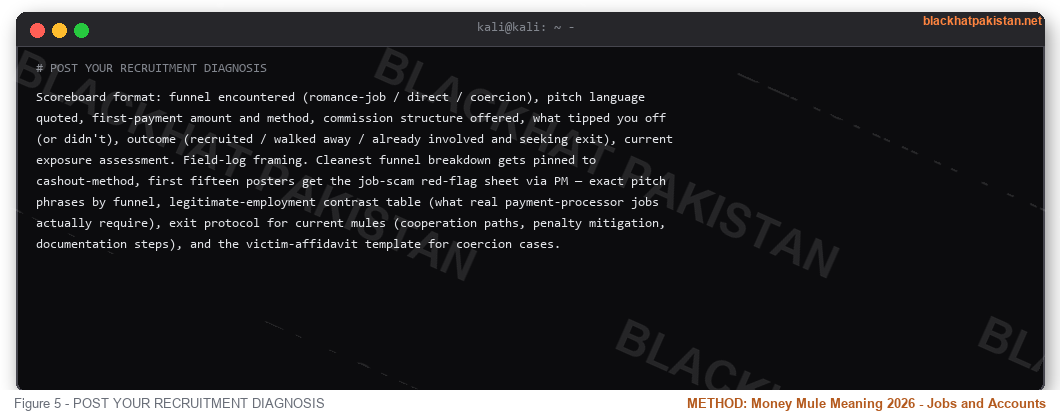
POST YOUR RECRUITMENT DIAGNOSIS
Scoreboard format: funnel encountered (romance-job / direct / coercion), pitch language quoted, first-payment amount and method, commission structure offered, what tipped you off (or didn't), outcome (recruited / walked away / already involved and seeking exit), current exposure assessment. Field-log framing. Cleanest funnel breakdown gets pinned to cashout-method, first fifteen posters get the job-scam red-flag sheet via PM — exact pitch phrases by funnel, legitimate-employment contrast table (what real payment-processor jobs actually require), exit protocol for current mules (cooperation paths, penalty mitigation, documentation steps), and the victim-affidavit template for coercion cases.
FAQ
- Q: Money mule kya hota hai (Hindi)?
A: "Money mule" matlab hai jo apne bank account mein fraude se prapt funds receive karta hai aur unhe aage transfer ya withdraw karta hai, apna commission (cut) lekar. Yeh kaam bank fraud, money laundering aur structuring ke under aata hai — India mein bhi serious jurm hai (PMLA Act, IT Act). Job scams mein logon ko "payment agent" bana kar use kiya jata hai; pehle chhote commission, phir bade amounts.
- Q: Money mule meaning in Urdu?
A: "Money mule" ka matlab hai jo banda apne bank account mein fraude ke paise receive karta hai aur unhe transfer karke apna commission leta hai. Yeh activity money laundering aur bank fraud hai — har mumalik mein jurm. Job scams mein "financial agent" ya "transfer specialist" keh kar logon ko is kaam mein phasaya jata hai; pehle chhote commission se bharosa banaya jata hai.
- Q: Is a money mule the same as a money launderer?
A: Functionally overlapping — the mule is the ACCOUNT-HOLDER layer of a laundering operation; the launderer framing usually implies the organizer moving larger volumes through layered accounts; the mule is the disposable human node whose account gets flagged and frozen first; statutes charge both under money-laundering law, with the organizer facing conspiracy-organizer enhancements and the mule facing base charges (plus structuring if sub-threshold splits were instructed).
- Q: Can I get in trouble if I "didn't know" the money was stolen?
A: The money-laundering charge does not require knowing the SPECIFIC source fraud — "reasonable suspicion" suffices in most jurisdictions, and the "financial agent" job framing is designed to manufacture plausible deniability while the structuring instructions (split amounts, specific timing) manufacture the knowledge evidence; ignorance weakens sentencing where cooperation is real, but the charge itself stands on the willful-blindness standard many prosecutors apply.
- Q: How do banks actually detect mule accounts?
A: Graph topology (inbound-from-many-outbound-to-few), rapid-dispersal latency (funds in and out inside 24-48 hours), thin-account volume spikes, and cross-bank freeze propagation — the mule-score function above is a simplified version of what AML teams run; the signals join across accounts and time windows, which is why mule farms collapse in cascades when one holder gets visited and names the chain.
- Q: What should a coercion victim do first?
A: File police report immediately, file identity-theft affidavit (FTC IdentityTheft.gov in US, local cybercrime equivalents elsewhere), close the account with documentation, and preserve every communication showing you never authorized the account activity; the victim defense requires ACTIVE proof-building — passivity while fraud proceeds continue flowing through your account erodes it fast; the bank's mule-score graph does not care about your story unless the paper trail supports it.
RELATED
Money Mule Networks Explained
Bank Drop Operations 2026 - Account Lifecycle
Cashout Pipeline 2026: Material to Landed Money
Structuring Explained 2026


