

- Joined
- Dec 30, 2024
- Messages
- 401
- Reaction score
- 209
- Points
- 62
- Website
- blackhatpakistan.net
- Points
- 1,208
- USD
- 1,208
A data breach is the confirmed unauthorized access, acquisition, or disclosure of protected information - and IBM's 2025 Cost of a Data Breach Report puts the global average price of one at USD 4.44 million, with the United States averaging USD 10.22 million, the highest of any country for the fifteenth year running. It is not a warning, not a near-miss, not a vulnerability sitting unexploited: data moved somewhere it was never supposed to move, and someone who should not have seen it did.
TL;DR - A breach starts with credentials, phishing, misconfiguration, or a third party - Verizon's DBIR keeps stolen credentials and social engineering at the top of the action list every cycle. Detection speed decides cost: incidents identified and contained in under 20 days run roughly half the price of ones dragging past 200 days. Your first 72 hours are contain, scope, preserve evidence, then notify - GDPR's clock is 72 hours to the supervisory authority, HIPAA gives 60 days to individuals, US public companies have 4 business days for material incidents. Prevention is boring on purpose: MFA everywhere, least privilege, encrypted stores with managed keys, secret scanning in CI, and vendor review before they touch your data.
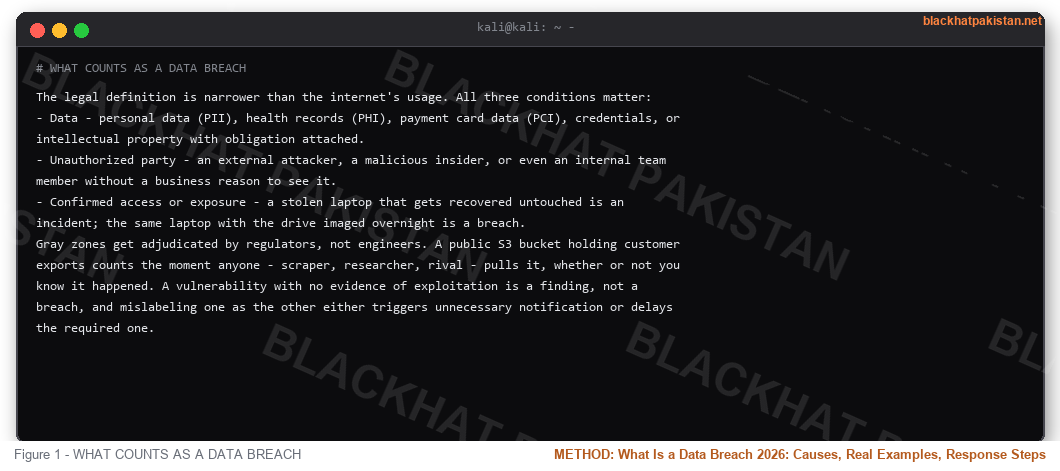
WHAT COUNTS AS A DATA BREACH
The legal definition is narrower than the internet's usage. All three conditions matter:
- Data - personal data (PII), health records (PHI), payment card data (PCI), credentials, or intellectual property with obligation attached.
- Unauthorized party - an external attacker, a malicious insider, or even an internal team member without a business reason to see it.
- Confirmed access or exposure - a stolen laptop that gets recovered untouched is an incident; the same laptop with the drive imaged overnight is a breach.
Gray zones get adjudicated by regulators, not engineers. A public S3 bucket holding customer exports counts the moment anyone - scraper, researcher, rival - pulls it, whether or not you know it happened. A vulnerability with no evidence of exploitation is a finding, not a breach, and mislabeling one as the other either triggers unnecessary notification or delays the required one.
HOW BREACHES ACTUALLY HAPPEN
Fourteen years of incident data keeps producing the same short list. The mechanics, in rough order of frequency:
- Stolen credentials - phishing, infostealer logs, credential stuffing against reused passwords. Attackers log in; nothing alarms, because it is a valid login.
- Phishing and business email compromise - the human layer again, this time with a link, an invoice, or a MFA fatigue prompt.
- Misconfiguration - public storage buckets, open databases, default credentials on appliances, debug endpoints left in production.
- Unpatched edge systems - VPN concentrators, mail gateways, and firewalls with known exploits and a change window that keeps slipping.
- Supply chain - a trusted vendor, library, or managed service provider becomes the door. MOVEit and the Snowflake customer incidents both worked this way.
- Insider action - negligence counts. The export to a personal drive, the admin account shared "just for now," the contractor whose access was never revoked.
The through-line: almost none of these are zero-days. They are control failures - identity, configuration, patching, vendor governance - repeating in public for years.
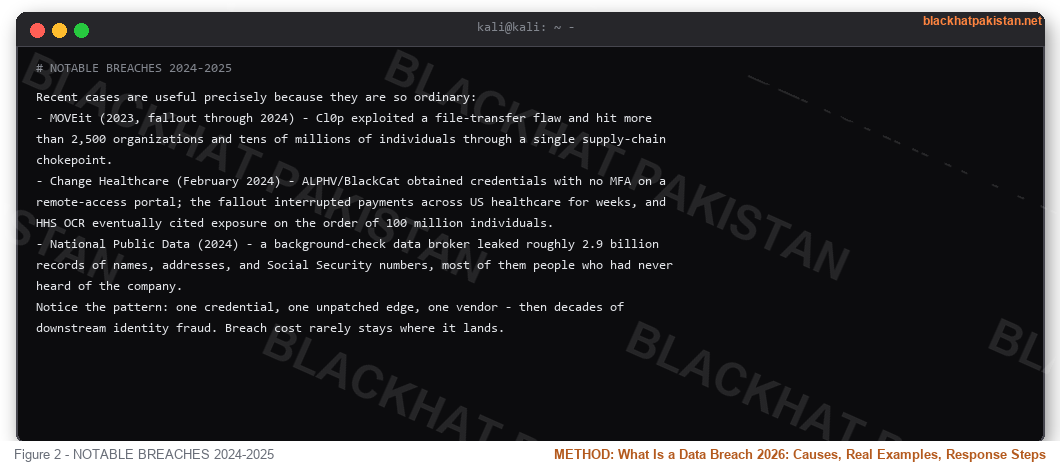
NOTABLE BREACHES 2024-2025
Recent cases are useful precisely because they are so ordinary:
- MOVEit (2023, fallout through 2024) - Cl0p exploited a file-transfer flaw and hit more than 2,500 organizations and tens of millions of individuals through a single supply-chain chokepoint.
- Change Healthcare (February 2024) - ALPHV/BlackCat obtained credentials with no MFA on a remote-access portal; the fallout interrupted payments across US healthcare for weeks, and HHS OCR eventually cited exposure on the order of 100 million individuals.
- National Public Data (2024) - a background-check data broker leaked roughly 2.9 billion records of names, addresses, and Social Security numbers, most of them people who had never heard of the company.
Notice the pattern: one credential, one unpatched edge, one vendor - then decades of downstream identity fraud. Breach cost rarely stays where it lands.
WHAT DATA ATTACKERS WALK AWAY WITH
The dataset decides the damage, and the damage decides the clock:
- Credentials and session tokens - the raw material for the next breach; treat any password dump as live until rotated.
- Government identifiers - Social Security numbers, national IDs: no expiration, no rotation, permanent fraud exposure.
- Health data - diagnoses, treatments, insurance IDs: highest notification severity in most frameworks, and the most sensitive to extortion.
- Payment data - card numbers with CVV trigger PCI DSS forensic requirements even when nothing else was touched.
- Communications - email threads and internal chat give attackers context for perfect business email compromise.
- Source code and trade secrets - no consumer notification at all, which is why these sit lower on the breach stats than they should.
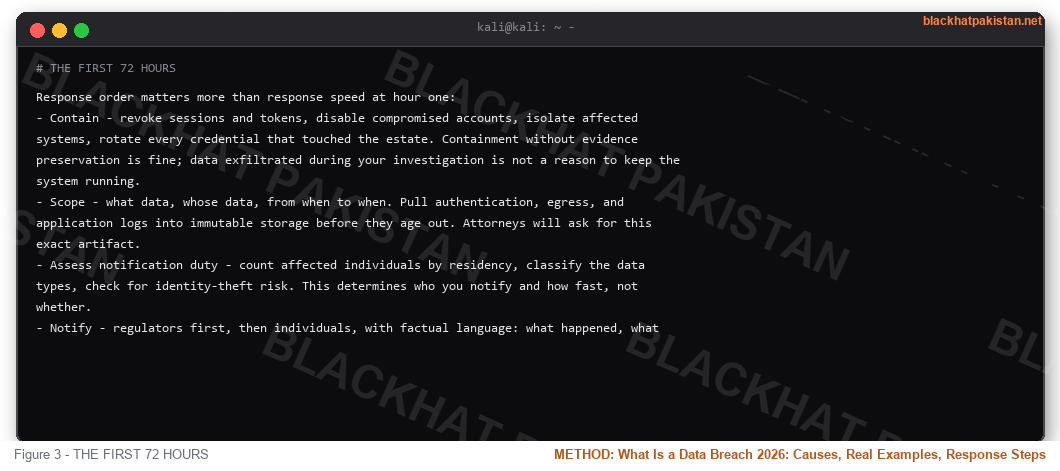
THE FIRST 72 HOURS
Response order matters more than response speed at hour one:
- Contain - revoke sessions and tokens, disable compromised accounts, isolate affected systems, rotate every credential that touched the estate. Containment without evidence preservation is fine; data exfiltrated during your investigation is not a reason to keep the system running.
- Scope - what data, whose data, from when to when. Pull authentication, egress, and application logs into immutable storage before they age out. Attorneys will ask for this exact artifact.
- Assess notification duty - count affected individuals by residency, classify the data types, check for identity-theft risk. This determines who you notify and how fast, not whether.
- Notify - regulators first, then individuals, with factual language: what happened, what data, what you are doing, what they should do. Law enforcement coordination when extortion is in play.
- Fix forward - the vulnerability that opened the door gets a change ticket with an owner and a date, not a paragraph in the postmortem.
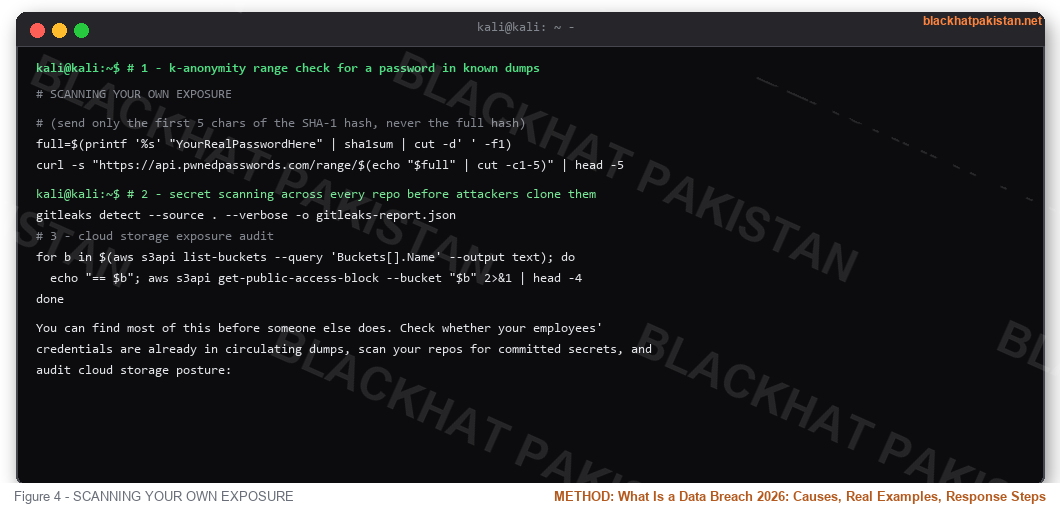
SCANNING YOUR OWN EXPOSURE
You can find most of this before someone else does. Check whether your employees' credentials are already in circulating dumps, scan your repos for committed secrets, and audit cloud storage posture:
Code:
# 1 - k-anonymity range check for a password in known dumps

# (send only the first 5 chars of the SHA-1 hash, never the full hash)

full=$(printf '%s' "YourRealPasswordHere" | sha1sum | cut -d' ' -f1)

curl -s "https://api.pwnedpasswords.com/range/$(echo "$full" | cut -c1-5)" | head -5
Code:
# 2 - secret scanning across every repo before attackers clone them

gitleaks detect --source . --verbose -o gitleaks-report.json

# 3 - cloud storage exposure audit

for b in $(aws s3api list-buckets --query 'Buckets[].Name' --output text); do

  echo "== $b"; aws s3api get-public-access-block --bucket "$b" 2>&1 | head -4

done
Run the password range check against your organization's common test passwords, wire gitleaks into CI so commits with keys fail the build, and make the cloud audit a weekly cron instead of a quarterly panic. Three commands, most of the preventable surface.
REGULATORY CLOCK: WHO YOU MUST TELL AND WHEN
Notification obligations stack - you usually owe more than one regulator:
- GDPR - notify the supervisory authority within 72 hours of becoming aware, with documentation justifying any delay; notify affected individuals without undue delay when risk to rights and freedoms is high.
- HIPAA - notify affected individuals without unreasonable delay and no later than 60 days; media notice at that threshold for stateside breaches over 500 residents; HHS gets 60 days for 500+ or annual for smaller.
- US state laws - all 50 states have notification statutes, typically 30-60 days to residents, some requiring attorney general notice at volume.
- SEC - US public companies disclose material cybersecurity incidents on Form 8-K within four business days of determining materiality.
Missed deadlines are a second incident on top of the first. Calendar these the moment a breach is confirmed, not when the investigation closes.
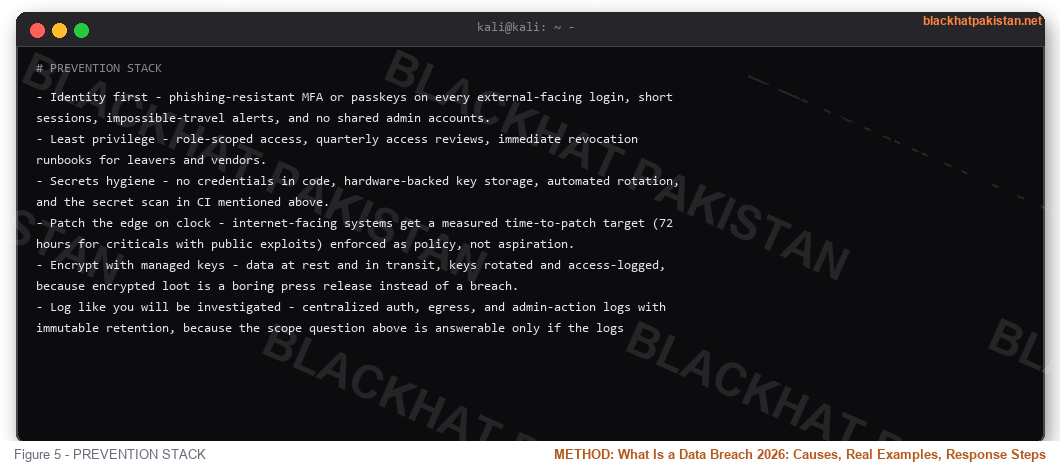
PREVENTION STACK
- Identity first - phishing-resistant MFA or passkeys on every external-facing login, short sessions, impossible-travel alerts, and no shared admin accounts.
- Least privilege - role-scoped access, quarterly access reviews, immediate revocation runbooks for leavers and vendors.
- Secrets hygiene - no credentials in code, hardware-backed key storage, automated rotation, and the secret scan in CI mentioned above.
- Patch the edge on clock - internet-facing systems get a measured time-to-patch target (72 hours for criticals with public exploits) enforced as policy, not aspiration.
- Encrypt with managed keys - data at rest and in transit, keys rotated and access-logged, because encrypted loot is a boring press release instead of a breach.
- Log like you will be investigated - centralized auth, egress, and admin-action logs with immutable retention, because the scope question above is answerable only if the logs survived.
FAQ
- Q: How do I know if my data was in a breach?
A: Check the affected company's official notice, then search your email against a reputable breach-notification service and reset any password that reappears - breaches like National Public Data mean millions of people were exposed without ever being a customer.
- Q: Is a ransomware attack automatically a data breach?
A: If data was exfiltrated before encryption - which modern double-extortion groups do routinely - yes, it is a breach with full notification duties even if every file was later restored from backup.
- Q: Do small companies get breached?
A: Per-incident cost does not scale down nicely: IBM's report shows smaller organizations average proportionally higher costs relative to revenue, and supply-chain breaches make any vendor a target regardless of size.
- Q: How long does a breach investigation take?
A: Weeks to months for scoping large estates; the notification clocks above start from awareness of the breach, not from the end of the investigation, so parallel workstreams are mandatory.
- Q: Should we pay the ransom?
A: Payment neither guarantees deletion nor removes notification obligations, and sanctions rules can prohibit it when extortionists are listed - legal counsel and law enforcement belong in that decision on day one.
RELATED
Password Leak Check
How to Spot Phishing Emails 2026
Vulnerability Assessment 2026
OWASP Top 10 2026


