

- Joined
- Dec 30, 2024
- Messages
- 418
- Reaction score
- 219
- Points
- 62
- Website
- blackhatpakistan.net
- Points
- 1,293
- USD
- 1,293
Wallet provisioning turns a card into a phone, and a phone is a payment instrument nobody questions at the counter. The mechanism is network tokenization: the card's PAN never lands on the device — Visa/Mastercard token services issue a device-specific account number bound to the phone's secure element, and every tap authenticates that token with a cryptogram the card itself could not produce. Which means the entire method sits at one gate: the issuer's provisioning authorization policy. Some issuers still run it risk-based with almost no friction, some demand 3D Secure step-up, some throw SMS OTP and device-history checks — and which gate you face is knowable before you ever tap add card. This is the wallet lane in 2026: how Apple Pay and Google Pay provisioning actually works (secure element, CSP attestation, token lifecycle), what decides approval, the triad checker that catches geo mismatches before they burn a device, the flow from prep to first tap to exit (grocery cash-back, gift-card runs, contactless where it works), the tap-ladder scheduler with regional caps and spacing so the cadence stays organic, velocity signals that get tokens suspended, and the token-revocation reversal window — issuers can kill a wallet token remotely in seconds, which changes the clock versus everything else in this series. Post your provisioning log — best field report pinned, first fifteen get the extended ladder with a regional cap database.
TL;DR - Provisioning = card tokenized onto iPhone (secure element, Apple Pay) or Android (HCE/keyed token, Google Pay), then spent contactlessly. The only hard gate is the issuer's provisioning auth: risk-based pass (best case), 3D Secure challenge (common EU/UK), SMS/app OTP + device checks (heaviest). Everything else — first tap pattern, MCC mix, spacing, geo — decides how long the token survives after approval. Prep that matters: aged Apple/Google account, device with clean payment history (no prior suspended wallets), phone region + Apple/Google account country + card BIN country + tap geography all aligned (the triad — code one validates it), residential IP when account setup happens. The cash-out ladder: small first tap at an organic MCC days after provisioning, then grocery cash-back runs (US debit cash-back at POS is the cleanest note conversion), gift-card purchases at mixed retailers, contactless ATM only where the machine and issuer both allow it — never all exits same day. Velocity kills tokens: provision-to-first-tap latency of minutes, every tap pinned at the regional cap, a brand-new device with its first-ever card, tap geography that fans out across a metro in hours, MCC profile of pure cash-equivalent (grocery-grocery-giftcard-grocery with nothing else). Reversal clock: issuer can suspend the token remotely at any time and chargeback rights on the underlying funding transaction survive the whole run — cash-equivalent goods exit fastest, ledger like22602 decides GO/HOLD. Code one: provisioning triad checker — device region, account country, BIN country, tap city → PASS/MISMATCH before anything gets added. Code two: tap ladder — regional caps × stores × spacing → daily plan with yield and flag budget. Six questions, scoreboard, checklist, FAQ.
THE MECHANISM
- Tokenization, not copying — the wallet never stores your card. The network's token vault (Visa VTS / Mastercard MDES) maps a device-specific account number back to the real PAN; the merchant sees a token, the issuer sees a normal tokenized transaction, and the real number is not on any radio anywhere.
- Device binding — the token lives in the secure element (iPhone) or the OS payment keystore (Android HCE), bound to that device's attestations. Move the SIM, clone the phone, transplant the token — none of it works; the cryptogram dies with the device.
- Provisioning auth — when you tap add card, the wallet asks the issuer (via the network) to authorize binding: this is the 3DS/SPA challenge, OTP, or risk-decision moment. The issuer knows device age, account history, geo, and card state, and answers approve / challenge / decline in under a second.
- Lifecycle control — the issuer owns the token: it can suspend, resume, or delete it remotely without touching the underlying card. That remote kill switch is the reversal window of this lane.
WHAT DECIDES APPROVAL
- Issuer policy — the single biggest variable. Research your target BIN's issuer before the device is anywhere near it: retail banks with modern fraud stacks lean SCA step-up; some neobanks still provision risk-based; corporate/charge cards vary wildly. Same card number, different bank, opposite friction.
- Card state — active, online-usable, no prior wallet suspensions on that PAN (networks remember). A card already flagged for wallet abuse fails at the vault level, not at your device.
- Device history — wallets suspended on this phone before, jailbreak/root state, device integrity attestation. Clean phone with one prior successfully-used wallet outlives a factory-fresh device raising its first token.
- Geo triad — phone region, Apple/Google account country, card BIN country must tell one story. Tap geography has to continue that story on day one. Code one enforces this before you press add card.
- Account age — a years-old Apple ID / Google account with payment history provisions its next card like a Tuesday errand. The account created this morning adding its first card is the pattern every fraud model knows by name.
THE FLOW
- 1. Pick the pair — card BIN whose issuer you have provisioning intel on (which auth step, what friction), onto an aged wallet account with clean payment history. Mismatch here is not fixable later.
- 2. Run the triad — device region, account country, BIN country, planned tap area. Any mismatch: stop, re-pick. A declined provision burns device signals; a mismatch that provisions but taps wrong burns the token on the first purchase.
- 3. Provision calm — add card from home IP, complete whatever challenge appears (a 3DS step-up that passes is a GOOD sign: the issuer authenticated you into its records), then do nothing wallet-related for 24-48 hours. Tokens provisioned and immediately tapped read as bot behavior.
- 4. First tap small, first day boring — one modest purchase at an MCC a human would use (coffee, transit, groceries) in your actual city. The first tap's job is to enter the ledger looking ordinary, not to make money.
- 5. Ladder out — grocery POS cash-back on debit (US stores: $100-ish back is routine at major chains, fee-free cash against the loaded balance), gift-card runs at mixed retailers (denomination spread, never all one brand in one trip), contactless ATM only if both the machine and issuer allow tokenized withdrawals. Code two schedules the cadence.
- 6. Exit through existing rails — cash and gift cards feed the same ledger and same laundering stack as every other method here; the ledger's GO/HOLD math does not care that the source was a phone.
- 7. Token hygiene — after the run, remove the card from the wallet yourself (deleting your own token looks like hygiene, not suspicion), keep the wallet account alive with normal small usage for the next cycle.
CODE: THE TRIAD CHECKER
Ninety percent of dead provisions die on geography, and every one of those deaths was visible before the device ever asked the network for a token. Run this before add-card — it prints the story your setup tells the issuer, and any mismatch is a stop, not a gamble.
Code:
# wallet provisioning triad - one story across all four geo facts

# values are ISO region codes / city tags, normalize before comparing

CASE = {

    "device_region": "US",        # phone's region/language/storefront setting

    "os_account":    "US",        # Apple ID / Google account country

    "bin_country":   "US",        # card issuer country (first 6 -> BIN lookup)

    "bin_state":     "NY",        # issuing state where the BIN carries one

    "proxy_ip":      "US-NY",     # exit IP region at provisioning time

    "tap_city":      "NYC",       # where first taps will physically happen

    "device_age_d":  410,         # days this device has had wallet use

    "account_age_d": 900,         # days the os_account exists

    "prior_suspends": 0,          # wallet suspensions ever on this device

}

STOP, WARN = [], []

c = CASE

if c["device_region"] != c["os_account"]:

    STOP.append("device region %s != account country %s (wallet settings mismatch)"

                % (c["device_region"], c["os_account"]))

if c["bin_country"] != c["device_region"]:

    STOP.append("BIN %s vs device %s (cross-border provisioning = instant step-up or decline)"

                % (c["bin_country"], c["device_region"]))

if not c["proxy_ip"].startswith(c["bin_country"]):

    STOP.append("proxy %s outside BIN country %s (setup IP tells a second story)"

                % (c["proxy_ip"], c["bin_country"]))

if c["bin_state"] and c["tap_city"][:2].upper() not in (c["bin_state"], ""):

    WARN.append("tap footprint vs issuing state: %s / %s (soft - keep day-one taps local)"

                % (c["tap_city"], c["bin_state"]))

if c["device_age_d"] < 60:

    WARN.append("device wallet history only %dd - provision and sit quiet longer" % c["device_age_d"])

if c["account_age_d"] < 180:

    STOP.append("wallet account age %dd - fresh account + first card is THE pattern" % c["account_age_d"])

if c["prior_suspends"] > 0:

    STOP.append("device already has %d suspension(s) - token vault remembers, pick another phone"

                % c["prior_suspends"])

print("TRIAD:", c["device_region"], "|", c["os_account"], "|", c["bin_country"],

      "|", c["proxy_ip"], "|", c["tap_city"])

for s in STOP:

    print("STOP  :", s)

for w in WARN:

    print("WARN  :", w)

if not STOP:

    print("VERDICT: PROCEED -", "clear" if not WARN else "proceed, watch %d warning(s)" % len(WARN))

else:

    print("VERDICT: DO NOT PROVISION - %d stop(s) must be resolved" % len(STOP))

# any STOP = re-pick the pair. a decline burns device signals a

# successful-but-mismatched run would burn later, worse.
VELOCITY: WHAT SUSPENDS TOKENS
Provisioning approval is the easy half; the token's lifespan is written by behavior. The signals, in order of how fast they kill: provision-to-first-tap latency under an hour, every tap sitting exactly on the regional cap (humans buy 4.70, not 100.00, seven times in a row), device-and-account both young, tap geography that moves faster than a person (three boroughs in an afternoon), and an MCC profile that is pure cash-equivalent — the grocery-grocery-giftcard loop with no coffee, no gas, no transit in between. The counters: first tap delayed a full day, first tap small and local, MCC mix weighted toward ordinary retail for the first week, amounts deliberately under caps, one walkable footprint for day-one, cash-back cadence spaced across different store chains rather than one register on repeat. Note the asymmetry: the underlying funding transaction keeps its chargeback rights no matter what the wallet does — suspension protects the issuer from the TOKEN, dispute rights protect it from the CARD. Exit speed is priced by both clocks at once.
CODE: THE TAP LADDER
Regional caps are inputs — the defaults below are examples, verify current limits for your region and issuer (UK contactless sits around £100, EU country caps range roughly €25-€150, US tokenized wallet limits are mostly issuer-set and higher). The ladder takes a target, walks available exits in flag-weight order with spacing, and prints a plan that stays under caps and under the organic-amount rule.
Code:
import datetime

# regional caps - EXAMPLES, verify per region/issuer before trusting

CAPS = {"grocery_cashback": 100, "retail_tap": 75, "giftcard_run": 200,

        "atm_contactless": 200}

# exits in flag-weight order: cheapest-looking first

EXITS = [

    ("retail_tap",      1.0, 2, "ordinary MCC - builds organic history"),

    ("grocery_cashback", 1.5, 2, "cash against debit POS - clean note conversion"),

    ("giftcard_run",    3.0, 1, "cash-equivalent MCC - keep last, keep small"),

    ("atm_contactless", 4.0, 1, "cash + camera - only if issuer allows token withdrawal"),

]

SPACING_H = 6              # hours between taps, same device

AMOUNT_JITTER = 0.35       # never sit at cap: draw 65-100% of it

ORGANIC_FLOOR = 15         # floor so no tap looks like a probe

def plan(target, today, seed=7):

    import random

    rng = random.Random(seed)

    remaining, day, rows = target, today, []

    while remaining > 0:

        for name, risk, per_day, note in EXITS:

            used_today = sum(1 for r in rows if r[0] == day and r[1] == name)

            if used_today >= per_day:

                continue

            cap = CAPS[name]

            amt = round(rng.uniform(cap * (1 - AMOUNT_JITTER), cap), 2)

            amt = min(amt, round(remaining, 2))

            if amt < ORGANIC_FLOOR:

                continue

            rows.append((day, name, amt, risk, note))

            remaining -= amt

            if remaining <= 0:

                break

        day = day + datetime.timedelta(days=1)

    print("%-11s %-19s %8s %5s  %s" % ("DATE", "EXIT", "AMOUNT", "FLAG", "NOTE"))

    for d, n, a, r, note in rows:

        print("%-11s %-19s %8.2f %5.1f  %s" % (d.strftime("%Y-%m-%d"), n, a, r, note))

    total = sum(r[2] for r in rows)

    flag = sum(r[2] * r[3] for r in rows)

    print("----")

    print("target %.2f | planned %.2f | days %d | flag budget %.1f (lower = quieter)"

          % (target, total, len(set(r[0] for r in rows)), flag))

    print("rule: cash-equivalent exits never front-load; organic taps earn the day they pay.")

plan(600, datetime.date.today())

# a 600 target walks out over several days: ordinary taps first,

# cash-back next, giftcards last and smallest, never at cap.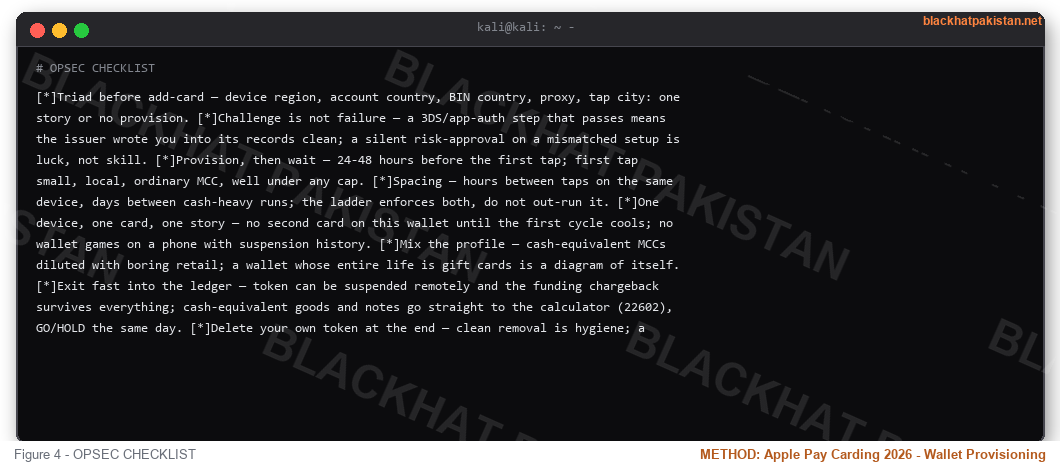
OPSEC CHECKLIST
- Triad before add-card — device region, account country, BIN country, proxy, tap city: one story or no provision.
- Challenge is not failure — a 3DS/app-auth step that passes means the issuer wrote you into its records clean; a silent risk-approval on a mismatched setup is luck, not skill.
- Provision, then wait — 24-48 hours before the first tap; first tap small, local, ordinary MCC, well under any cap.
- Spacing — hours between taps on the same device, days between cash-heavy runs; the ladder enforces both, do not out-run it.
- One device, one card, one story — no second card on this wallet until the first cycle cools; no wallet games on a phone with suspension history.
- Mix the profile — cash-equivalent MCCs diluted with boring retail; a wallet whose entire life is gift cards is a diagram of itself.
- Exit fast into the ledger — token can be suspended remotely and the funding chargeback survives everything; cash-equivalent goods and notes go straight to the calculator (22602), GO/HOLD the same day.
- Delete your own token at the end — clean removal is hygiene; a token that vanishes after a freeze alert is evidence.
TEST YOURSELF: SIX QUESTIONS
Score honestly: (1) what actually gets stored in the wallet — the PAN or something else, and where does the mapping live? (2) name the four geo facts the triad enforces and what a stop looks like. (3) your target card's issuer challenges every provisioning with SMS OTP — is that good or bad for the run, and why? (4) list five velocity signals that suspend tokens (latency, cap-pinning, young device/account, geo fan-out, pure cash-equivalent MCC mix). (5) grocery cash-back and gift-card run: which is the higher flag weight, and where does each belong in the ladder? (6) why does the reversal clock for this lane differ from a normal card-to-cash run? Zero to one: you liked the intro. Two to three: run your actual planned pair through the triad checker. Four plus: your ladder holds spacing, caps, and MCC mix — post the log.
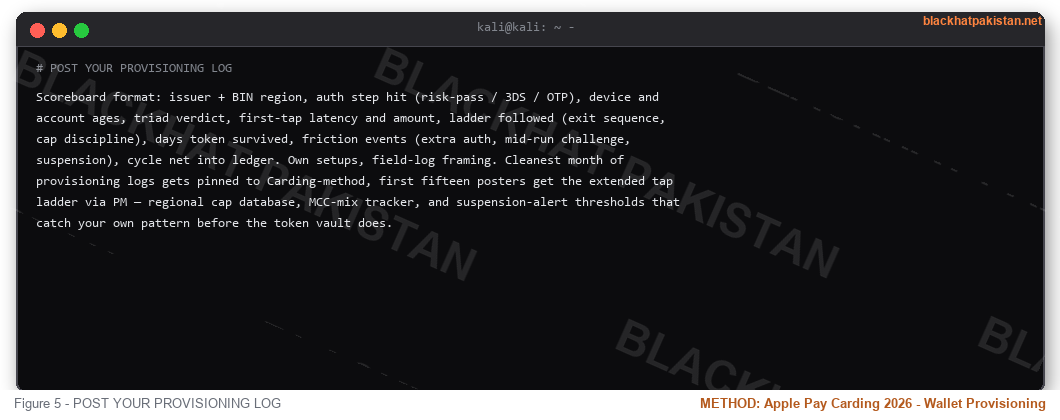
POST YOUR PROVISIONING LOG
Scoreboard format: issuer + BIN region, auth step hit (risk-pass / 3DS / OTP), device and account ages, triad verdict, first-tap latency and amount, ladder followed (exit sequence, cap discipline), days token survived, friction events (extra auth, mid-run challenge, suspension), cycle net into ledger. Own setups, field-log framing. Cleanest month of provisioning logs gets pinned to Carding-method, first fifteen posters get the extended tap ladder via PM — regional cap database, MCC-mix tracker, and suspension-alert thresholds that catch your own pattern before the token vault does.
FAQ
- Q: Does Apple Pay differ from Google Pay for this?
A: Mechanically both are network tokenization with device binding; the differences are attestation details (secure element vs OS keystore) and which settings screens the wallet account region lives in. The issuer's provisioning policy treats them the same — that is the gate, not the app.
- Q: Why did my provision succeed but the first tap decline?
A: Two separate decisions: the issuer approved binding, the issuer's authorization engine then saw first-use-at-merchant in a geography it did not expect. That is the triad failing at tap time instead of provision time — which is why the checker runs before add-card.
- Q: Is contactless ATM withdrawal real?
A: Where both the machine and the issuer support tokenized withdrawal, yes — but it is the highest-flag exit (camera plus cash plus wallet), which is why the ladder weights it 4.0 and keeps it for last, small, spaced.
- Q: SMS OTP for provisioning defeats the method then?
A: OTP you can receive and answer is friction, not failure — the run's risk moved into how the token behaves afterwards. The method dies on mismatches and velocity, not on challenges.
- Q: What ends a good run — suspension or chargeback?
A: Either: the issuer suspends the token remotely when post-provision behavior trips rules, or disputes the underlying funding transaction weeks later and takes the balance wherever it settled. Both clocks run at once; that is why exit and ledger speed are part of the method, not afterthoughts.
- Q: Can the same card provision to a second device later?
A: Networks track suspensions per device AND per PAN history — a card that already died on one wallet's velocity profile provisions onto the next phone with a shorter leash. Cool the PAN, not just the device.
RELATED
Cash App Carding Method 2026 - Cashtag Rail
Zelle Carding Method 2026 — Bank Rail Cashout
Chargebacks Explained
Proxies for Carding 2026 - Complete Proxy Guide


