

- Joined
- Dec 30, 2024
- Messages
- 430
- Reaction score
- 219
- Points
- 62
- Website
- blackhatpakistan.net
- Points
- 1,353
- USD
- 1,353
Combolist meaning, exact: a text file of breached username-password pairs — typically formatted as site:emaildata:image/gif;base64,R0lGODlhAQABAIAAAAAAAP///yH5BAEAAAAALAAAAAABAAEAAAIBRAA7assword or emaildata:image/gif;base64,R0lGODlhAQABAIAAAAAAAP///yH5BAEAAAAALAAAAAABAAEAAAIBRAA7assword per line — aggregated from credential-stuffing databases, phishing harvests, and malware stealer logs, and used to attempt account takeover on platforms where the same credentials were reused. Where fullz carry identity and CC packages carry card data, combo lists carry the LOGINS: the credential pairs that open accounts (email, e-commerce, banking portals, crypto exchanges, payment apps with saved cards) when victims reuse passwords across sites. The 2026 combolist is not one artifact but a layered ecosystem: fresh stealer-log combos (captured by infostealer malware from infected machines, hours-to-days old, highest success rates), breach-aggregated combos (years of accumulated leaks merged and deduplicated, lower success but enormous volume), and phishing-harvested combos (freshly harvested by kit-based phishing pages, premium pricing). This is the combolist meaning master guide in 2026: what the file format actually contains (field decode), where lists come from (stealer logs, breach aggregation, phishing kits), the account-takeover pipeline that converts combos into spend (saved-card wallets, crypto exchange accounts, e-commerce accounts with stored payment), credential-stuffing mechanics and the breach-list detection layer, and the beginner questions in English, Urdu, and Hindi that bring most searchers to this page — including the defensive "what to do if your combo appears" queries that ride every major breach news cycle. Post your combo-to-landing diagnosis — cleanest ATO walkthrough gets pinned to blackhat-hacking-tools, first fifteen get the credential-rotation priority matrix via PM.
TL;DR - Combo list = breached emaildata:image/gif;base64,R0lGODlhAQABAIAAAAAAAP///yH5BAEAAAAALAAAAAABAAEAAAIBRAA7assword or site:emaildata:image/gif;base64,R0lGODlhAQABAIAAAAAAAP///yH5BAEAAAAALAAAAAABAAEAAAIBRAA7assword pairs in text format. Field decode: LINE TYPES — emaildata:image/gif;base64,R0lGODlhAQABAIAAAAAAAP///yH5BAEAAAAALAAAAAABAAEAAAIBRAA7assword (universal login pairs), site:emaildata:image/gif;base64,R0lGODlhAQABAIAAAAAAAP///yH5BAEAAAAALAAAAAABAAEAAAIBRAA7assword (site-scoped pairs from breach dumps), emaildata:image/gif;base64,R0lGODlhAQABAIAAAAAAAP///yH5BAEAAAAALAAAAAABAAEAAAIBRAA7assword:url (phishing-harvested with source), emaildata:image/gif;base64,R0lGODlhAQABAIAAAAAAAP///yH5BAEAAAAALAAAAAABAAEAAAIBRAA7assword:hashdata:image/gif;base64,R0lGODlhAQABAIAAAAAAAP///yH5BAEAAAAALAAAAAABAAEAAAIBRAA7laintext (stealer logs sometimes capture both hash and plaintext); SUCCESS TIERS — stealer-log combos (hours-to-days fresh, plaintext captured from infected machine keylogs, highest ATO success), phishing-harvested (fresh, victim typed password directly into fake login page), breach-aggregated (multi-year merges, deduplicated, lower success due to rotation and reissue), combo-of-combos (aggregated from multiple breach sources, lowest success per line, highest volume). The ATO pipeline: combo -> credential-stuffing attempt (automated login attempts against target platform, often via residential-proxy rotation to dodge IP blocks) -> session hijack or account takeover (successful login = session cookies, saved payment methods, stored PII exposed) -> conversion (saved-card wallets drained or used, crypto exchange accounts emptied, e-commerce accounts used for fraud purchases, email accounts used for password-reset cascades on other services). Detection: credential-stuffing velocity models (login attempts per account, per device, per IP in rolling windows), breach-list checking services (Have I Been Pwned-style feeds consumed by platforms pre-login), impossible-travel login signals (new device + new geography + immediate sensitive action), and post-takeover behavioral triggers (password change + immediate withdrawal or purchase = auto-flag). Legal: possessing and using breached credential lists violates computer-fraud statutes (unauthorized access) regardless of how the list was obtained; "I only checked if my own email was there" is defensible; "I loaded 400k lines into a checker" is not. The defensive query family ("combolist breach what to do", "combolist leak") rides every breach news cycle and is the fastest-growing search cluster in this vertical — this post serves both the decoder intent and the defense protocol.
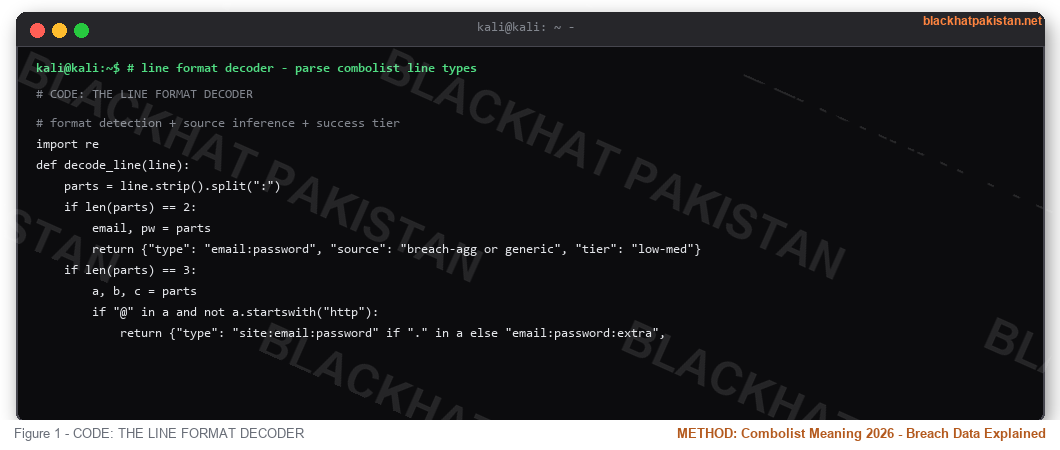
CODE: THE LINE FORMAT DECODER
Field-by-field decode of common combolist line formats — what each segment contains, its source signature, and the success tier it implies. Three real-world line examples parsed.
Code:
# line format decoder - parse combolist line types

# format detection + source inference + success tier

import re

def decode_line(line):

    parts = line.strip().split(":")

    if len(parts) == 2:

        email, pw = parts

        return {"type": "email:password", "source": "breach-agg or generic", "tier": "low-med"}

    if len(parts) == 3:

        a, b, c = parts

        if "@" in a and not a.startswith("http"):

            return {"type": "site:email:password" if "." in a else "email:password:extra",

                    "source": "breach dump (site-scoped)", "tier": "medium"}

        if a.startswith("http"):

            return {"type": "url:email:password", "source": "phishing harvest", "tier": "high"}

    if len(parts) == 4:

        return {"type": "email:pass:hash:plain", "source": "stealer log", "tier": "highest"}

    return {"type": "unknown", "source": "unparsed", "tier": "n/a"}

sample = [

    "user@mail.com:Summer2026!",

    "shop.example.com:user@mail.com:Password123",

    "http://phish.example/login:user@mail.com:MyPass99",

    "user@mail.com:MyPass99:a1b2c3:MyPass99",

]

for line in sample:

    d = decode_line(line)

    print("  %-52s" % line[:52])

    print("    type: %-24s tier: %-8s source: %s" % (d["type"], d["tier"], d["source"]))
THE ATO PIPELINE
- Combo sourcing — stealer logs (infostealer malware like RedLine, Raccoon, Vidar capture browser-saved passwords, cookies, and crypto wallets from infected machines; logs sold per- infected-machine or per-batch, hours-to-days fresh); phishing kits (fake login pages harvesting credentials in real time, kit panels manage victim flows); breach aggregation (multi-year credential dumps merged and deduplicated, enormous volume but low freshness); combo markets (Telegram channels and forums selling tiered access — "verified" stealer logs command premium over raw breach merges).
- Stuffing mechanics — automated login attempts against target platform using the list; residential-proxy rotation to dodge IP-block velocity rules; success-rate modeling (which breach, what vintage, what platform gets tested first); credential-stuffing-as-a-service panels (stuffer.tools-class dashboards) lower the skill floor to list upload and target selection.
- Takeover conversion — successful login yields session cookies (session hijack without re-login), saved payment methods (card-on-file wallets like PayPal, Cash App, Amazon), stored PII (for identity fraud or password-reset cascades on other services where the email is the recovery), and crypto exchange access (if the combo opens an exchange account, direct asset withdrawal).
- Password-reset cascade — email-account takeover (via combo) unlocks password resets on every service where that email is the recovery; the cascade converts ONE emaildata:image/gif;base64,R0lGODlhAQABAIAAAAAAAP///yH5BAEAAAAALAAAAAABAAEAAAIBRAA7assword combo into access across dozens of services; this is why fresh email creds command higher prices than site-scoped pairs.
- The detection stack — credential-stuffing velocity models (login attempts per account/device/IP in rolling windows — the stuffing fingerprint), breach-list pre-login checking (Have I Been Pwned-style feeds consumed at login, blocking known-breached credentials regardless of whether the attempt "succeeds"), impossible-travel signals (new device + new geography + immediate sensitive action = auto-flag), and post-takeover behavioral triggers (password change followed immediately by withdrawal or purchase = automatic session-interruption and review).
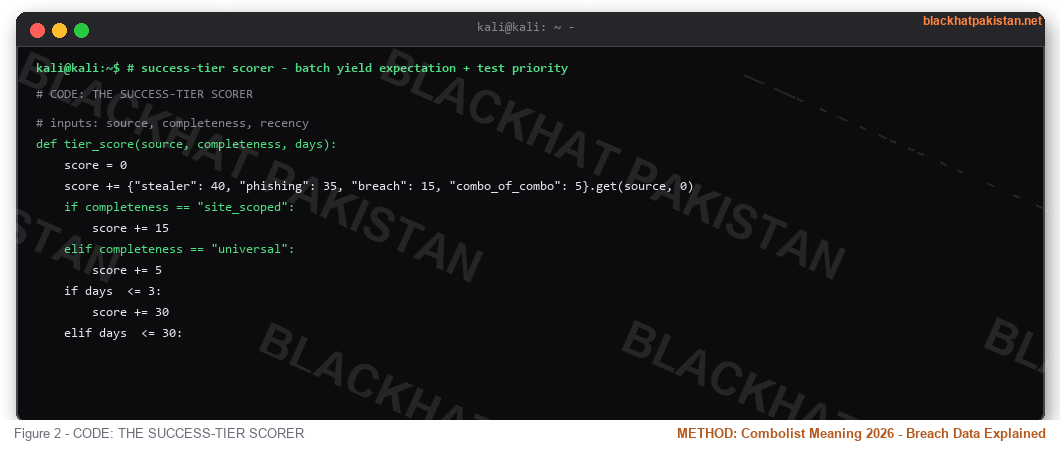
CODE: THE SUCCESS-TIER SCORER
Scores a combolist batch for ATO yield expectation: source type (stealer > phishing > breach-agg), line completeness (site-scoped vs universal), and recency (days since capture/source date). Outputs expected-success tier and a recommended testing priority. Three sample batches demonstrate scoring.
Code:
# success-tier scorer - batch yield expectation + test priority

# inputs: source, completeness, recency

def tier_score(source, completeness, days):

    score = 0

    score += {"stealer": 40, "phishing": 35, "breach": 15, "combo_of_combo": 5}.get(source, 0)

    if completeness == "site_scoped":

        score += 15

    elif completeness == "universal":

        score += 5

    if days  <= 3:

        score += 30

    elif days  <= 30:

        score += 15

    elif days  > 180:

        score -= 10

    if score  >= 70:

        tier = "HIGH - test first, expect strongest yield"

    elif score  >= 40:

        tier = "MEDIUM - test selectively, check platform vintage"

    else:

        tier = "LOW - test last, low expectation"

    return score, tier

batches = [

    ("stealer", "site_scoped", 2),

    ("phishing", "universal", 1),

    ("breach", "universal", 200),

]

for src, comp, d in batches:

    s, t = tier_score(src, comp, d)

    print("  %-8s score=%-4s %s" % (src, s, t))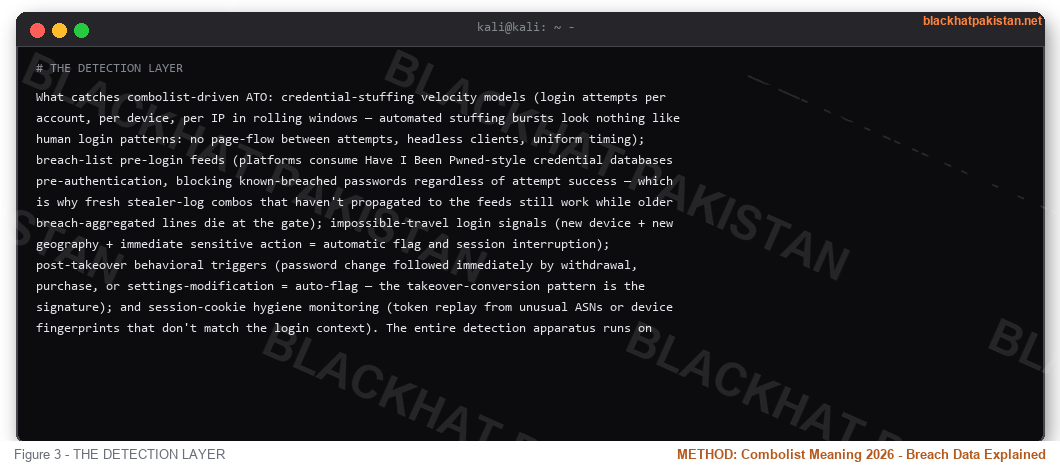
THE DETECTION LAYER
What catches combolist-driven ATO: credential-stuffing velocity models (login attempts per account, per device, per IP in rolling windows — automated stuffing bursts look nothing like human login patterns: no page-flow between attempts, headless clients, uniform timing); breach-list pre-login feeds (platforms consume Have I Been Pwned-style credential databases pre-authentication, blocking known-breached passwords regardless of attempt success — which is why fresh stealer-log combos that haven't propagated to the feeds still work while older breach-aggregated lines die at the gate); impossible-travel login signals (new device + new geography + immediate sensitive action = automatic flag and session interruption); post-takeover behavioral triggers (password change followed immediately by withdrawal, purchase, or settings-modification = auto-flag — the takeover-conversion pattern is the signature); and session-cookie hygiene monitoring (token replay from unusual ASNs or device fingerprints that don't match the login context). The entire detection apparatus runs on VELOCITY and RECENCY joins — which is why the OPSEC layer in every ATO method post is about residential-proxy rotation, human-timing simulation, and fresh-batch selection, not about any single login attempt's plausibility.
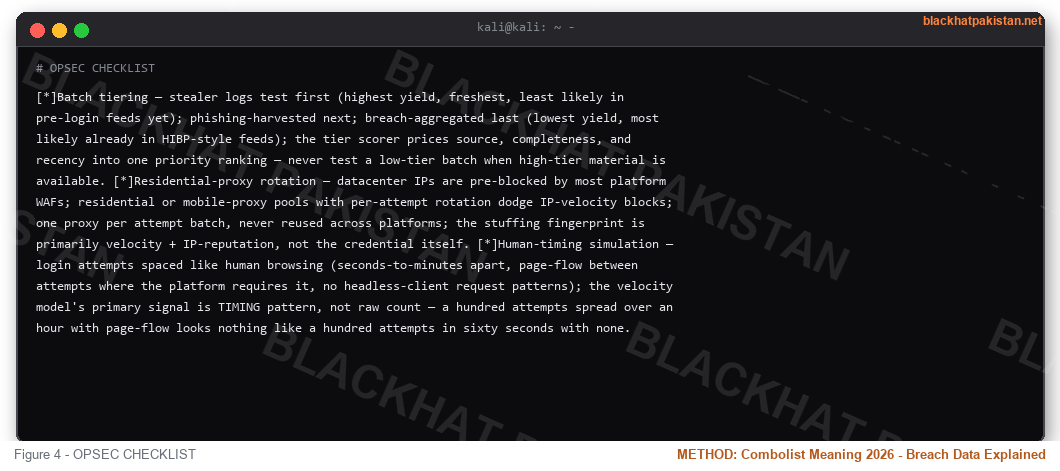
OPSEC CHECKLIST
- Batch tiering — stealer logs test first (highest yield, freshest, least likely in pre-login feeds yet); phishing-harvested next; breach-aggregated last (lowest yield, most likely already in HIBP-style feeds); the tier scorer prices source, completeness, and recency into one priority ranking — never test a low-tier batch when high-tier material is available.
- Residential-proxy rotation — datacenter IPs are pre-blocked by most platform WAFs; residential or mobile-proxy pools with per-attempt rotation dodge IP-velocity blocks; one proxy per attempt batch, never reused across platforms; the stuffing fingerprint is primarily velocity + IP-reputation, not the credential itself.
- Human-timing simulation — login attempts spaced like human browsing (seconds-to-minutes apart, page-flow between attempts where the platform requires it, no headless-client request patterns); the velocity model's primary signal is TIMING pattern, not raw count — a hundred attempts spread over an hour with page-flow looks nothing like a hundred attempts in sixty seconds with none.
- Freshness window — stealer logs lose value as platforms ingest them into pre-login feeds (hours-to-days for major platforms, longer for smaller ones); test fresh batches immediately upon sourcing; aging batches lose yield geometrically, not linearly — the tier scorer's recency component exists precisely because of this decay.
- Session hygiene post-takeover — never perform password-change + immediate-withdrawal (the auto-flag pattern); wait for the behavioral-baseline to absorb the login before converting; convert saved-card wallets and exchange accounts through normal-looking spend patterns, not rapid drains; the post-takeover behavioral trigger is what catches the takeover AFTER the login succeeds.
- Defensive discipline (operator side) — check your own email against breach feeds (HIBP, Mozilla Monitor) regularly; rotate reused passwords; enable hardware-key or app-based 2FA where available (SMS 2FA is SIM-swap-vulnerable per the sim-swap method posts); the combo that was YOURS in a breach is how your accounts get added to the next batch someone tests.
TEST YOURSELF: SIX QUESTIONS
Score honestly: (1) combolist meaning in one sentence — what does the file contain that a fullz package does not? (2) line decode: "http://phish.example/login:user@mail.com:MyPass99" — what type, what source, what success tier? (3) pipeline: why does email-account takeover unlock a password-reset cascade across dozens of services? (4) tier scorer: stealer batch (site_scoped, 2 days) vs breach batch (universal, 200 days) — scores and test priority? (5) detection: what is the single strongest stuffing-fingerprint signal — raw count, or timing/IP-reputation pattern, and why? (6) defense: what three actions reduce YOUR password's value in a future batch, and why is SMS 2FA weaker than hardware/app 2FA? Zero to one: you read the TL;DR and can define combolist in one sentence. Two to three: you can decode four line formats and run the tier scorer on a sample batch. Four plus: you can explain the password-reset cascade and the post-takeover behavioral trigger — post your diagnosis.
POST YOUR ATO DIAGNOSIS
Scoreboard format: batch source (stealer / phishing / breach / combo-of-combo), line count, completeness (site-scoped / universal), days-since-source, tier score at test time, platform tested, success rate observed, conversion path (saved-card wallet / exchange / e-commerce / email-cascade), friction events (pre-login block, impossible-travel flag, session interruption, post-takeover trigger). Field-log framing, own test batches only. Cleanest combo-to-landing walkthrough gets pinned to blackhat-hacking-tools, first fifteen posters get the credential-rotation priority matrix via PM — which passwords to rotate first (email, banking, exchange, then long-tail), hardware-key setup notes, breach-feed monitoring cadence, and the session-hygiene checklist after a suspected exposure.
FAQ
- Q: Combolist meaning in Urdu?
A: "Combolist" ka matlab hai hacked emaildata:image/gif;base64,R0lGODlhAQABAIAAAAAAAP///yH5BAEAAAAALAAAAAABAAEAAAIBRAA7assword pairs ki text file — jo credential stuffing (automatic login attempts) aur account takeover ke liye istemal hoti hai. Yeh breaches, phishing, ya stealer malware se banti hai; account takeover computer-fraud jurm hai. Agar aap ka email list mein ho to password turant badlein aur 2FA enable karein.
- Q: Combolist meaning in Hindi?
A: "Combolist" arth hai chori ki gayi emaildata:image/gif;base64,R0lGODlhAQABAIAAAAAAAP///yH5BAEAAAAALAAAAAABAAEAAAIBRAA7assword pairs ki text file — jo account takeover (ATO) ke liye automatic login attempts mein use hoti hai. Sources: breach data, phishing pages, stealer malware. Agar aapka email kisi breach list mein mile, to password rotate karein, 2FA (hardware/app) enable karein, aur HIBP jaise tools se check karte rahein.
- Q: What is the difference between a combolist and a fullz?
A: Combolist = login credentials (emaildata:image/gif;base64,R0lGODlhAQABAIAAAAAAAP///yH5BAEAAAAALAAAAAABAAEAAAIBRAA7assword pairs) for account takeover via credential reuse; fullz = full identity package (SSN, DOB, address, card) for identity fraud and account opening; a combo gets you INTO an account that reuses the password; fullz gets you a NEW account in someone else's name; different crime types, different capture methods, different detection surfaces.
- Q: Is possessing a combolist illegal?
A: Yes — possessing and using breached credential lists violates computer-fraud and unauthorized-access statutes regardless of how the list was obtained; "I only checked if my own email was there" (checking your own email against Have I Been Pwned or similar) is a distinct defensive act; "I loaded 400k lines into a checker and tested logins" is unauthorized access; the legal line is USAGE, not possession, in most jurisdictions — but possession with intent to use is prosecutable in many.
- Q: Why do fresh stealer logs work better than old breach lists?
A: Platforms ingest breached credentials into pre-login blocking feeds (Have I Been Pwned-style) with delay measured in days-to-weeks; stealer logs captured hours ago haven't propagated yet, so the credential passes pre-login checks; freshness also means the victim hasn't rotated the password (stealer logs capture passwords from machines whose owners don't know they're infected); the tier scorer's recency component exists precisely because this decay is geometric, not linear.
- Q: What should I do if my email appears in a breach?
A: Rotate the password immediately (and every other service where you reused it — the password-reset cascade is the real risk); enable hardware-key or app-based 2FA (SMS 2FA is SIM-swap-vulnerable); check whether the breach exposed sessions or saved payment methods (log out all sessions, review wallet cards); monitor with breach-feed tools (Have I Been Pwned, Mozilla Monitor) for future exposures; the defensive query family riding every breach news cycle is exactly this protocol.
RELATED
Combos and Lists Operations Guide 2026
What Is a Data Breach 2026: Causes, Response Steps
Credential Stuffing 2026: Check Your Exposure
Bank Drop Operations 2026 - Account Lifecycle


