

- Joined
- Dec 30, 2024
- Messages
- 410
- Reaction score
- 216
- Points
- 62
- Website
- blackhatpakistan.net
- Points
- 1,253
- USD
- 1,253

Google dorks are search-engine operators chained into recon queries, and the same ten strings have been pulling exposed admin panels, database dumps, and open camera feeds out of Google's index for twenty years - because the index keeps hundreds of billions of pages and website owners keep forgetting what they published. Forty ready-to-run dorks below, copy-paste format, categorized by what they catch - post your best find in the thread and redact nothing except the live target.
TL;DR - A dork is just Google syntax: site: scopes it, inurl: and intitle: read the address bar and page title, filetype: and ext: hunt document types, intext: greps page bodies, and before:/after: put a date on the hunt. The forty below run in four sets - login panels, exposed files, databases and error leaks, cameras and IoT - each ready to paste with a target swapped in. Results read like an operator: combine two or three constraints instead of trusting one, kill obvious aggregators, and check what a site publishes before deciding it is interesting. Rules of the road: authorized targets only, no touching what you find, and the thread's scoreboard is the best dork posted - first fifteen gets custom recon strings for their own engagement.
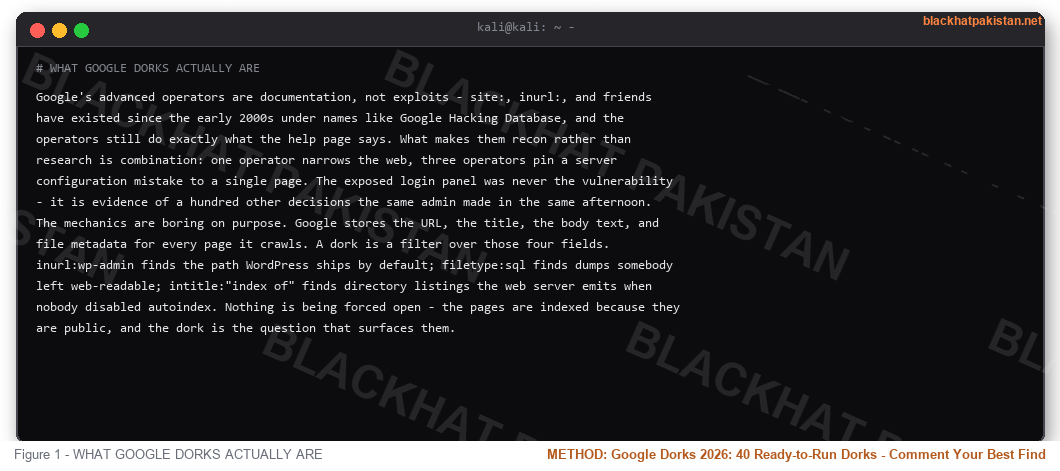
WHAT GOOGLE DORKS ACTUALLY ARE
Google's advanced operators are documentation, not exploits - site:, inurl:, and friends have existed since the early 2000s under names like Google Hacking Database, and the operators still do exactly what the help page says. What makes them recon rather than research is combination: one operator narrows the web, three operators pin a server configuration mistake to a single page. The exposed login panel was never the vulnerability - it is evidence of a hundred other decisions the same admin made in the same afternoon.
The mechanics are boring on purpose. Google stores the URL, the title, the body text, and file metadata for every page it crawls. A dork is a filter over those four fields. inurl:wp-admin finds the path WordPress ships by default; filetype:sql finds dumps somebody left web-readable; intitle:"index of" finds directory listings the web server emits when nobody disabled autoindex. Nothing is being forced open - the pages are indexed because they are public, and the dork is the question that surfaces them.
OPERATOR ANATOMY
- site:target.com or site:*.gov - scope by domain or wildcard TLD; the first half of every serious string.
- inurl:admin / inurl:login - match against the URL path; great for panels, terrible alone (too noisy).
- intitle:"admin login" - match against the page title; titles are written by humans, so they carry intent.
- intext:"password" or intext:"INSERT INTO" - grep the indexed body; where dumps and config leaks give themselves away.
- filetype:sql / filetype:env / ext:bak - document type filter; the highest-signal operator for exposed files.
- cache: and related: - inspect what Google last stored, or find sibling pages of a known one.
- before:2020-01-01 / after:2024-06-01 - date-bounded hunting; stale indexes often mean forgotten infrastructure.
- "-" exclusion and OR - kill aggregators and branch queries without leaving the string.
- intext:"error" intitle:"index of" - stack-error plus directory listing is the oldest two-operator combo in the book.
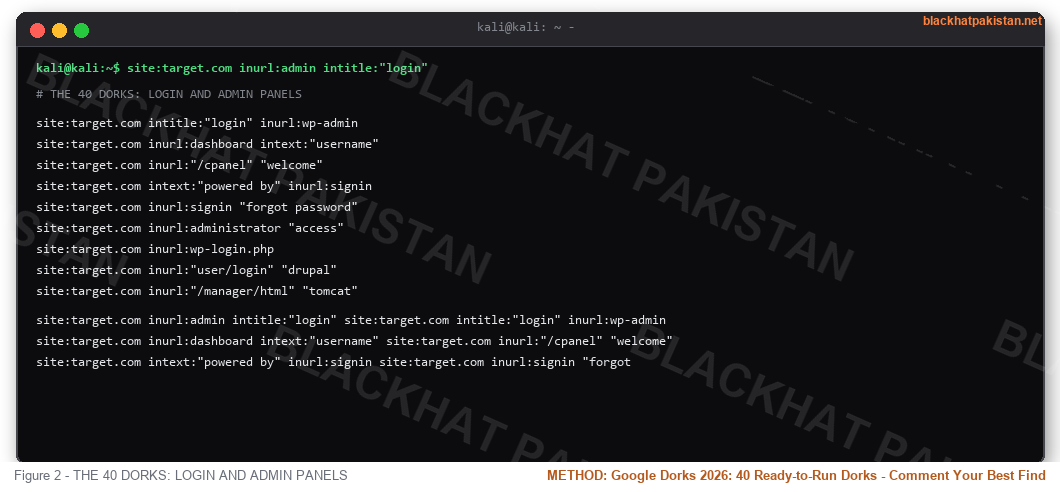
THE 40 DORKS: LOGIN AND ADMIN PANELS
Code:
site:target.com inurl:admin intitle:"login"

site:target.com intitle:"login" inurl:wp-admin

site:target.com inurl:dashboard intext:"username"

site:target.com inurl:"/cpanel" "welcome"

site:target.com intext:"powered by" inurl:signin

site:target.com inurl:signin "forgot password"

site:target.com inurl:administrator "access"

site:target.com inurl:wp-login.php

site:target.com inurl:"user/login" "drupal"

site:target.com inurl:"/manager/html" "tomcat"
THE 40 DORKS: EXPOSED FILES AND CONFIGS
Code:
site:target.com filetype:env "DB_PASSWORD"

site:target.com filetype:log intext:"password"

site:target.com filetype:bak "config"

site:target.com filetype:sql "INSERT INTO users"

site:target.com filetype:conf "secret_key"

site:target.com filetype:yml "aws_secret"

site:target.com filetype:ini "passwd"

site:target.com ext:txt intext:"credentials"

site:target.com filetype:git "config"

site:target.com filetype:zip "backup"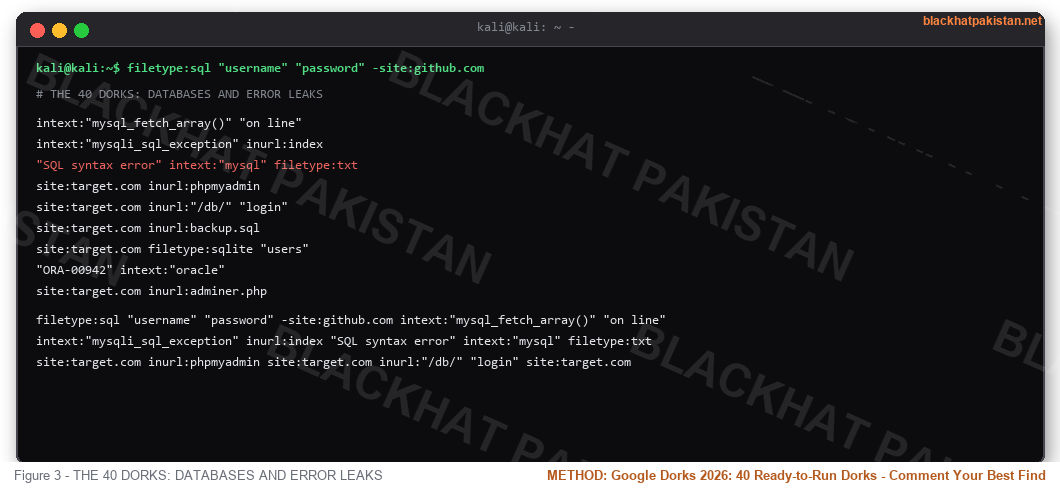
THE 40 DORKS: DATABASES AND ERROR LEAKS
Code:
filetype:sql "username" "password" -site:github.com

intext:"mysql_fetch_array()" "on line"

intext:"mysqli_sql_exception" inurl:index

"SQL syntax error" intext:"mysql" filetype:txt

site:target.com inurl:phpmyadmin

site:target.com inurl:"/db/" "login"

site:target.com inurl:backup.sql

site:target.com filetype:sqlite "users"

"ORA-00942" intext:"oracle"

site:target.com inurl:adminer.php
THE 40 DORKS: CAMERAS AND IOT
Code:
inurl:"ViewerFrame?Mode="

intitle:"IP Webcam" inurl:"/video"

inurl:"/config/httpd.conf" "password"

inurl:"/cgi-bin/luci" "openwrt"

intitle:"Hikvision" inurl:"Login"

intitle:"index of" inurl:"/NVR/"

inurl:"/rtsp://" intitle:"live"

inurl:"/info/deviceInfo" "serial"

intitle:"webcamxp" intext:"live view"

inurl:"/device/config" "admin_password"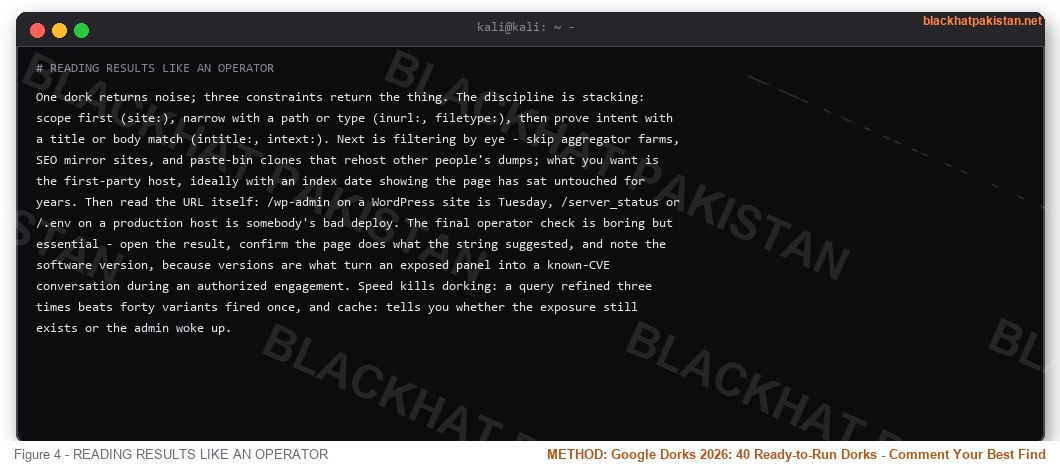
READING RESULTS LIKE AN OPERATOR
One dork returns noise; three constraints return the thing. The discipline is stacking: scope first (sitedata:image/gif;base64,R0lGODlhAQABAIAAAAAAAP///yH5BAEAAAAALAAAAAABAAEAAAIBRAA7, narrow with a path or type (inurl:, filetypedata:image/gif;base64,R0lGODlhAQABAIAAAAAAAP///yH5BAEAAAAALAAAAAABAAEAAAIBRAA7, then prove intent with a title or body match (intitle:, intextdata:image/gif;base64,R0lGODlhAQABAIAAAAAAAP///yH5BAEAAAAALAAAAAABAAEAAAIBRAA7. Next is filtering by eye - skip aggregator farms, SEO mirror sites, and paste-bin clones that rehost other people's dumps; what you want is the first-party host, ideally with an index date showing the page has sat untouched for years. Then read the URL itself: /wp-admin on a WordPress site is Tuesday, /server_status or /.env on a production host is somebody's bad deploy. The final operator check is boring but essential - open the result, confirm the page does what the string suggested, and note the software version, because versions are what turn an exposed panel into a known-CVE conversation during an authorized engagement. Speed kills dorking: a query refined three times beats forty variants fired once, and cache: tells you whether the exposure still exists or the admin woke up.
RULES OF THE ROAD
Authorized scope only - dork your own infrastructure, your client's contracted assets, or bug-bounty programs with published scope; a result is not permission. Do not touch, download, or "verify" someone else's exposed data - viewing indexed metadata during research and interacting with a live system are different acts with different consequences, and the second one has a lawyer attached. Watch rate behavior: hammering hundreds of queries from one IP gets CAPTCHA-gated, which is an anti-automation signal, not a challenge to defeat with proxies. And run the mirror dorks against yourself quarterly - every string above works as a defensive audit: if your company's .env shows up in block three, that is a finding on your own desk before it is someone else's writeup.
POST YOUR BEST FIND
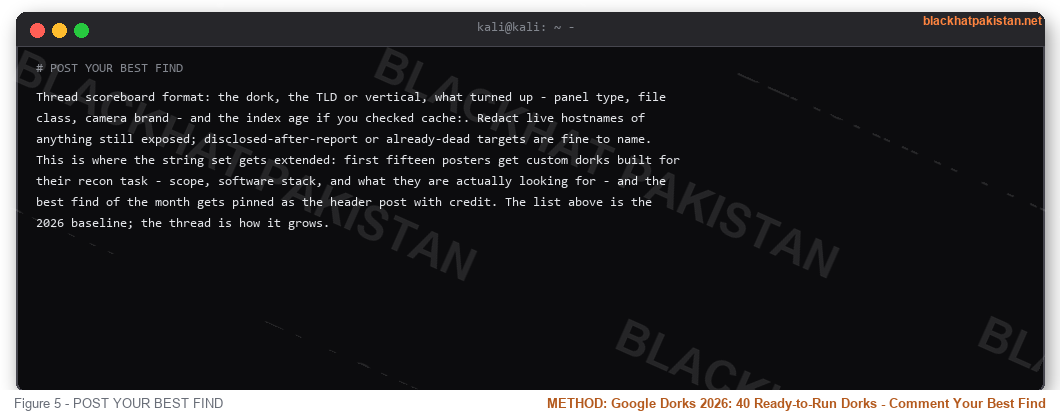
Thread scoreboard format: the dork, the TLD or vertical, what turned up - panel type, file class, camera brand - and the index age if you checked cache:. Redact live hostnames of anything still exposed; disclosed-after-report or already-dead targets are fine to name. This is where the string set gets extended: first fifteen posters get custom dorks built for their recon task - scope, software stack, and what they are actually looking for - and the best find of the month gets pinned as the header post with credit. The list above is the 2026 baseline; the thread is how it grows.
FAQ
- Q: Are Google dorks legal?
A: The operators are Google's own documented search syntax and using them is not an intrusion - legality turns on what happens next. Reading results inside authorized scope is research; accessing systems or data you have no right to touch is not, regardless of how you found them.
- Q: Does Google still allow dorking in 2026?
A: Yes - every operator above comes from Google's current advanced-search documentation. Rate limits and CAPTCHAs throttle bulk automated querying, but individual strings work fine in a normal browser session.
- Q: Why do exposed pages stay in the index?
A: Indexing lags reality - a page can be removed server-side and sit in search results for days or weeks. cache: shows what Google last saw, which is why old results sometimes point at remediated holes.
- Q: Which single operator is most powerful?
A: filetype: - document-type filtering surfaces backups, dumps, and configs that no amount of inurl: guessing finds, which is why exposed-file dorks dominate real findings lists.
- Q: How do I protect my own site from these dorks?
A: Walk the forty against your domain like an audit: block web-readable sensitive extensions at the server, disable directory autoindex, keep .env and backup paths outside the web root, and purge stale URLs from Search Console so the index forgets them.
- Q: Why do I get CAPTCHA after twenty queries?
A: Google flags automated-looking query volume from one IP and challenges the session. It is anti-bot enforcement - slow down, keep queries human-shaped, and never route around it on targets you do not own.
RELATED
Vulnerability Assessment 2026: Method, Tools and Report Template
OWASP Top 10 2026
Password Leak Check
What Is a Data Breach 2026


