

- Joined
- Dec 30, 2024
- Messages
- 396
- Reaction score
- 208
- Points
- 62
- Website
- blackhatpakistan.net
- Points
- 1,108
- USD
- 1,108
An undetectable RAT is a remote access trojan engineered against each layer of modern detection - static signatures, heuristic scanning, behavioral EDR, and cloud reputation - so no single layer flags it. "Undetectable" in practice means unsigned binaries with no signature database hits, no telltale strings on disk, quiet process behavior, and C2 traffic that resembles ordinary TLS. Nothing is undetectable forever; the discipline is keeping every layer's signal below its threshold at the same time.
TL;DR - Detection runs in layers: static (hashes, strings, entropy), heuristic (suspicious API patterns), behavioral (process chains, injection, persistence writes), and cloud (reputation + ML). Evasion is a per-layer problem: source-level cleanliness for static, indirection for behavioral, encryption for strings, and traffic shaping for C2. The layer that catches most first attempts is behavioral, which is why process behavior gets the most attention below - and why a sample that passes a local AV scan means almost nothing.
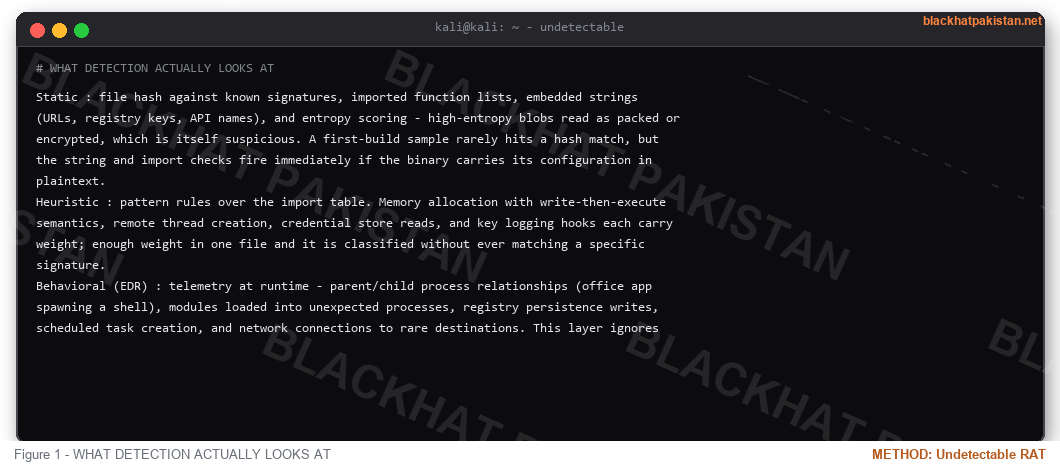
WHAT DETECTION ACTUALLY LOOKS AT
Static: file hash against known signatures, imported function lists, embedded strings (URLs, registry keys, API names), and entropy scoring - high-entropy blobs read as packed or encrypted, which is itself suspicious. A first-build sample rarely hits a hash match, but the string and import checks fire immediately if the binary carries its configuration in plaintext.
Heuristic: pattern rules over the import table. Memory allocation with write-then-execute semantics, remote thread creation, credential store reads, and key logging hooks each carry weight; enough weight in one file and it is classified without ever matching a specific signature.
Behavioral (EDR): telemetry at runtime - parent/child process relationships (office app spawning a shell), modules loaded into unexpected processes, registry persistence writes, scheduled task creation, and network connections to rare destinations. This layer ignores what the file is and scores what the host does.
Cloud: first-seen samples are reputation-pending; anything that looks like known families gets an immediate verdict from the vendor's model before local scanning finishes. Fresh compilation helps for exactly as long as the family resemblance stays under the model's threshold.
THE EVASION CLASSES
- Source-level cleanliness - no debug artifacts, no embedded config, no logging, no default strings from the framework it was built from.
- String and config encryption - URLs, mutex names, and registry paths decrypted at runtime into buffers instead of sitting in the binary's data section.
- Import indirection - resolving sensitive functions at runtime rather than importing them by name, so the static import table looks like an ordinary application.
- Entropy management - padding and section structure that keeps the file from reading as one high-entropy blob to scanners that score entropy alone.
- Process indirection - running code through channels the host already trusts instead of creating obviously new ones.
- Traffic shaping - C2 over TLS with headers, paths, and jitter that match the application the traffic pretends to be.
PROCESS BEHAVIOR - WHERE SAMPLES DIE
The telltale chain is well documented: a document or script starts something that starts something else, the last process allocates memory it did not compile with, writes a payload into a second process, and that second process begins making outbound connections. Every step exists as an EDR correlation rule.
Breaking the chain means changing each link: the initial step comes from a vector that already has a plausible reason to run code (a macro-enabled workflow, a build script, an installer); the middle step avoids the specific allocation-write-execute fingerprint scanners score by using paths the vendor classifies as legitimate for that process type; the outbound step is TLS to a destination with real reputation, at intervals shaped like an application heartbeat rather than fixed-period polling. Direct syscalls and unhooking address a different layer - the in-process userland hooks EDR plants - and matter only once the behavioral signals above are handled.
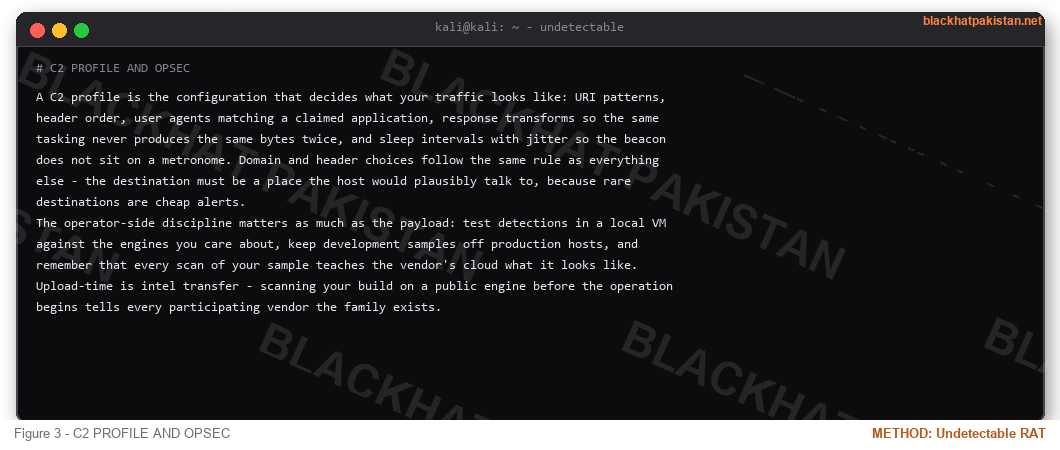
C2 PROFILE AND OPSEC
A C2 profile is the configuration that decides what your traffic looks like: URI patterns, header order, user agents matching a claimed application, response transforms so the same tasking never produces the same bytes twice, and sleep intervals with jitter so the beacon does not sit on a metronome. Domain and header choices follow the same rule as everything else - the destination must be a place the host would plausibly talk to, because rare destinations are cheap alerts.
The operator-side discipline matters as much as the payload: test detections in a local VM against the engines you care about, keep development samples off production hosts, and remember that every scan of your sample teaches the vendor's cloud what it looks like. Upload-time is intel transfer - scanning your build on a public engine before the operation begins tells every participating vendor the family exists.
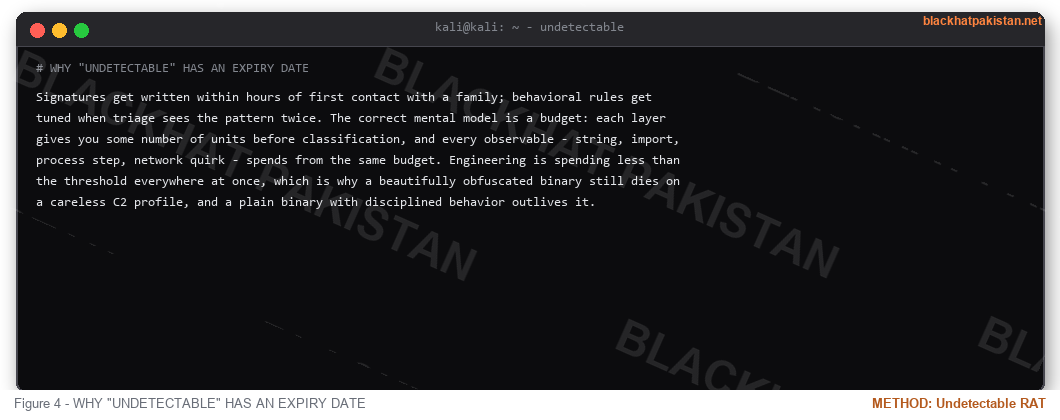
WHY "UNDETECTABLE" HAS AN EXPIRY DATE
Signatures get written within hours of first contact with a family; behavioral rules get tuned when triage sees the pattern twice. The correct mental model is a budget: each layer gives you some number of units before classification, and every observable - string, import, process step, network quirk - spends from the same budget. Engineering is spending less than the threshold everywhere at once, which is why a beautifully obfuscated binary still dies on a careless C2 profile, and a plain binary with disciplined behavior outlives it.
FAQ
Q: Does a clean VirusTotal scan mean it is undetectable?
A: No. First, public uploads feed the vendors' clouds permanently. Second, many detections are behavioral and fire on execution, not on the file - a static scan never runs that layer.
Q: What catches most custom samples first?
A: Behavioral: process chains and memory operations. Static string and import checks come second, cloud reputation third when the sample circulates.
Q: Is packing enough?
A: Packing handles static inspection and raises entropy, which trades one static signal for another and does nothing about runtime behavior. It is one line item in the budget, not the budget.
Q: How do defenders separate a tested tool from a novel one?
A: Novel families get the slower analysis path because nothing matches; heavily customized variants of known families trigger family-level rules anyway. What survives longest is behavior that does not resemble any family at all - which is why the behavioral section matters more than the packing notes.
RELATED ON BLACKHAT PAKISTAN
Reverse Shell Cheatsheet - the transport a RAT payload hands off to.
Python Keylogger Tutorial 2026 - capture modules and their hook surface.
Windows Privilege Escalation - privileges that widen what the payload can reach.
Metasploit Tutorial - handlers, sessions, and payload delivery infrastructure.
TL;DR - Detection runs in layers: static (hashes, strings, entropy), heuristic (suspicious API patterns), behavioral (process chains, injection, persistence writes), and cloud (reputation + ML). Evasion is a per-layer problem: source-level cleanliness for static, indirection for behavioral, encryption for strings, and traffic shaping for C2. The layer that catches most first attempts is behavioral, which is why process behavior gets the most attention below - and why a sample that passes a local AV scan means almost nothing.
WHAT DETECTION ACTUALLY LOOKS AT
Static: file hash against known signatures, imported function lists, embedded strings (URLs, registry keys, API names), and entropy scoring - high-entropy blobs read as packed or encrypted, which is itself suspicious. A first-build sample rarely hits a hash match, but the string and import checks fire immediately if the binary carries its configuration in plaintext.
Heuristic: pattern rules over the import table. Memory allocation with write-then-execute semantics, remote thread creation, credential store reads, and key logging hooks each carry weight; enough weight in one file and it is classified without ever matching a specific signature.
Behavioral (EDR): telemetry at runtime - parent/child process relationships (office app spawning a shell), modules loaded into unexpected processes, registry persistence writes, scheduled task creation, and network connections to rare destinations. This layer ignores what the file is and scores what the host does.
Cloud: first-seen samples are reputation-pending; anything that looks like known families gets an immediate verdict from the vendor's model before local scanning finishes. Fresh compilation helps for exactly as long as the family resemblance stays under the model's threshold.
THE EVASION CLASSES
- Source-level cleanliness - no debug artifacts, no embedded config, no logging, no default strings from the framework it was built from.
- String and config encryption - URLs, mutex names, and registry paths decrypted at runtime into buffers instead of sitting in the binary's data section.
- Import indirection - resolving sensitive functions at runtime rather than importing them by name, so the static import table looks like an ordinary application.
- Entropy management - padding and section structure that keeps the file from reading as one high-entropy blob to scanners that score entropy alone.
- Process indirection - running code through channels the host already trusts instead of creating obviously new ones.
- Traffic shaping - C2 over TLS with headers, paths, and jitter that match the application the traffic pretends to be.
PROCESS BEHAVIOR - WHERE SAMPLES DIE
The telltale chain is well documented: a document or script starts something that starts something else, the last process allocates memory it did not compile with, writes a payload into a second process, and that second process begins making outbound connections. Every step exists as an EDR correlation rule.
Breaking the chain means changing each link: the initial step comes from a vector that already has a plausible reason to run code (a macro-enabled workflow, a build script, an installer); the middle step avoids the specific allocation-write-execute fingerprint scanners score by using paths the vendor classifies as legitimate for that process type; the outbound step is TLS to a destination with real reputation, at intervals shaped like an application heartbeat rather than fixed-period polling. Direct syscalls and unhooking address a different layer - the in-process userland hooks EDR plants - and matter only once the behavioral signals above are handled.
C2 PROFILE AND OPSEC
A C2 profile is the configuration that decides what your traffic looks like: URI patterns, header order, user agents matching a claimed application, response transforms so the same tasking never produces the same bytes twice, and sleep intervals with jitter so the beacon does not sit on a metronome. Domain and header choices follow the same rule as everything else - the destination must be a place the host would plausibly talk to, because rare destinations are cheap alerts.
The operator-side discipline matters as much as the payload: test detections in a local VM against the engines you care about, keep development samples off production hosts, and remember that every scan of your sample teaches the vendor's cloud what it looks like. Upload-time is intel transfer - scanning your build on a public engine before the operation begins tells every participating vendor the family exists.
WHY "UNDETECTABLE" HAS AN EXPIRY DATE
Signatures get written within hours of first contact with a family; behavioral rules get tuned when triage sees the pattern twice. The correct mental model is a budget: each layer gives you some number of units before classification, and every observable - string, import, process step, network quirk - spends from the same budget. Engineering is spending less than the threshold everywhere at once, which is why a beautifully obfuscated binary still dies on a careless C2 profile, and a plain binary with disciplined behavior outlives it.
FAQ
Q: Does a clean VirusTotal scan mean it is undetectable?
A: No. First, public uploads feed the vendors' clouds permanently. Second, many detections are behavioral and fire on execution, not on the file - a static scan never runs that layer.
Q: What catches most custom samples first?
A: Behavioral: process chains and memory operations. Static string and import checks come second, cloud reputation third when the sample circulates.
Q: Is packing enough?
A: Packing handles static inspection and raises entropy, which trades one static signal for another and does nothing about runtime behavior. It is one line item in the budget, not the budget.
Q: How do defenders separate a tested tool from a novel one?
A: Novel families get the slower analysis path because nothing matches; heavily customized variants of known families trigger family-level rules anyway. What survives longest is behavior that does not resemble any family at all - which is why the behavioral section matters more than the packing notes.
RELATED ON BLACKHAT PAKISTAN
Reverse Shell Cheatsheet - the transport a RAT payload hands off to.
Python Keylogger Tutorial 2026 - capture modules and their hook surface.
Windows Privilege Escalation - privileges that widen what the payload can reach.
Metasploit Tutorial - handlers, sessions, and payload delivery infrastructure.
Last edited:


