

- Joined
- Dec 30, 2024
- Messages
- 410
- Reaction score
- 216
- Points
- 62
- Website
- blackhatpakistan.net
- Points
- 1,253
- USD
- 1,253
Vishing - voice phishing - is the same credential-harvesting playbook as email phishing moved to a live phone call, and the FBI's Internet Crime Complaint Center counted 193,407 phishing and spoofing complaints in its 2024 report while Verizon's DBIR keeps the human element inside roughly 68 percent of all breaches. The economics have not changed: a voice call is real-time, emotional, and trusted by default, so the attacker gets to set urgency, read your answers, and adapt mid-sentence in a way no email ever can.
TL;DR - Vishing works because the phone carries institutional trust: caller ID is presentation, not proof, and a live attacker can react to everything you say. The 15 red flags below cover the whole surface - callback resistance, artificial urgency, credential requests, payment pressure, and verification theater. Two annotated scripts show how the bank-fraud-desk and IT-helpdesk variants actually run, beat by beat. Defense is verification discipline: hang up, call the published number, enforce STIR/SHAKEN attestation on the org's own inbound calls, train staff with recorded mock calls, and if you already gave it up, the kill sequence is card freeze first, then password rotation, then the credit freeze.
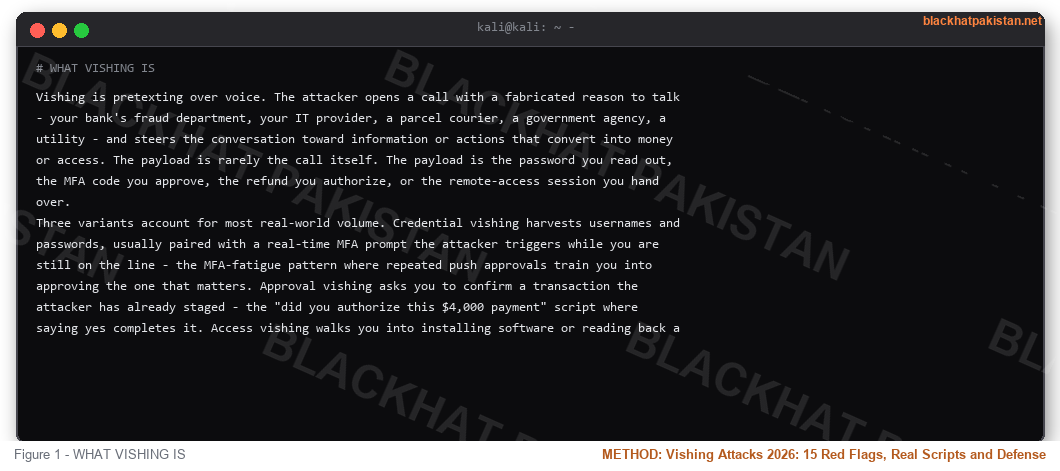
WHAT VISHING IS
Vishing is pretexting over voice. The attacker opens a call with a fabricated reason to talk - your bank's fraud department, your IT provider, a parcel courier, a government agency, a utility - and steers the conversation toward information or actions that convert into money or access. The payload is rarely the call itself. The payload is the password you read out, the MFA code you approve, the refund you authorize, or the remote-access session you hand over.
Three variants account for most real-world volume. Credential vishing harvests usernames and passwords, usually paired with a real-time MFA prompt the attacker triggers while you are still on the line - the MFA-fatigue pattern where repeated push approvals train you into approving the one that matters. Approval vishing asks you to confirm a transaction the attacker has already staged - the "did you authorize this $4,000 payment" script where saying yes completes it. Access vishing walks you into installing software or reading back a one-time code so the attacker can take over an account or a machine directly.
WHY THE PHONE STILL WORKS
Email filters improved faster than human skepticism about ringing phones. A caller ID that says your bank's name arrives pre-trusted, and several deep behavioral levers fire in sequence. Authority: the caller announces an institution you already obey. Urgency: the story has a clock - your account freezes in ten minutes, the officer is waiting, the parcel is being returned. Secrecy: the scenario collapses if you verify independently, so the script pre-empts verification with a reason to stay on the line. Reciprocity and commitment: once you have spent three minutes confirming details, ending the call feels rude, and sunk-cost keeps you on the line through the part that costs you. Live audio adds something email cannot: real-time adaptation. Hesitation gets answered, objections get reframed, and your own words become the next paragraph of the script.
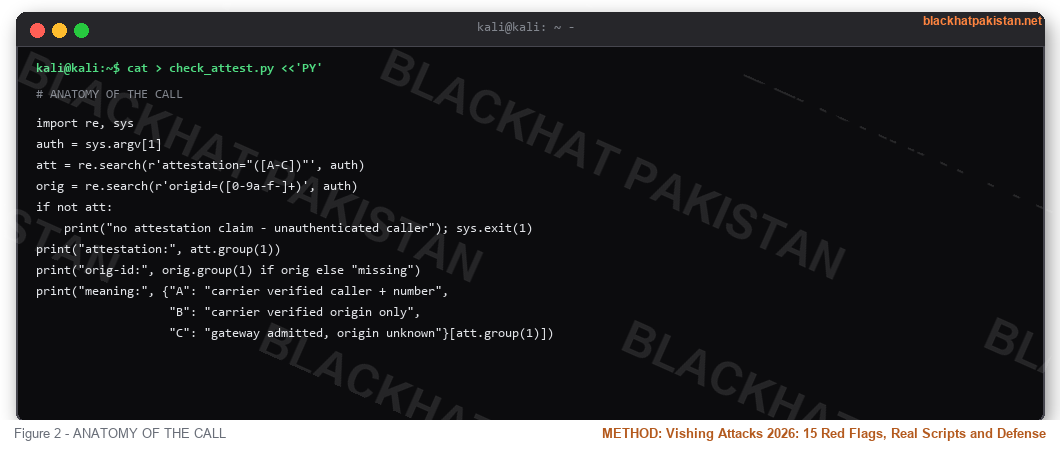
ANATOMY OF THE CALL
Every professional vishing operation runs the same four-stage pipeline. Preparation: the target list arrives from prior breaches, scraped directories, or purchased leads, enriched with name, bank, employer, and recent order data so the opener can quote something real. Spoofing: the caller ID displays a number the target recognizes - a bank's published line, a local number, sometimes the target's own number, which is a known spoofing trick called neighbor spoofing. Execution: the script runs, branching on the target's answers, with a second operator available to play the "supervisor" when resistance appears. Conversion: the harvested credential, approved push, or installed session gets used within minutes, because every minute between the call and the use is a minute the target might call the real bank.
Caller ID reality needs its own paragraph. Caller ID is a presentation field, set by whoever originates the call, and carriers pass it through with minimal verification on the public telephony path. STIR/SHAKEN - the caller ID authentication framework US carriers implemented under FCC mandate - signs originating calls with an attestation level: A means the carrier verified the caller is authorized to use the number, B means the carrier knows the origin but not the caller, C means gateway-level admission with no origin claim. A call with no attestation claim arriving as your bank's number is exactly what it looks like: unauthenticated. Telecom analytics then score remaining calls for spam likelihood, but score-based labeling only helps targets who look at the screen before answering - which is step one of defense anyway.
Code:
cat > check_attest.py <<'PY'

import re, sys

auth = sys.argv[1]

att = re.search(r'attestation="([A-C])"', auth)

orig = re.search(r'origid=([0-9a-f-]+)', auth)

if not att:

    print("no attestation claim - unauthenticated caller"); sys.exit(1)

print("attestation:", att.group(1))

print("orig-id:", orig.group(1) if orig else "missing")

print("meaning:", {"A": "carrier verified caller + number",

                   "B": "carrier verified origin only",

                   "C": "gateway admitted, origin unknown"}[att.group(1)])

PY

python3 check_attest.py 'Authorization: Credential ... attestation="A" origid=7f3a-91c2'

attestation: A

meaning: carrier verified caller + number
THE 15 RED FLAGS
- The call comes in unsolicited about an account, payment, or problem you did not report.
- Caller ID shows a number you recognize, but the voice asks you to verify identity anyway - institutions that actually called you already know who you are.
- Urgency with a deadline: account suspended in ten minutes, warrant pending, parcel returned today.
- Any request for a password, PIN, full card number, CVV, MFA code, or one-time passcode - real institutions never ask for these on an inbound call.
- Pressure to stay on the line while you "handle it" - hanging up and calling back is the universal escape and the script pre-empts it with arguments about queue times and case numbers.
- Requests to install software, approve a remote-access session, or read your screen - the tell of a tech-support or refund scam.
- Payment pressure toward gift cards, cryptocurrency, wire transfer, or a "safe account" - channels with no reversal and no identity check.
- Emotional temperature management: the caller manufactures panic, sympathy, or flattery to occupy the thinking part of your brain.
- Artificial verification theater - reciting your own address or partial account digits back to you. Data the attacker already holds is not proof of anything.
- Transfer chains: first-line agent, supervisor, "fraud department", each voice re-confirming the story so the escalation itself feels like verification.
- Requests for information that contradicts how your institution actually communicates - a bank that never calls about card activity suddenly very concerned about card activity.
- Caller ID that matches a number you can independently confirm as belonging to the organization, combined with callback resistance - spoofed plus defensive is the highest-confidence pair.
- Requests to move to a different channel mid-call - text me the code, continue over WhatsApp - which breaks the audit trail you could build by hanging up.
- The story requires secrecy from family, IT, or colleagues: real institutions do not need you to hide the call.
- Anything that feels rehearsed: rapid speech, minimal pause before answers, and scripted transitions when you push back - live operators reading a document have audible tells.
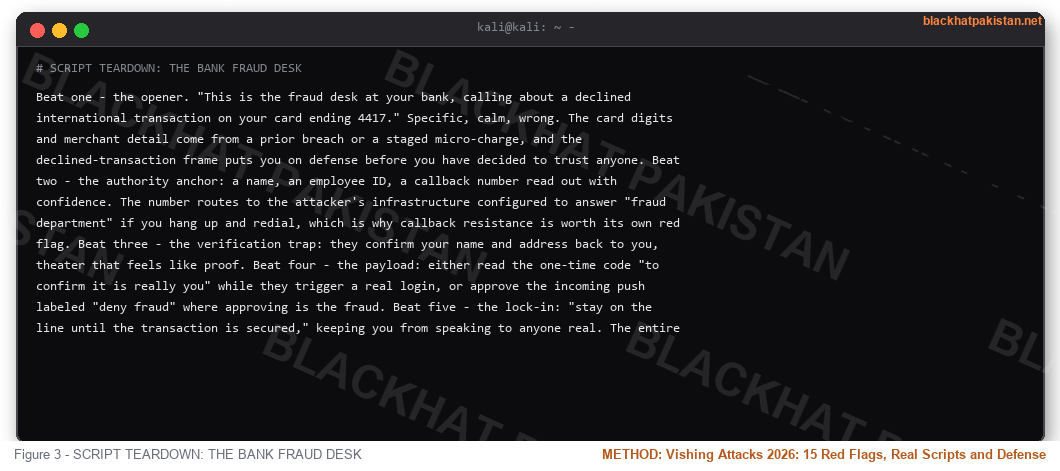
SCRIPT TEARDOWN: THE BANK FRAUD DESK
Beat one - the opener. "This is the fraud desk at your bank, calling about a declined international transaction on your card ending 4417." Specific, calm, wrong. The card digits and merchant detail come from a prior breach or a staged micro-charge, and the declined-transaction frame puts you on defense before you have decided to trust anyone. Beat two - the authority anchor: a name, an employee ID, a callback number read out with confidence. The number routes to the attacker's infrastructure configured to answer "fraud department" if you hang up and redial, which is why callback resistance is worth its own red flag. Beat three - the verification trap: they confirm your name and address back to you, theater that feels like proof. Beat four - the payload: either read the one-time code "to confirm it is really you" while they trigger a real login, or approve the incoming push labeled "deny fraud" where approving is the fraud. Beat five - the lock-in: "stay on the line until the transaction is secured," keeping you from speaking to anyone real. The entire script typically runs under three minutes; the money moves in the last forty seconds.
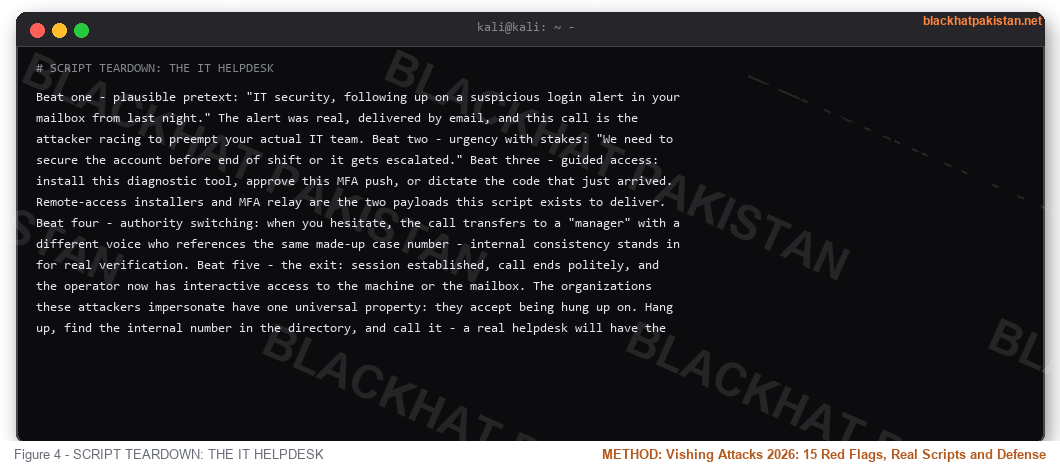
SCRIPT TEARDOWN: THE IT HELPDESK
Beat one - plausible pretext: "IT security, following up on a suspicious login alert in your mailbox from last night." The alert was real, delivered by email, and this call is the attacker racing to preempt your actual IT team. Beat two - urgency with stakes: "We need to secure the account before end of shift or it gets escalated." Beat three - guided access: install this diagnostic tool, approve this MFA push, or dictate the code that just arrived. Remote-access installers and MFA relay are the two payloads this script exists to deliver. Beat four - authority switching: when you hesitate, the call transfers to a "manager" with a different voice who references the same made-up case number - internal consistency stands in for real verification. Beat five - the exit: session established, call ends politely, and the operator now has interactive access to the machine or the mailbox. The organizations these attackers impersonate have one universal property: they accept being hung up on. Hang up, find the internal number in the directory, and call it - a real helpdesk will have the ticket; an attacker will not have your phone.
DEFENSE STACK
Personal layer: treat inbound calls as untrusted contacts until verified. Do not answer from the screen - if the story matters, end the call and dial the number on the back of your card, the number in your account portal, or the number printed on the bill. Never read codes, never approve unexpected pushes, never install software on instruction. Freeze your card in the banking app the moment a call feels wrong; card freezes are instant and reversible, unlike the forty seconds you spend debating it. Enable call screening on mobile, register the number with the Do Not Call registry where it applies, and treat robocalls as reconnaissance for the live calls that follow.
Organizational layer: authentication first - ensure your own inbound voice channel carries STIR/SHAKEN attestation so customers can trust calls you actually originate, and publish one verification number with staff instructions to use it for every callback. Training that rehearses the act: mock vishing calls quarterly with measured pickup-to-disclosure rates, because a lecture does not build the reflex that hanging up does. Tiered verification: outbound customer-facing staff cannot move funds or reset credentials based on a voice claim alone - a voice is an authentication factor for nothing. Monitor the brand: watch for spoofed numbers impersonating your domain, and brief customers on the one number you will never call from. The technical control that catches the rest is on the telecom side - spam labeling and analytics only suppress what they score, so the human reflex layer remains the last line.
VoIP abuse detection for teams running their own infrastructure has the same shape as any other scanner problem: log, threshold, ban. The snippet below drops a fail2ban jail for SIP enumeration and brute-force attempts hitting an SBC or PBX exposed to the internet.
Code:
sudo tee /etc/fail2ban/jail.d/sip-scan.conf <<'EOF'

[sip-scan]

enabled  = true

filter   = sip-scan

logpath  = /var/log/fail2ban-sip.log

maxretry = 5

findtime = 600

bantime  = 3600

action   = iptables-allports[name=SIP]

EOF

sudo fail2ban-client reload

fail2ban-client status sip-scan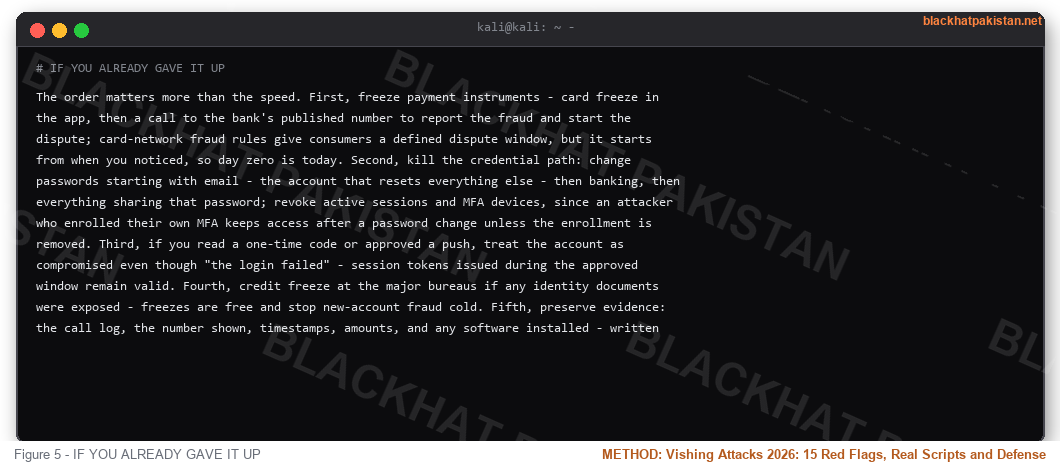
IF YOU ALREADY GAVE IT UP
The order matters more than the speed. First, freeze payment instruments - card freeze in the app, then a call to the bank's published number to report the fraud and start the dispute; card-network fraud rules give consumers a defined dispute window, but it starts from when you noticed, so day zero is today. Second, kill the credential path: change passwords starting with email - the account that resets everything else - then banking, then everything sharing that password; revoke active sessions and MFA devices, since an attacker who enrolled their own MFA keeps access after a password change unless the enrollment is removed. Third, if you read a one-time code or approved a push, treat the account as compromised even though "the login failed" - session tokens issued during the approved window remain valid. Fourth, credit freeze at the major bureaus if any identity documents were exposed - freezes are free and stop new-account fraud cold. Fifth, preserve evidence: the call log, the number shown, timestamps, amounts, and any software installed - written down before the details blur. Sixth, report it: the bank's fraud line, local police for the report number your bank will ask for, and the FTC's complaint portal in the US - reports aggregate into the statistics that fund the enforcement side of this problem.
FAQ
- Q: Can caller ID really be faked to show my bank's real number?
A: Yes - caller ID is a presentation field, spoofing tools set it at will, and STIR/SHAKEN attestation exists precisely because the industry admitted it. Treat an unrecognized or unattested caller ID as decorative.
- Q: Should I ever verify a caller by hanging up and calling back?
A: Hang up, then call the number printed on your card, statement, or the organization's official site - never a number the caller gave you, however real it sounds. A genuine institution will still be there when you dial their published line.
- Q: What is the single most dangerous thing I can do on a suspicious call?
A: Read back a one-time code or approve an unexpected MFA push while the caller is still talking. Credentials can be changed; an approved authentication window often cannot be recalled.
- Q: Do banks ever call customers about fraud?
A: They do - but they never ask for full card numbers, PINs, passwords, or codes, and they expect you to hang up and call back if anything feels off. Legitimate fraud teams build the callback into the script.
- Q: Does call blocking solve vishing?
A: Blocking and spam labeling suppress known bad numbers, but spoofed calls pass through daily. Screening reduces volume; the verification reflex is what stops the call that gets through.
- Q: What should a company do first against vishing?
A: Publish one verification number, train staff to use it for every callback, and lock the rule that no credential or fund movement ever completes on a voice claim alone. Then rehearse with mock calls so the reflex exists before the real one lands.
RELATED
How to Spot Phishing Emails 2026
What Is a Data Breach 2026
Password Leak Check
OWASP Top 10 2026


