

- Joined
- Dec 30, 2024
- Messages
- 410
- Reaction score
- 216
- Points
- 62
- Website
- blackhatpakistan.net
- Points
- 1,253
- USD
- 1,253
Credential stuffing is the attack that proves password strength was never the point: a leaked username-and-password pair from one breach gets replayed against every service you use, and login forms do not care where the pair came from. No cracking, no brute force, no software to exploit - just automation testing millions of known pairs until something works. Below: the 2026 combo-list economy, why MFA bends but does not break, a safe self-audit you can run against your own password export, a six-question exposure test, and the defense order that actually stops it. Post your worst reuse story - the one where one old forum password opened something that mattered.
TL;DR - Stuffing takes pairs from breach dumps and stealer logs and replays them everywhere, at scale, for cents per thousand attempts. Your password can be excellent and your account still dies if the same one ever appeared anywhere else. The 2026 twist: infostealers now exfiltrate session cookies too, so the pair is optional - a stolen cookie logs you in with no password and no MFA prompt at all. The self-audit below checks your own password-manager export for reuse and for known-breached entries without sending anything anywhere. The six-question test scores your exposure: auto-fill-everywhere, reusing work/personal patterns, no unique emails, MFA only on email, SMS as the only second factor, accepting every "session expired" prompt. Defense order: unique generated passwords per site via a manager, hardware key or app-based MFA everywhere it exists, kill SMS fallback, and treat any account tied to a phone number as a potential domino. Score it, post your dominoes, best cleanup story gets pinned.
WHAT STUFFING ACTUALLY IS
The mechanics are boring, which is why they work. Someone breaches a forum, a shop, a delivery app - the dump contains email addresses and password hashes, many of them unsalted MD5 or bcrypt with cheap parameters. Cracking recovers a chunk; the recovered pairs become combo lists, sold or traded by the thousand. A stuffing run points a distributed botnet at target login endpoints, walking the list: username field gets the email, password field gets the pair, a captcha farm or residential proxy pool keeps the rate limit happy. Success rate per list is typically one to five percent against real users, because people reuse - and one percent of ten million attempts is an account estate. Nothing about your chosen password matters unless it was unique.
WHY IT WORKS: THE FOUR FAILURE MODES
- Reuse - the load-bearing failure. One password across a 2013 forum and your current email means the forum breach IS the email breach, just delayed.
- Pattern reuse - unique but derivable: DogName2019! for the forum, DogName2020! for the bank. Cheap hashcat rules walk family names and years; pattern-uniques fall almost as fast as plain reuse.
- No second factor where it counts - stuffing scripts test in parallel; the accounts without MFA are the ones that complete. Email without MFA is the crown domino because password resets route through it.
- Session tokens as the shortcut - 2026's infostealers do not stop at passwords. They pull live cookies: a logged-in session replayed from a different country logs in as you, MFA satisfied long ago on the infected machine.
THE 2026 COMBO-LIST ECONOMY
Commodity lists are almost free - stealer-log collections trade for single-digit dollars because each log ships cookies AND passwords AND autofill data from one infected host. The economics flipped: an attacker no longer needs a big breach, they need one person running a cracked game installer on a machine with a browser worth stealing from. Redline, Lumma and similar loaders feed directly into stuffing-as-a-service panels where you pick a target domain, rent the botnet, and get results streamed back. The mitigation surface did not change - unique passwords and MFA still collapse the model - but the volume did: expect your old addresses to appear in new lists quarterly for the rest of time.
SAFE SELF-AUDIT: RUN IT ON YOUR OWN EXPORT
Everything below runs offline against a password-manager export. Nothing is transmitted - the breach check uses the k-anonymity range API where you send only the first five characters of a hash and receive matching suffixes locally. Take the export, run the audit, delete the export. The script prints reused passwords, pattern families, and any password whose hash appears in known breach corpora.
Code:
# 1. export from your password manager (Bitwarden/1Password/KeePass: csv)

# 2. audit locally - no network except the k-anonymity range lookup

python3 - <<'PY'

import csv, hashlib, urllib.request, collections

rows = list(csv.DictReader(open("export.csv", encoding="utf-8")))

pw = [r.get("password", "") for r in rows if r.get("password")]

# reuse groups

c = collections.Counter(pw)

reused = {k: v for k, v in c.items() if v > 1}

print("entries:", len(pw), "| reused passwords:", len(reused))

for k, v in sorted(reused.items(), key=lambda x: -x[1])[:10]:

    print("  x%d  %s..." % (v, k[:4] + "*" * 8))

# breach check by k-anonymity (5-char prefix only leaves this machine)

for p in list({k for k in reused} | set(pw))[:50]:

    h = hashlib.sha1(p.encode()).hexdigest().upper()

    u = "https://api.pwnedpasswords.com/range/" + h[:5]

    try:

        body = urllib.request.urlopen(u, timeout=10).read().decode()

        if any(line.split(":")[0] == h[5:] for line in body.splitlines()):

            print("BREACHED:", p[:4] + "*" * 8)

    except Exception as e:

        print("lookup skip:", str(e)[:40])

PY
STUFFING IN THE WILD: HOW IT FEELS FROM THE VICTIM SIDE
The account does not get "hacked" dramatically - it drifts. First: a login alert from a city you have never visited, dismissed once as a datacenter IP. Then: recovery email changed quietly. Then: the account sends messages to your contacts because the inbox is now a staging ground for the next wave. Businesses see it as a spike in failed logins followed by a thin tail of successes, always from residential proxies, always targeting the login endpoint directly rather than browsing the site. The tell that separates stuffing from a targeted compromise: no social engineering, no phishing click, no malware on your machine - just the correct pair arriving from somewhere that has never seen you before.
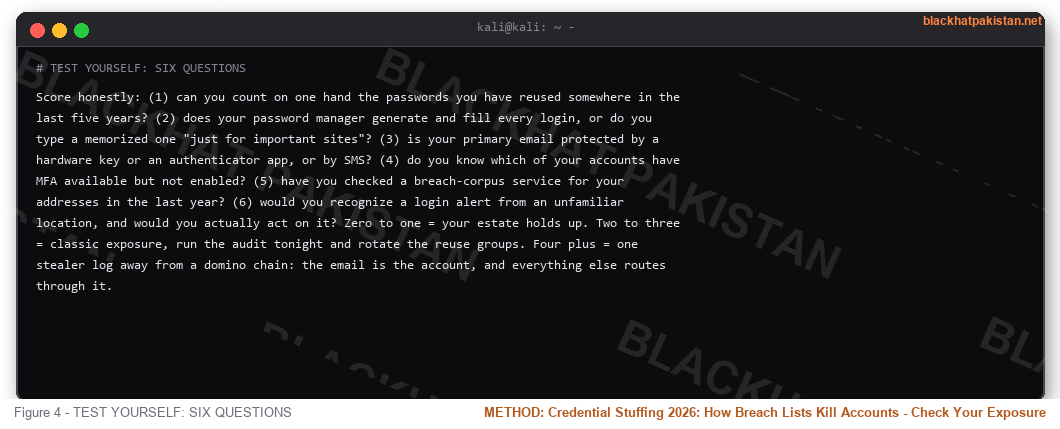
TEST YOURSELF: SIX QUESTIONS
Score honestly: (1) can you count on one hand the passwords you have reused somewhere in the last five years? (2) does your password manager generate and fill every login, or do you type a memorized one "just for important sites"? (3) is your primary email protected by a hardware key or an authenticator app, or by SMS? (4) do you know which of your accounts have MFA available but not enabled? (5) have you checked a breach-corpus service for your addresses in the last year? (6) would you recognize a login alert from an unfamiliar location, and would you actually act on it? Zero to one = your estate holds up. Two to three = classic exposure, run the audit tonight and rotate the reuse groups. Four plus = one stealer log away from a domino chain: the email is the account, and everything else routes through it.
POST YOUR CLEANUP
Report back in scoreboard format: number of reuse groups found, worst age of the reused password, which accounts sat behind the same one, and the MFA state you ended up with after cleanup. No actual credentials - describe, do not paste. Best before-and-after gets pinned; first fifteen posters who run the audit get the extended version of the script with pattern-family detection (years, pet names, keyboard walks) built in.
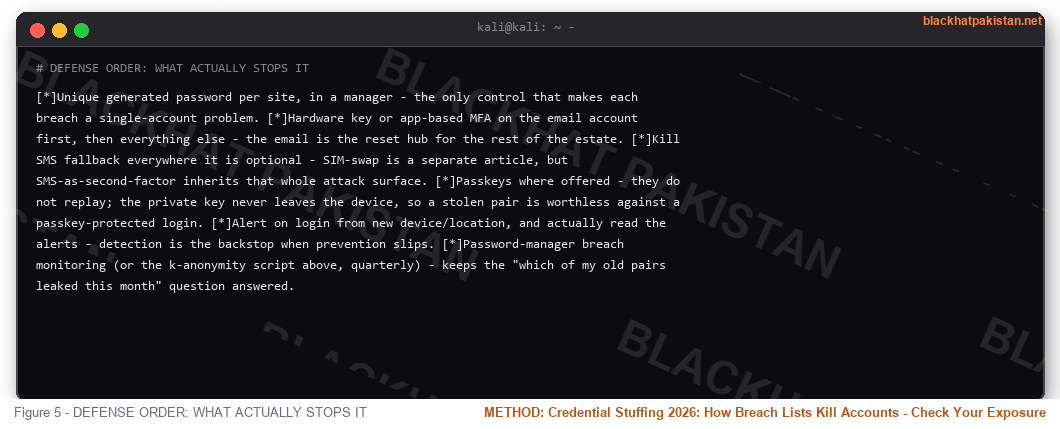
DEFENSE ORDER: WHAT ACTUALLY STOPS IT
- Unique generated password per site, in a manager - the only control that makes each breach a single-account problem.
- Hardware key or app-based MFA on the email account first, then everything else - the email is the reset hub for the rest of the estate.
- Kill SMS fallback everywhere it is optional - SIM-swap is a separate article, but SMS-as-second-factor inherits that whole attack surface.
- Passkeys where offered - they do not replay; the private key never leaves the device, so a stolen pair is worthless against a passkey-protected login.
- Alert on login from new device/location, and actually read the alerts - detection is the backstop when prevention slips.
- Password-manager breach monitoring (or the k-anonymity script above, quarterly) - keeps the "which of my old pairs leaked this month" question answered.
FAQ
- Q: If my password is long and random, am I safe from stuffing?
A: Safe from cracking, yes. Safe from stuffing only if that random password exists on exactly one site - the replay does not care about entropy, it cares about repetition.
- Q: Does MFA make stuffing irrelevant?
A: For accounts where MFA is actually enforced, near enough. Attackers route around it: they target accounts without it, or steal the session cookie so the MFA prompt never fires.
- Q: Where do combo lists come from now, post-2023?
A: Stealer logs dominate - one infected machine yields passwords, cookies and autofill from every site that person logged into. Old breach dumps still circulate underneath.
- Q: Is checking my email on a breach site safe?
A: K-anonymity range checks (the HIBP model) never send your password or full hash anywhere. Full-account lookup services email-verify first; use the ones that show you the result set, not the ones that sell "monitoring."
- Q: How often should I rotate passwords?
A: Not on a calendar - on events: a breach notice involving a site you use, a reuse-group found in your audit, or a login alert you cannot explain. Routine rotation without reuse discipline just produces patterns.
- Q: What is the single highest-value action tonight?
A: Make your primary email's password unique and put app-or-hardware MFA on it. Every other account can be reset from there; if "there" falls, nothing else matters.
RELATED
Password Leak Check
What Is a Data Breach 2026: Causes, Real Examples, Response Steps
What Is Malware 2026: 9 Types Ranked by Damage - Which One Hit You?
SIM Swap Attack 2026: 8 Signs Your Number Is Targeted (Take the Self-Check)


