

- Joined
- Dec 30, 2024
- Messages
- 410
- Reaction score
- 216
- Points
- 62
- Website
- blackhatpakistan.net
- Points
- 1,253
- USD
- 1,253
Malware is software built to do what someone else wants on a machine you own - and AV-TEST counts more than 450,000 new malicious samples hitting the internet every single day, so the question in 2026 is not whether something gets through your perimeter but which of the nine families it belongs to and how fast it moves. Rank, vectors, triage commands and a diagnosis test below: identify your strain, post it, get a detection snippet back.
TL;DR - Nine families cover almost everything you will meet: wiper, ransomware, banker trojan, infostealer, worm, botnet agent, rootkit, stalkerware, cryptominer - ranked below by how fast each one ruins your week. Entry vectors in 2026 stay boringly consistent: phishing email, cracked software, malicious ads, supply-chain updates, and browser extensions. Triage order when you suspect infection: disconnect, boot clean, image, then hunt - the two command blocks below pull process, persistence and network evidence on Windows and Linux. Defense that covers all nine: patched OS, hardened browser, an AV that actually scans archives, egress monitoring, and off-box backups tested quarterly. Post which of the nine you have actually seen in the wild - best diagnosis story gets pinned and the first fifteen posters get a custom detection snippet for their stack.
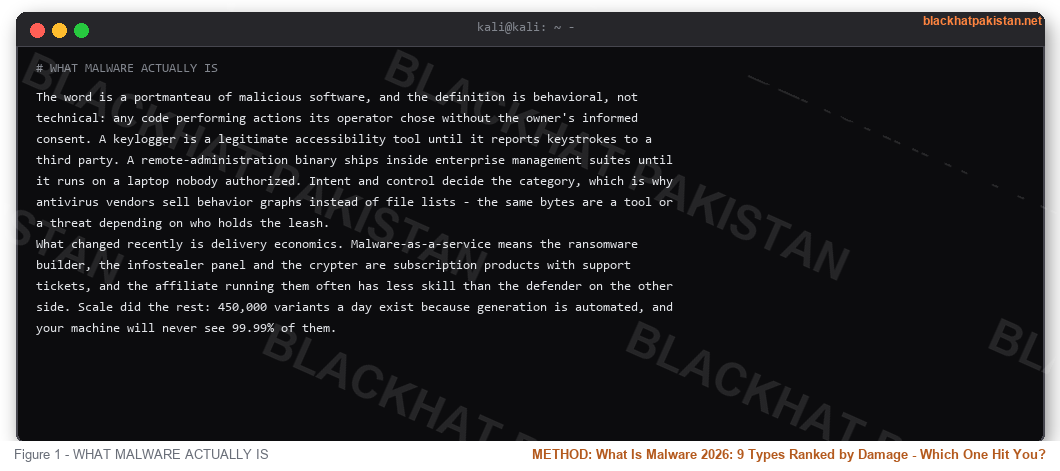
WHAT MALWARE ACTUALLY IS
The word is a portmanteau of malicious software, and the definition is behavioral, not technical: any code performing actions its operator chose without the owner's informed consent. A keylogger is a legitimate accessibility tool until it reports keystrokes to a third party. A remote-administration binary ships inside enterprise management suites until it runs on a laptop nobody authorized. Intent and control decide the category, which is why antivirus vendors sell behavior graphs instead of file lists - the same bytes are a tool or a threat depending on who holds the leash.
What changed recently is delivery economics. Malware-as-a-service means the ransomware builder, the infostealer panel and the crypter are subscription products with support tickets, and the affiliate running them often has less skill than the defender on the other side. Scale did the rest: 450,000 variants a day exist because generation is automated, and your machine will never see 99.99% of them.
THE 9 TYPES AND WHAT EACH ONE WANTS
- 1 - Wiper - wants destruction. Trashes partitions or overwrites boot structures; minutes to irreversible, politics or sabotage as motive.
- 2 - Ransomware - wants your money on a clock. Encrypts, posts the leak-site countdown, negotiates through support portals; hours to damage.
- 3 - Banker trojan - wants your session. Injects into banking and crypto sites, harvests one-time codes, proxies your authenticated traffic; days to wire transfers.
- 4 - Infostealer - wants everything at once. Passwords, cookies, wallet files, session tokens, screenshots - sold as per-host logs within hours of infection.
- 5 - Worm - wants neighbors. Self-replicates over SMB, RDP or vulnerable services; your machine becomes a factory before you notice.
- 6 - Botnet agent - wants your bandwidth and IP. Participates in DDoS or proxy-for-hire networks; often silent, discovered when abuse reports arrive.
- 7 - Rootkit - wants tenure. Patches kernel or firmware to hide itself and its friends; months of residency is normal, rebuild is the only cure.
- 8 - Stalkerware - wants one person's life. Hides on phones, forwards location, messages and mic recordings; the family-violence vector, not the corporate one.
- 9 - Cryptomoner - wants your electricity. Parasites the GPU or CPU; slowest burn, loudest fans, highest power bill.
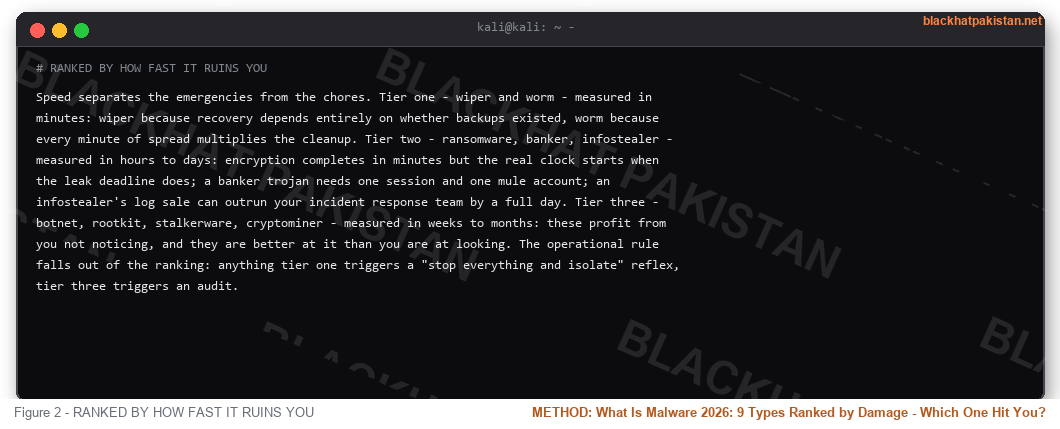
RANKED BY HOW FAST IT RUINS YOU
Speed separates the emergencies from the chores. Tier one - wiper and worm - measured in minutes: wiper because recovery depends entirely on whether backups existed, worm because every minute of spread multiplies the cleanup. Tier two - ransomware, banker, infostealer - measured in hours to days: encryption completes in minutes but the real clock starts when the leak deadline does; a banker trojan needs one session and one mule account; an infostealer's log sale can outrun your incident response team by a full day. Tier three - botnet, rootkit, stalkerware, cryptominer - measured in weeks to months: these profit from you not noticing, and they are better at it than you are at looking. The operational rule falls out of the ranking: anything tier one triggers a "stop everything and isolate" reflex, tier three triggers an audit.
HOW MALWARE GETS IN: 2026'S TOP 5 VECTORS
- Phishing email - still number one: credential-harvest pages, malicious HTML attachments that bypass gateway filters, and thread-hijacked replies to real conversations.
- Cracked software and "loaders" - the pirate scene is an infostealer marketplace wearing a keygen costume; the loader takes a cut by installing its customer's stealer alongside your torrent.
- Malicious and compromised advertising - malvertising drops fileless payloads through browser exploit kits, no click beyond the ad required in the worst rotations.
- Supply-chain updates - legitimate updaters signed with stolen or leaked certificates, dependency confusion in build pipelines, compromised npm or PyPI packages.
- Browser extensions and coupon tools - permissions requested once, behavior changed silently at version bump, data exfiltration dressed as "feature improvement."
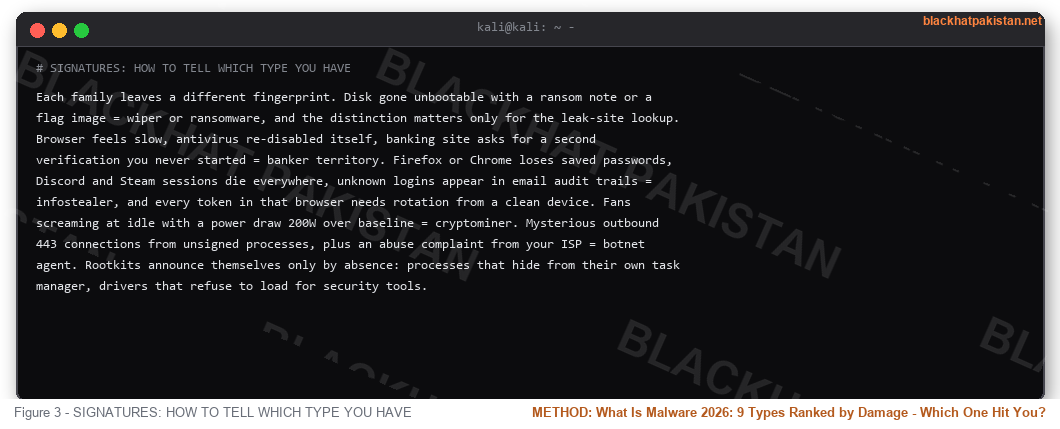
SIGNATURES: HOW TO TELL WHICH TYPE YOU HAVE
Each family leaves a different fingerprint. Disk gone unbootable with a ransom note or a flag image = wiper or ransomware, and the distinction matters only for the leak-site lookup. Browser feels slow, antivirus re-disabled itself, banking site asks for a second verification you never started = banker territory. Firefox or Chrome loses saved passwords, Discord and Steam sessions die everywhere, unknown logins appear in email audit trails = infostealer, and every token in that browser needs rotation from a clean device. Fans screaming at idle with a power draw 200W over baseline = cryptominer. Mysterious outbound 443 connections from unsigned processes, plus an abuse complaint from your ISP = botnet agent. Rootkits announce themselves only by absence: processes that hide from their own task manager, drivers that refuse to load for security tools.
REMOVAL ORDER: WHAT TO DO FIRST
Sequence beats tooling. One: disconnect - network cable or Wi-Fi off, because staged second-stage payloads are minutes behind the first and exfiltration is already running if it is an infostealer. Two: boot from clean media, never from the infected OS, because rootkits hook the running system's own introspection. Three: image the disk before touching anything if the machine matters - memory-resident evidence (tokens, injected code) dies on shutdown, so memory capture comes first when you can. Four: hunt persistence - scheduled tasks, services, Run keys, WMI subscriptions, browser extension IDs. Five: rotate credentials from a known-clean device, not the machine you just cleaned - session cookies do not need your password to keep working. The two blocks below pull the first three answers from a live system:
Code:
# Windows triage (PowerShell, run elevated)

Get-MpComputerStatus | Select AMServiceEnabled,RealTimeProtectionEnabled

Get-Process | Sort WS -Desc | Select -First 15 Name,Id,@{n='MB';e={[int]($_.WS/1MB)}}

Get-CimInstance Win32_StartupCommand | Select Name,Command

Get-ScheduledTask | Where {$_.State -ne 'Disabled'} | Select TaskName,TaskPath

Get-NetTCPConnection -State Established | Select OwningProcess,RemoteAddress
Code:
# Linux triage (root shell)

ps aux --sort=-%mem | head -15

ls -la /etc/cron.* /var/spool/cron 2>/dev/null

ss -tunap | grep ESTAB

ls -l /bin /usr/bin /sbin /usr/sbin 2>/dev/null | grep '^...s'

systemctl list-units --type=service --state=running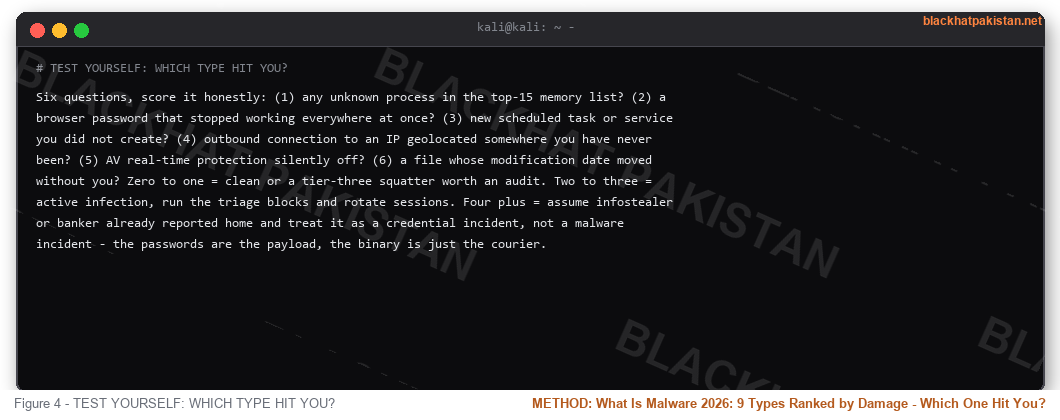
TEST YOURSELF: WHICH TYPE HIT YOU?
Six questions, score it honestly: (1) any unknown process in the top-15 memory list? (2) a browser password that stopped working everywhere at once? (3) new scheduled task or service you did not create? (4) outbound connection to an IP geolocated somewhere you have never been? (5) AV real-time protection silently off? (6) a file whose modification date moved without you? Zero to one = clean or a tier-three squatter worth an audit. Two to three = active infection, run the triage blocks and rotate sessions. Four plus = assume infostealer or banker already reported home and treat it as a credential incident, not a malware incident - the passwords are the payload, the binary is just the courier.
POST YOUR DIAGNOSIS
Scoreboard format: the nine, which one you actually encountered, how it arrived, and how long it lived before you caught it - redact your own indicators, name the family freely. Best field story gets pinned; first fifteen posters get a detection snippet matched to their stack - YARA rule for files, PowerShell transcription for Windows, auditd rules for Linux, whichever fits what they run. The most instructive replies will be the tier-three ones: the miners and botnets people ran for months without knowing, because that is where the learning curve actually lives.
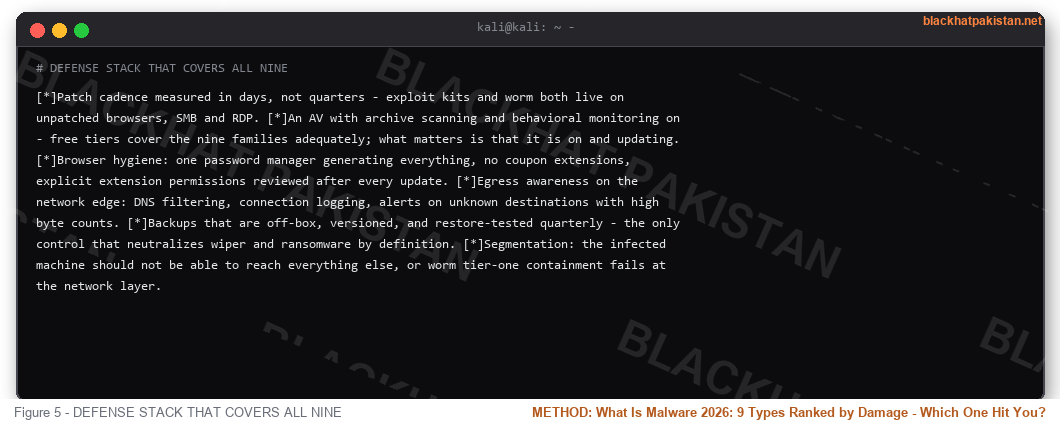
DEFENSE STACK THAT COVERS ALL NINE
- Patch cadence measured in days, not quarters - exploit kits and worm both live on unpatched browsers, SMB and RDP.
- An AV with archive scanning and behavioral monitoring on - free tiers cover the nine families adequately; what matters is that it is on and updating.
- Browser hygiene: one password manager generating everything, no coupon extensions, explicit extension permissions reviewed after every update.
- Egress awareness on the network edge: DNS filtering, connection logging, alerts on unknown destinations with high byte counts.
- Backups that are off-box, versioned, and restore-tested quarterly - the only control that neutralizes wiper and ransomware by definition.
- Segmentation: the infected machine should not be able to reach everything else, or worm tier-one containment fails at the network layer.
FAQ
- Q: Is malware the same as a virus?
A: Virus is one family inside the malware umbrella - self-replicating code that attaches to other files. Ransomware, stealers and rootkits are malware without being viruses; the terms collapsed in marketing long ago.
- Q: Do Macs and phones get malware?
A: Yes, at lower volume and rising. macOS infostealers (Atomic, Realm) and Android stalkerware are active product lines in 2026; platform market share keeps attracting development.
- Q: Does antivirus catch everything?
A: No - signature engines miss novel builds, and fileless or living-off-the-land activity uses legitimate binaries. Behavioral detection plus egress logging plus patching together cover what no single layer does.
- Q: Which vector is riskiest right now?
A: Phishing with session-token theft: it skips passwords entirely, and infostealer logs provide both the token and the context. Browser-session hygiene matters more than password complexity because of it.
- Q: Free or paid AV - does it matter for the nine?
A: Both stop the commodity families. Paid tiers add response tooling and better false-positive handling, not a different class of protection; spend the budget on backups and patching instead.
- Q: What is the first action after confirming infection?
A: Disconnect from network before anything else - staging and exfiltration both need connectivity, and every minute connected is a minute of evidence leaving.
RELATED
How to Spot Phishing Emails 2026: 15 Red Flags and Real Samples
Password Leak Check
What Is a Data Breach 2026: Causes, Real Examples, Response Steps
Cybersecurity Awareness Month 2026: 7-Day Challenge (Comment Your Score)
Last edited:


