

- Joined
- Dec 30, 2024
- Messages
- 410
- Reaction score
- 216
- Points
- 62
- Website
- blackhatpakistan.net
- Points
- 1,253
- USD
- 1,253
An IP logger is a wrapper link that captures your IP address, ISP, approximate city, browser, and device the instant you open it - Grabify, IPLogger and similar services pull it off through an ordinary redirect chain, roughly 4.2 billion IPv4 addresses still route consumer traffic, and the logger only needs the one your browser hands over for free. Nothing on your screen blinks. The page loads, the bait image shows, and the log entry is already written.
TL;DR - A grabber link is a shortened URL that redirects through a logging server, stores the visitor's IP, reverse-DNS hostname, ISP org, city-level geolocation, user-agent, referrer and (if WebRTC cooperates) local interface addresses, then forwards you to the real content. What it realistically reveals: your internet provider, your metro area, your browser build, your OS - not your street address, not your name, not your phone's photos. What it does not protect you from: the same data feeds targeted phishing and social engineering, which is why the recon chain in this thread's ecosystem flows dork to logger to vishing script. Test it yourself below with a link you control, post what your own logger captured, and the first ten posters get filter rules that strip every logged field before the redirect fires.
WHAT AN IP LOGGER ACTUALLY IS
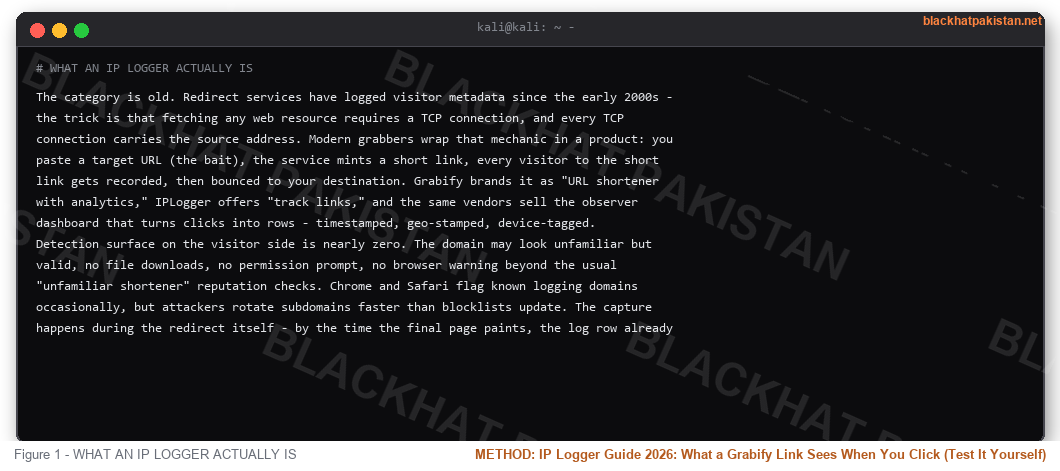
The category is old. Redirect services have logged visitor metadata since the early 2000s - the trick is that fetching any web resource requires a TCP connection, and every TCP connection carries the source address. Modern grabbers wrap that mechanic in a product: you paste a target URL (the bait), the service mints a short link, every visitor to the short link gets recorded, then bounced to your destination. Grabify brands it as "URL shortener with analytics," IPLogger offers "track links," and the same vendors sell the observer dashboard that turns clicks into rows - timestamped, geo-stamped, device-tagged.
Detection surface on the visitor side is nearly zero. The domain may look unfamiliar but valid, no file downloads, no permission prompt, no browser warning beyond the usual "unfamiliar shortener" reputation checks. Chrome and Safari flag known logging domains occasionally, but attackers rotate subdomains faster than blocklists update. The capture happens during the redirect itself - by the time the final page paints, the log row already exists.
WHAT YOUR IP ADDRESS REALLY REVEALS
Curiosity runs hot here: people believe their IP is a home-address beacon. The reality sits between marketing fear and dismissal.
- ISP and ASN - which provider routes you (Comcast, Jio, PTCL) and the network block's registration org. Instantly visible, no tools needed.
- Approximate location - city or metro region resolved from the ISP's allocation records, typically accurate to 10-50 km in dense countries, often the ISP's hub city instead of yours.
- Browser and OS fingerprint - the User-Agent string (Chrome 130, Windows 11), Accept-Language, and screen hints from JavaScript when the logger runs a payload.
- Referrer and entry path - which page linked to you, what campaign tag rode along, whether you arrived from Gmail, WhatsApp or Discord.
- Reverse DNS and ports - hostname lookups (cpe-72-14-201-5.example.cox.net) leak ISP naming schemes; exposed ports on your address are trivially enumerable afterward.
- Not revealed: your legal name, street address, Wi-Fi password, contacts or files. That mapping lives with your ISP, served only to lawful process - a logger row has no warrant attached.
HOW A GRABBER LINK WORKS STEP BY STEP
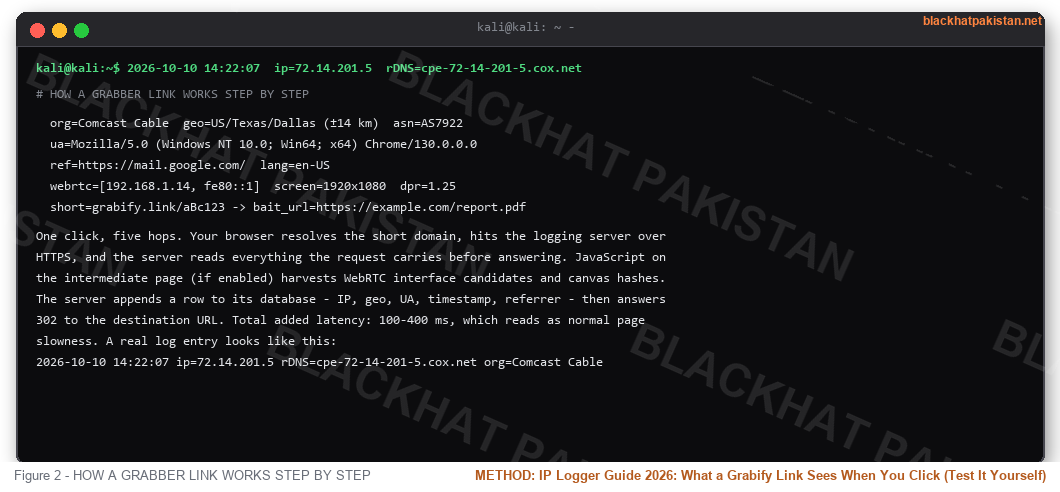
One click, five hops. Your browser resolves the short domain, hits the logging server over HTTPS, and the server reads everything the request carries before answering. JavaScript on the intermediate page (if enabled) harvests WebRTC interface candidates and canvas hashes. The server appends a row to its database - IP, geo, UA, timestamp, referrer - then answers 302 to the destination URL. Total added latency: 100-400 ms, which reads as normal page slowness. A real log entry looks like this:
Code:
2026-10-10 14:22:07  ip=72.14.201.5  rDNS=cpe-72-14-201-5.cox.net

  org=Comcast Cable  geo=US/Texas/Dallas (±14 km)  asn=AS7922

  ua=Mozilla/5.0 (Windows NT 10.0; Win64; x64) Chrome/130.0.0.0

  ref=https://mail.google.com/  lang=en-US

  webrtc=[192.168.1.14, fe80::1]  screen=1920x1080  dpr=1.25

  short=grabify.link/aBc123 -> bait_url=https://example.com/report.pdf
Read the row like an operator: the rDNS line confirms ISP and region, the webrtc line (when present) leaks the private LAN address, and the referrer tells the attacker which pretext worked - a fake invoice mail gets different follow-up than a Discord DM.
ANATOMY OF A LOGGED REQUEST
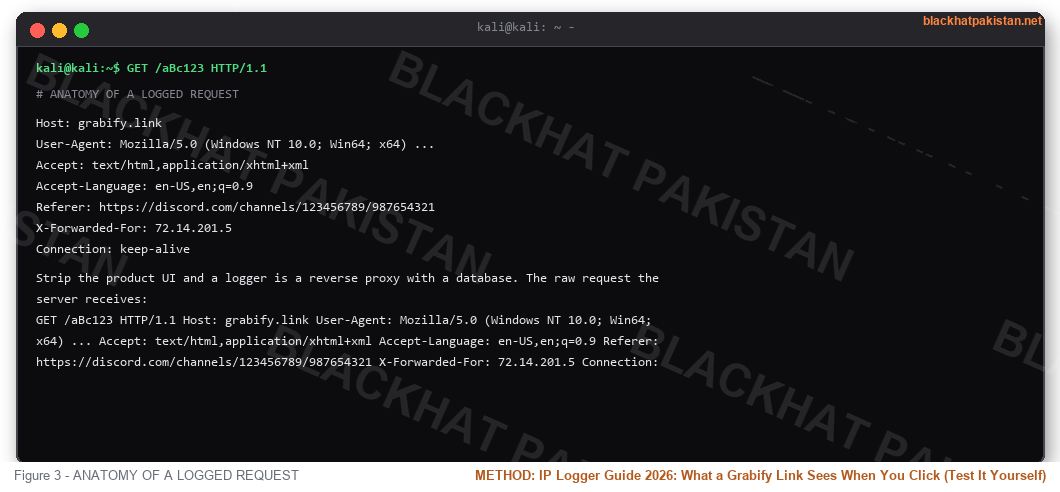
Strip the product UI and a logger is a reverse proxy with a database. The raw request the server receives:
Code:
GET /aBc123 HTTP/1.1

Host: grabify.link

User-Agent: Mozilla/5.0 (Windows NT 10.0; Win64; x64) ...

Accept: text/html,application/xhtml+xml

Accept-Language: en-US,en;q=0.9

Referer: https://discord.com/channels/123456789/987654321

X-Forwarded-For: 72.14.201.5

Connection: keep-alive
Every line is volunteered by the browser as part of normal protocol behavior - no exploit, no malware, no privilege. That is the whole trick: the data needed for the log is the same data every web server already receives, and most site owners never look at their own access logs with this lens.
TESTING IT: MAKE YOUR OWN LOGGED LINK
The only ethical configuration of this tool is against yourself. Grab your own short link from Grabify or IPLogger, set the bait to a URL you own (your blog, a cat photo, anything real), and send it to yourself - phone on mobile data, laptop on home Wi-Fi, ideally a friend who consents. Open the dashboard and read your own rows: city precision, ISP naming, what the referrer looked like coming from WhatsApp versus email. Twenty minutes of this teaches more than any defense thread - you will see exactly how coarse the geo is, exactly which fields your VPN wiped (IP but not User-Agent, not language, not referrer), and exactly what an attacker on the other side of the bait would now know.
DOES A VPN MAKE YOU INVISIBLE?
It changes the recorded IP to the VPN exit node's - city jumps to wherever the exit sits, ISP becomes the VPN's ASN - and that alone kills the geolocation angle. What survives: your User-Agent and browser build, your language and timezone hints, the referrer chain, and WebRTC leaks when the VPN does not handle them (modern VPN clients do, browser extensions often do not). DNS-over-HTTPS and disabling WebRTC close the remaining passive channels. Full invisibility requires all three layers at once - network (VPN/Tor), browser (consistent UA, WebRTC off), behavior (no referrer leaks from logged-in sessions) - because the logger records what your browser donates, and browsers are generous.
POST WHAT YOUR OWN LINK LOGGED
Scoreboard format: which service you used, which channel you delivered the link through (mail, WhatsApp, Discord, SMS), and which fields surprised you - keep the target yourself or a consenting friend, redact your public IP's last octet. Best row anatomy wins pin. First ten posters get a custom filter writeup: reverse-proxy header strip, WebRTC lock, and referrer policy settings matched to their stack - nginx, Apache, or Caddy configs included. The field that changes minds in every thread like this is referrer - people discover Gmail and Discord leak themselves through one header and never think about tracking pixels the same way again.
FAQ
- Q: Does an IP logger show my home address?
A: No. It shows your ISP and a city-level region resolved from public allocation records - typically 10-50 km accuracy, often the ISP's hub rather than your home. Street-level mapping requires ISP records plus lawful process, which the logger does not have.
- Q: Is clicking an IP logger link illegal or dangerous by itself?
A: Clicking records metadata you already transmit to every website you visit. The risk is follow-on: attackers combine the log with a pretext - a voice call citing your city, a phishing page wearing your ISP's branding - which is why the linked vishing playbook matters more than the logger.
- Q: How do I check if a link is a Grabify logger before opening it?
A: Hover and read the domain - grabify.link, iplogger.org and their vanity subdomains are the tell; unknown shorteners can be previewed by pasting them into a URL expander or a reputation checker without visiting. Browser "unfamiliar shortener" warnings flag many, not all.
- Q: Does a VPN or Tor block IP loggers completely?
A: It blocks the IP capture, not the fingerprint. User-Agent, language, screen metrics and referrer still log. Tor rotates addresses per circuit but marks the UA as Tor, which changes how attackers profile you rather than hiding you outright.
- Q: Do loggers work when the link is opened in WhatsApp or Telegram previews?
A: Sometimes better - messenger link previews fetch the URL server-side, so the first row can be the platform's crawler IP instead of yours. That row is a false read for the attacker and a warning sign for you if a "friend's" link prefetched before you ever tapped it.
- Q: How do I protect my own site's visitors from being logged through my domain?
A: Harden outbound links - set Referrer-Policy: strict-origin-when-cross-origin, avoid open-redirect endpoints (the dorks thread's /redirect?url= finds them), and log your own referral chains so wrap-around referrers through shorteners surface in your analytics.
RELATED
Vishing Attacks 2026: 15 Red Flags, Real Scripts and Defense
Google Dorks 2026: 40 Ready-to-Run Dorks
Vulnerability Assessment 2026: Method, Tools and Report Template
What Is a Data Breach 2026: Causes, Real Examples, Response Steps


