

- Joined
- Dec 30, 2024
- Messages
- 410
- Reaction score
- 216
- Points
- 62
- Website
- blackhatpakistan.net
- Points
- 1,253
- USD
- 1,253
Smishing is phishing delivered by text message, and the FTC's consumer data book logged $331 million in losses from scams that started with a single SMS in one year - because a phone screen shows every message, within minutes, to a person who is already holding it. This one is a test, not a lecture: ten real-world message patterns below, nine are hostile, one is legit, and your job is to score yourself out of ten and post it - the comments section is the scoreboard.
TL;DR - Smishing runs on guaranteed delivery: carrier SMS bypasses email filters entirely and industry data has held SMS open rates near 98 percent, almost all within the first three minutes. The ten-message quiz uses the real 2026 catalog - parcel holds, toll roads, bank reply-Y lures, payroll redirects, utility shutoffs, family emergencies - with every verdict and tell hidden in one click. The five universal tells cover the whole category: unexpected urgency, shortened or lookalike domains, requests for credentials or codes, payment pressure, and reply resistance to verification. If you already tapped: stop entering data, forward the text to 7726, change the relevant password from another device, and report it - your score goes in the thread below.
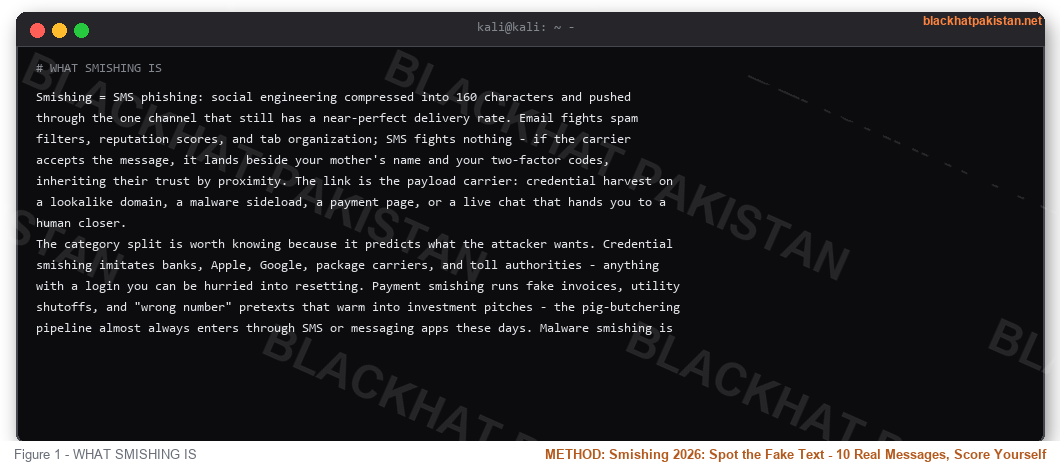
WHAT SMISHING IS
Smishing = SMS phishing: social engineering compressed into 160 characters and pushed through the one channel that still has a near-perfect delivery rate. Email fights spam filters, reputation scores, and tab organization; SMS fights nothing - if the carrier accepts the message, it lands beside your mother's name and your two-factor codes, inheriting their trust by proximity. The link is the payload carrier: credential harvest on a lookalike domain, a malware sideload, a payment page, or a live chat that hands you to a human closer.
The category split is worth knowing because it predicts what the attacker wants. Credential smishing imitates banks, Apple, Google, package carriers, and toll authorities - anything with a login you can be hurried into resetting. Payment smishing runs fake invoices, utility shutoffs, and "wrong number" pretexts that warm into investment pitches - the pig-butchering pipeline almost always enters through SMS or messaging apps these days. Malware smishing is rarer on modern iOS and Android but alive through enterprise profiles and sideload prompts on Android: the message that wants you to "install the viewer" or "update your banking app" from a provided link. Nine of the ten messages in the quiz below come from the first two categories.
WHY TEXTS BEAT EMAIL (FOR ATTACKERS)
Delivery: there is no spam folder in carrier SMS - filtering exists at the carrier and device level now, but spoofed or fresh sender IDs sail through at volume. Open rates: SMS has sat near 98 percent in industry measurement for years, with reads inside three minutes - no email marketing department has ever touched those numbers, and neither have defenders. Psychology: an unread text carries an open-loop obligation; an unread email carries none. The brain closes loops, which is why your bank text gets read at a red light and your bank email waits until Thursday. And the format itself compresses urgency: 160 characters cannot hold nuance, so every message reads like an alarm - exactly the register social engineering wants.
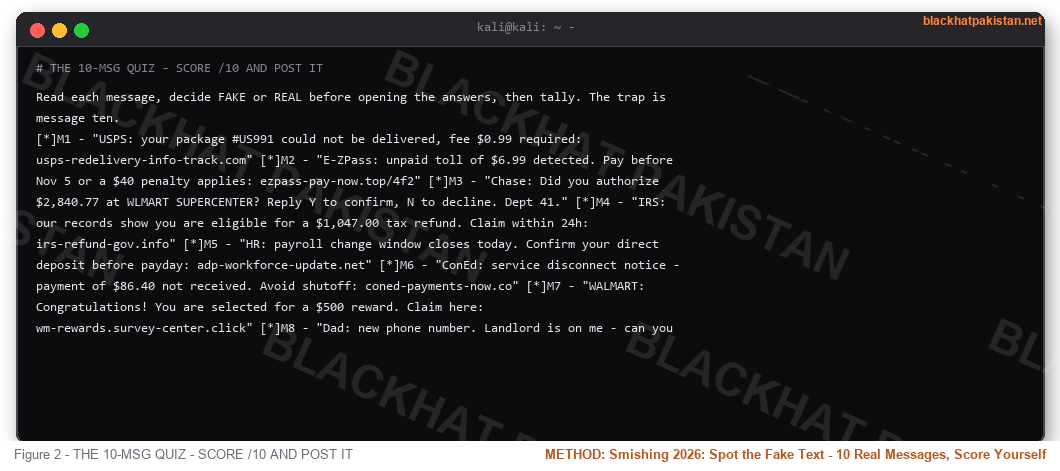
THE 10-MSG QUIZ - SCORE /10 AND POST IT
Read each message, decide FAKE or REAL before opening the answers, then tally. The trap is message ten.
- M1 - "USPS: your package #US991 could not be delivered, fee $0.99 required: usps-redelivery-info-track.com"
- M2 - "E-ZPass: unpaid toll of $6.99 detected. Pay before Nov 5 or a $40 penalty applies: ezpass-pay-now.top/4f2"
- M3 - "Chase: Did you authorize $2,840.77 at WLMART SUPERCENTER? Reply Y to confirm, N to decline. Dept 41."
- M4 - "IRS: our records show you are eligible for a $1,047.00 tax refund. Claim within 24h: irs-refund-gov.info"
- M5 - "HR: payroll change window closes today. Confirm your direct deposit before payday: adp-workforce-update.net"
- M6 - "ConEd: service disconnect notice - payment of $86.40 not received. Avoid shutoff: coned-payments-now.co"
- M7 - "WALMART: Congratulations! You are selected for a $500 reward. Claim here: wm-rewards.survey-center.click"
- M8 - "Dad: new phone number. Landlord is on me - can you Zelle $300 for rent right now? I'll send it back tonight."
- M9 - "Apple: your Apple ID was used to sign in on a new device in Ohio. Verify within 12 hours: apple-security-verify.com"
- M10 - "482913 is your Instagram login code. Don't share this code with anyone."
- M1 FAKE - carrier sites never collect a "re-delivery fee," and the domain hyphenates USPS branding over a .com you do not recognize. Real carriers text from short codes, not link-drops.
- M2 FAKE - toll authorities mail violators or post official portals; .top is a disposable-grade TLD, and the deadline-plus-penalty pair is manufactured urgency.
- M3 FAKE (the hardest one) - banks do send reply-Y fraud checks, which is why the number matters: the message never lets YOU verify, and a spoofed sender ID + short code look real. Legitimate version arrives with a callback number you already have - and any "Y" reply that leads to a call asking for codes is the upgrade attack.
- M4 FAKE - the IRS does not initiate refunds by SMS, ever, and .info with "gov" glued to it is the oldest lookalike trick in the book.
- M5 FAKE - payroll changes go through your actual HR portal with MFA, never through an SMS link; this is business email compromise wearing a text message.
- M6 FAKE - utility disconnect notices follow posted letters and official bill channels; the domain is a misspelled handbrake turn away from the real brand.
- M7 FAKE - you cannot win a drawing you never entered; survey-center.click is a credential or card-harvest page dressed as generosity.
- M8 FAKE - family emergency texts are the highest-conversion script in the catalog because love verifies slowly; the real tell is any payment channel requested under time pressure from a "new number."
- M9 FAKE - real Apple security alerts point you to Settings on the device in your hand, not to a domain; apple-security-verify.com is registration-service branding, not Apple.
- M10 REAL - IF you triggered it within the last minute. OTP texts from short codes are the genuine article; the attack built on top of them is MFA-fatigue - codes you did NOT request arriving repeatedly until you approve the one the attacker is using. No login prompt from you = treat the code text itself as the lure.
- M2 FAKE - toll authorities mail violators or post official portals; .top is a disposable-grade TLD, and the deadline-plus-penalty pair is manufactured urgency.
- M3 FAKE (the hardest one) - banks do send reply-Y fraud checks, which is why the number matters: the message never lets YOU verify, and a spoofed sender ID + short code look real. Legitimate version arrives with a callback number you already have - and any "Y" reply that leads to a call asking for codes is the upgrade attack.
- M4 FAKE - the IRS does not initiate refunds by SMS, ever, and .info with "gov" glued to it is the oldest lookalike trick in the book.
- M5 FAKE - payroll changes go through your actual HR portal with MFA, never through an SMS link; this is business email compromise wearing a text message.
- M6 FAKE - utility disconnect notices follow posted letters and official bill channels; the domain is a misspelled handbrake turn away from the real brand.
- M7 FAKE - you cannot win a drawing you never entered; survey-center.click is a credential or card-harvest page dressed as generosity.
- M8 FAKE - family emergency texts are the highest-conversion script in the catalog because love verifies slowly; the real tell is any payment channel requested under time pressure from a "new number."
- M9 FAKE - real Apple security alerts point you to Settings on the device in your hand, not to a domain; apple-security-verify.com is registration-service branding, not Apple.
- M10 REAL - IF you triggered it within the last minute. OTP texts from short codes are the genuine article; the attack built on top of them is MFA-fatigue - codes you did NOT request arriving repeatedly until you approve the one the attacker is using. No login prompt from you = treat the code text itself as the lure.
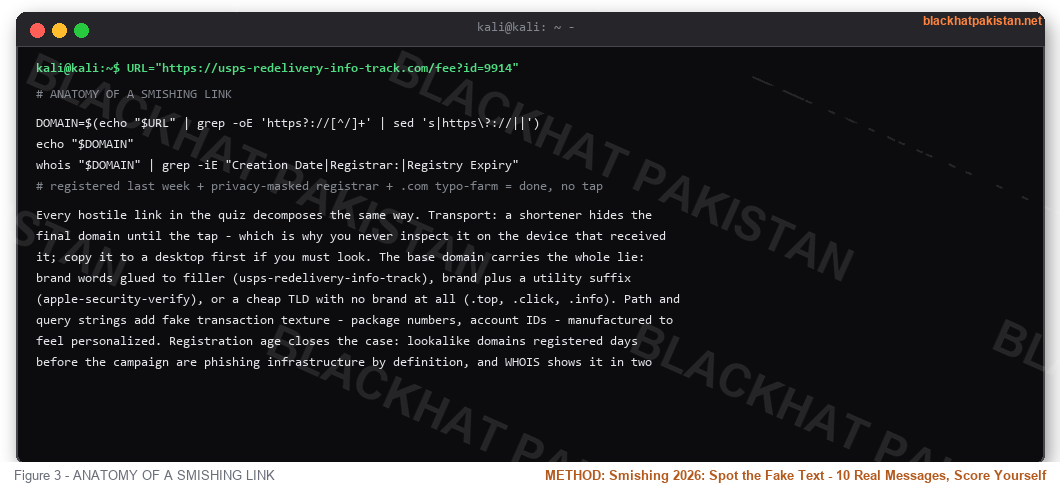
ANATOMY OF A SMISHING LINK
Every hostile link in the quiz decomposes the same way. Transport: a shortener hides the final domain until the tap - which is why you never inspect it on the device that received it; copy it to a desktop first if you must look. The base domain carries the whole lie: brand words glued to filler (usps-redelivery-info-track), brand plus a utility suffix (apple-security-verify), or a cheap TLD with no brand at all (.top, .click, .info). Path and query strings add fake transaction texture - package numbers, account IDs - manufactured to feel personalized. Registration age closes the case: lookalike domains registered days before the campaign are phishing infrastructure by definition, and WHOIS shows it in two lines.
Code:
URL="https://usps-redelivery-info-track.com/fee?id=9914"

DOMAIN=$(echo "$URL" | grep -oE 'https?://[^/]+' | sed 's|https\?://||')

echo "$DOMAIN"

whois "$DOMAIN" | grep -iE "Creation Date|Registrar:|Registry Expiry"

# registered last week + privacy-masked registrar + .com typo-farm = done, no tap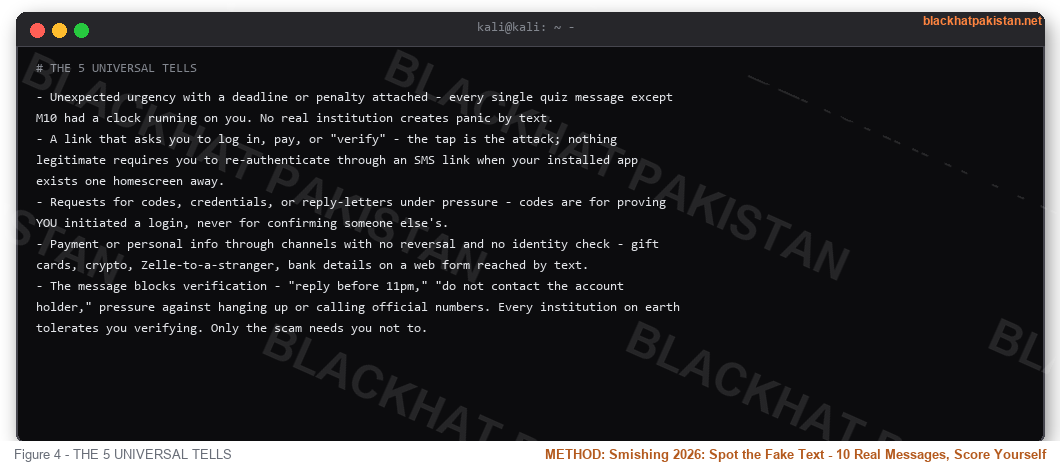
THE 5 UNIVERSAL TELLS
- Unexpected urgency with a deadline or penalty attached - every single quiz message except M10 had a clock running on you. No real institution creates panic by text.
- A link that asks you to log in, pay, or "verify" - the tap is the attack; nothing legitimate requires you to re-authenticate through an SMS link when your installed app exists one homescreen away.
- Requests for codes, credentials, or reply-letters under pressure - codes are for proving YOU initiated a login, never for confirming someone else's.
- Payment or personal info through channels with no reversal and no identity check - gift cards, crypto, Zelle-to-a-stranger, bank details on a web form reached by text.
- The message blocks verification - "reply before 11pm," "do not contact the account holder," pressure against hanging up or calling official numbers. Every institution on earth tolerates you verifying. Only the scam needs you not to.
IF YOU ALREADY TAPPED
Sequence matters. Stop the session: close the page, do not enter anything further - partial entries still feed the harvest. Capture: screenshot the message with the sender and link visible - you will need it for the report and the bank. Forward to 7726: the US carrier shortcode for spam - forward the message there and the carriers' abuse desks aggregate the campaign, which actually gets number ranges blocked. Rotate credentials from another device: if you typed a password anywhere reachable from that link, change it starting with email, and treat any code you read aloud during a call as burned - revoke sessions and re-enroll MFA. Money path: if banking details or card numbers were entered, freeze the card in-app first, then call the fraud line on the back of the card; card-network dispute windows start from discovery, and discovery is now. Report: ReportFraud.ftc.gov in the US, reportphishing@apwg.org for the sample itself, and your state's attorney general portal if money moved. Monitor: for the next sixty days, treat unexpected codes and "account changed" notifications as live incidents, not noise.
POST YOUR SCORE
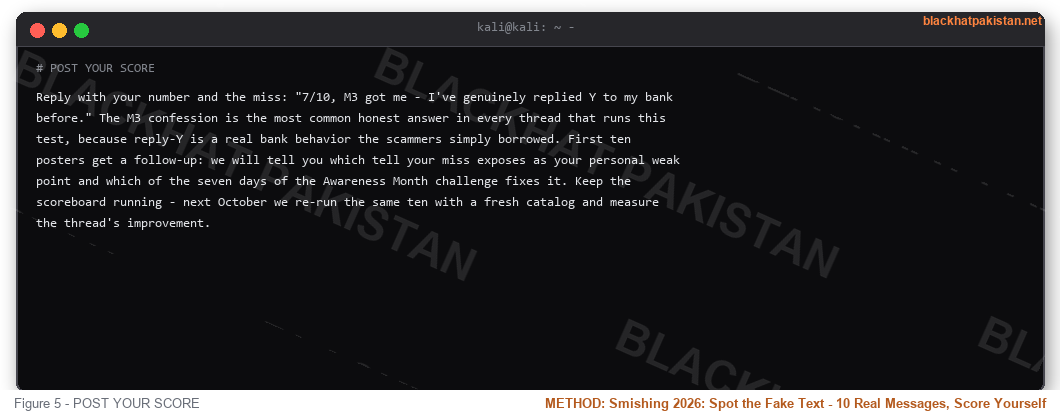
Reply with your number and the miss: "7/10, M3 got me - I've genuinely replied Y to my bank before." The M3 confession is the most common honest answer in every thread that runs this test, because reply-Y is a real bank behavior the scammers simply borrowed. First ten posters get a follow-up: we will tell you which tell your miss exposes as your personal weak point and which of the seven days of the Awareness Month challenge fixes it. Keep the scoreboard running - next October we re-run the same ten with a fresh catalog and measure the thread's improvement.
FAQ
- Q: What is smishing in one sentence?
A: Phishing that arrives by SMS - a text engineered to make you tap a link, read a code, or send money, riding the one messaging channel with near-guaranteed delivery.
- Q: Can a text message hack my phone just by being opened?
A: Opening a plain SMS does nothing - modern iOS and Android do not execute message content. The damage starts at the tap: the link harvest, the profile install, or the "call this number" handoff to a live voice closer.
- Q: How do I report a phishing text?
A: Forward it to 7726 (SPAM) for your carrier, submit it at ReportFraud.ftc.gov, and email the sample to reportphishing@apwg.org - forwarding matters because aggregate reports are what get sender ranges blocked.
- Q: Why did I get a verification code I never requested?
A: Someone is running the login with your password and needs the second factor - the repeated codes are MFA fatigue, bait for an accidental approval. Change the password immediately and remove unknown devices from the account's security page.
- Q: Are bank reply-Y fraud texts ever real?
A: Yes, banks send them - which is exactly why attackers imitate them. Never reply to a text to confirm or deny; call the number on your card instead. A real fraud department loses nothing when you hang up to verify.
- Q: What is the difference between phishing and smishing?
A: Same con, different pipe - phishing rides email or messaging apps, smishing rides SMS. Vishing moves it to a live phone call; the tells rhyme across all three because the psychology never changes.
RELATED
Vishing Attacks 2026: 15 Red Flags, Real Scripts and Defense
How to Spot Phishing Emails 2026
Cybersecurity Awareness Month 2026: 7-Day Challenge
What Is a Data Breach 2026


